All species › Passerines › New World blackbirds, troupials and allies › Crested Oropendola
Crested Oropendola | Psarocolius decumanus
Kuiforopendola | Oropéndola crestada | Japu
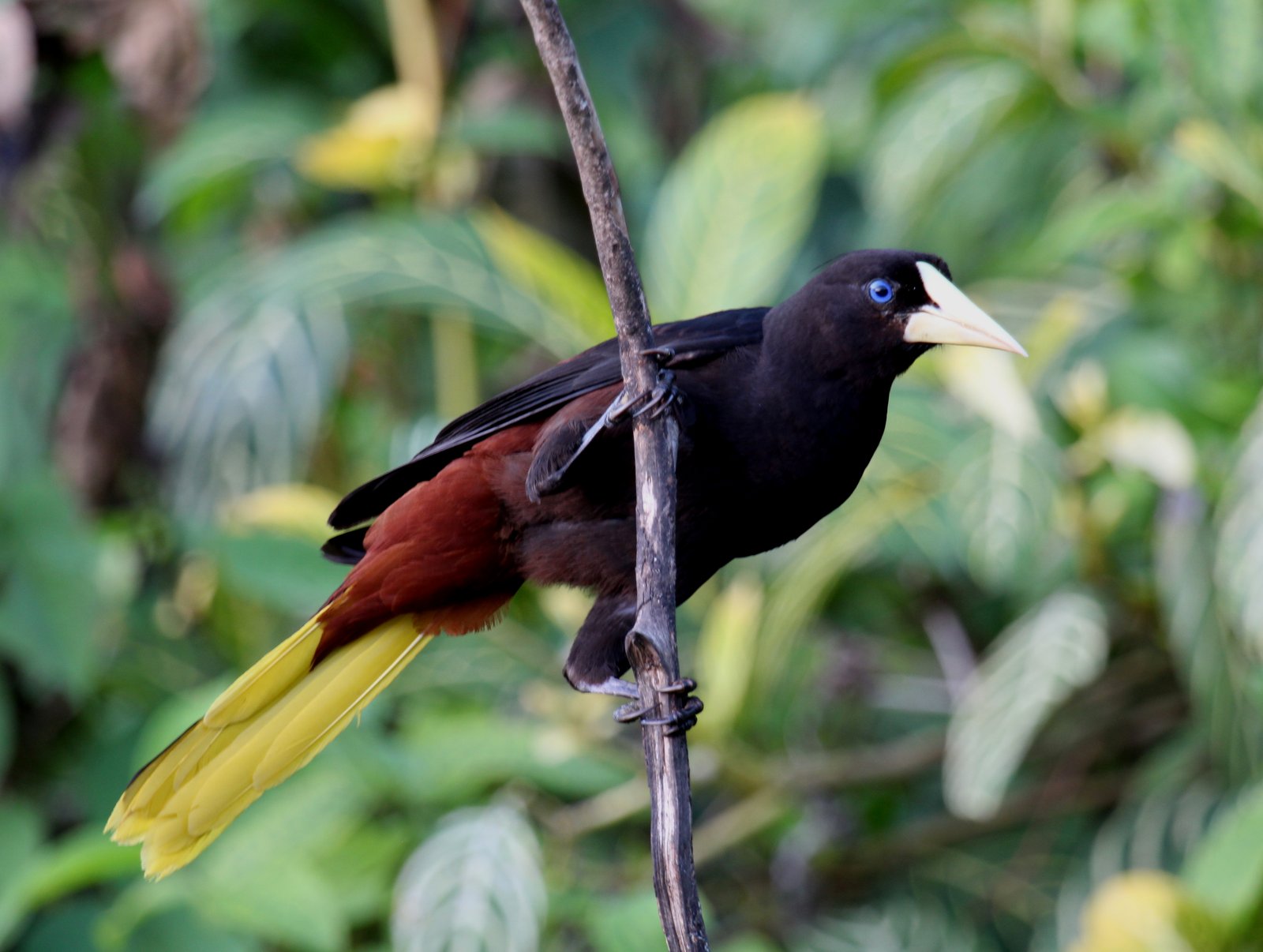
The Crested Oropendola is the most widespread oropendola of South America and occurs in the guide area in almost all forested lowland east of the Andes, as well as in northern Colombia. These black birds with a yellow tail and ivory bill are common inhabitants of forest edges, riverbanks and farmland with tall trees. Their colonies of hanging nests are often near villages.
Voice
The male bows deeply and gives a loud, rumbling, gurgling song ending in a gulping note, with a rustle of the wings. The call is a harsh chak.
Recording: Rosa Elena Albornoz @rosaelena_naturaleza — CC0 1.0 · xeno-canto
Identification
35–47 cm; the male is much larger than the female. The plumage is mostly black, with a chestnut rump and undertail. The tail is yellow with black central feathers. The bill is ivory to pale yellow, the eye pale blue. The male has a few long, thin crest feathers, visible only at close range. Juveniles are duller black, with a darker eye.
Confusion species
Yellow-rumped Cacique Cacicus cela is smaller, with a yellow rump, a yellow wing patch and a yellow tail base. Solitary Cacique Cacicus solitarius is all black, without yellow in the tail. Band-tailed Cacique Cacicus latirostris has a yellow tail with a black terminal band. Black Oropendola Psarocolius guatimozinus of north-western Colombia is larger, with a black bill with an orange tip, a bare cheek patch and a browner back. Chestnut-headed Oropendola Psarocolius wagleri has a chestnut head and neck.
Habitat
Forest edges, riverbanks, várzea, gallery forest in the llanos, secondary forest, plantations and gardens with tall trees, from the lowlands to about 1500 m, locally higher in valleys. It eats fruit, nectar, insects and other invertebrates in the canopy and middle storey. It breeds in colonies of woven nests up to one and a half metres long, hung from the branches of a tall, isolated tree.
Where the bird is most at home, classified by the vegetation units of the Andes and the west coast.


Range and movements
In Colombia in the Caribbean lowlands, the Magdalena valley and throughout the lowlands east of the Andes. In Ecuador in the eastern lowlands and foothills. In Peru and Bolivia throughout the lowlands east of the Andes and in the foothills. Largely absent from the Pacific side of Colombia and Ecuador, and from the Galápagos. Outside the guide area from Panama and Trinidad to northern Argentina.
- Resident
- dark = core range, pale = thinly spread
How and when to look
A colony in a tall, isolated tree near a village or along a river is the best starting point; displaying males are most active in the early morning.
Conservation status
Least Concern. A common species that copes well with semi-open farmland and secondary forest.
Scientific name
Psarocolius decumanus | (Pallas, 1769)
Pallas described the species in 1769 as Xanthornus decumanus; because it was later moved to another genus, the author and year stand in brackets. The genus Psarocolius was introduced in 1827 by Wagler. The genus name combines Greek psar, 'starling', with koloios, 'jackdaw'. The species name is Latin decumanus or decimanus, 'large, immense', derived from decimus, 'tenth', from decem, 'ten'; probably for the bird's size. The specimen the first description was based on came from Suriname.