All species › Passerines › Antpittas › Bay Antpitta
Bay Antpitta | Grallaria capitalis
Baaimierpitta | Tororoí bayo | Tovacuçu-baio
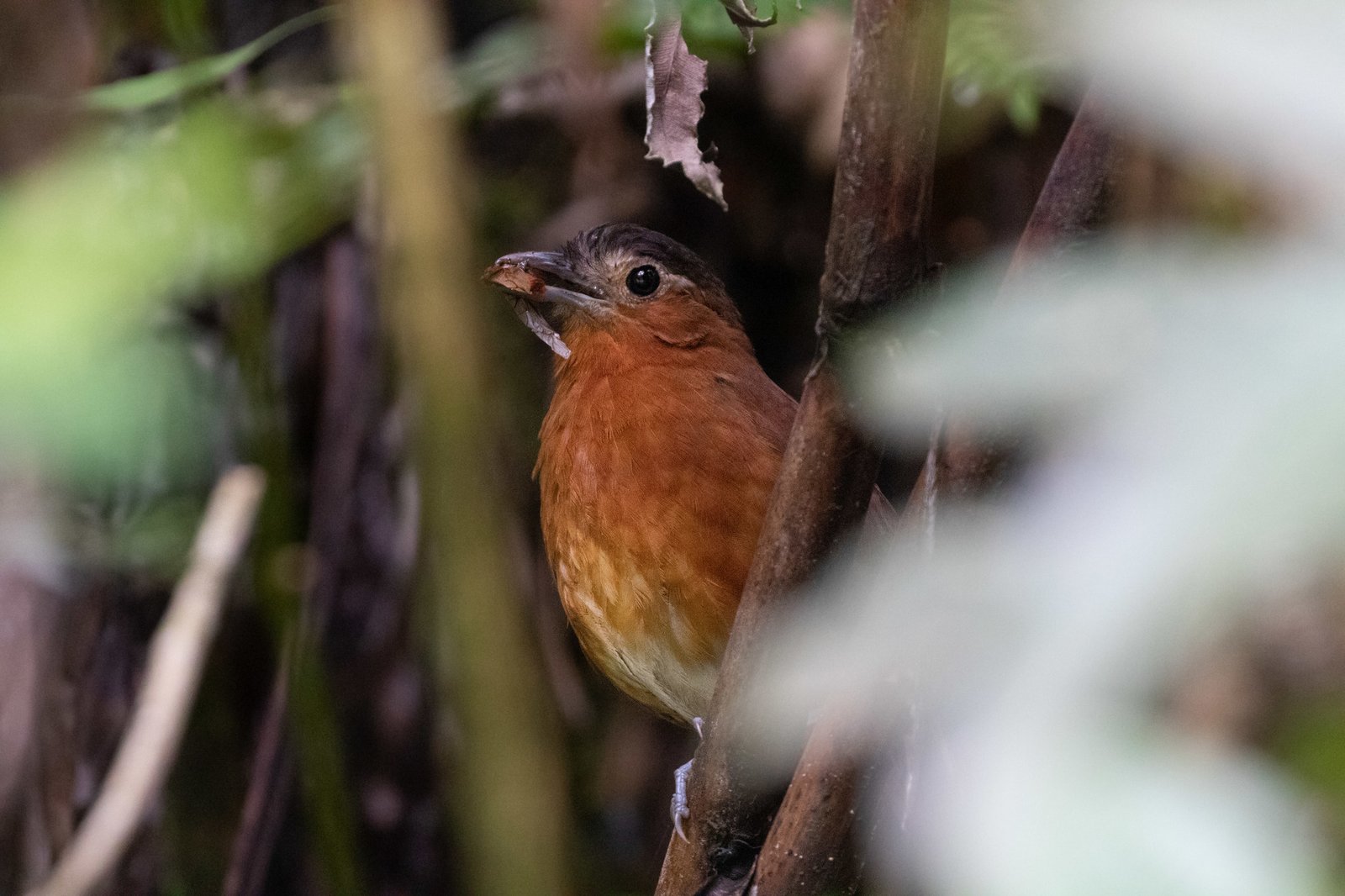
The Bay Antpitta is a dark chestnut antpitta of the east slope of the Andes in central Peru. It lives in dense growth in montane forest and is often found where forest is regrowing after landslides or clearing. Its song of a few hollow whistles carries far across the slopes.
Voice
The song is a hollow series of four, sometimes five whistles, the first higher and stressed: HEEP hew-hew-hew. The call is a soft, descending whistle.
Recording: Pritam Baruah — CC BY-NC-SA 4.0 · xeno-canto
Identification
16–17 cm, round and short-tailed, on long blue-grey legs, with a blue-grey bill. Almost entirely rufous to chestnut; the crown is duller, darker brown and the lores rufous to blackish. The back, wings and tail are warm chestnut. The underparts are rufous, darkest on the breast, with a paler, whitish-buff belly centre. The sexes are alike.
Confusion species
Rusty-tinged Antpitta Grallaria przewalskii further north has a grey forecrown, a white chin and a white belly. Red-and-white Antpitta Grallaria erythroleuca further south has a white throat and belly. Oxapampa Antpitta Grallaria centralis and Panao Antpitta Grallaria oneilli of the rufula group are smaller, plainer and paler rufous, with a pale eye-ring.
Habitat
Dense undergrowth of humid montane forest, especially regrowth on landslides, forest edges, secondary forest and abandoned fields, mostly between 1800 and 3000 m, locally from 1500 m. It searches the ground for invertebrates. Little is known about its breeding.
Where the bird is most at home, classified by the vegetation units of the Andes and the west coast.


Range and movements
Only in Peru, on the east slope of the Andes in Huánuco, Pasco and Junín. Absent from Colombia, Ecuador, Bolivia and the Galápagos. Does not occur outside the guide area.
- Resident
- dark = core range, pale = thinly spread
How and when to look
Listen at dawn along roads through montane forest on the east slope of Huánuco and Pasco, such as at the Carpish pass and around Oxapampa, for the hollow whistled series. It often sings from dense growth at the edge of landslides.
Conservation status
Least Concern. The range is small, but the population is considered stable and the species also uses regrowth and secondary forest. Deforestation could become a threat in the long term.
Scientific name
Grallaria capitalis | Chapman, 1926
Chapman described the species in 1926 and placed it straight away in the genus where it still stands. The genus Grallaria was introduced in 1816 by Vieillot. The genus name comes from New Latin grallarius, 'stilt-walker', referring to the long legs. The species name comes from Latin capitalis, 'of the head', referring to the distinctive head. The specimen the first description was based on came from Rumicruz, Junín, Peru.