All species › Passerines › Antpittas › Rusty-tinged Antpitta
Rusty-tinged Antpitta | Grallaria przewalskii
Roestkleurige mierpitta | Tororoí rojizo | Tovacuçu-ferrugíneo
The Rusty-tinged Antpitta is a medium-sized antpitta found only on the east slope of the Andes in northern Peru, south of the Marañón. It belongs to a group of closely related antpittas with a rufous head and breast that replace one another geographically along the Andes. It lives on the floor of humid montane forest and is mainly detected by its song.
Voice
The song is a series of three hollow whistles, the middle one lowest, the last highest and loudest: hoo hu-HEE. The call is a series of rising, plaintive, hollow notes.
Recording: Fabrice Schmitt — CC BY-NC-SA 4.0 · xeno-canto
Identification
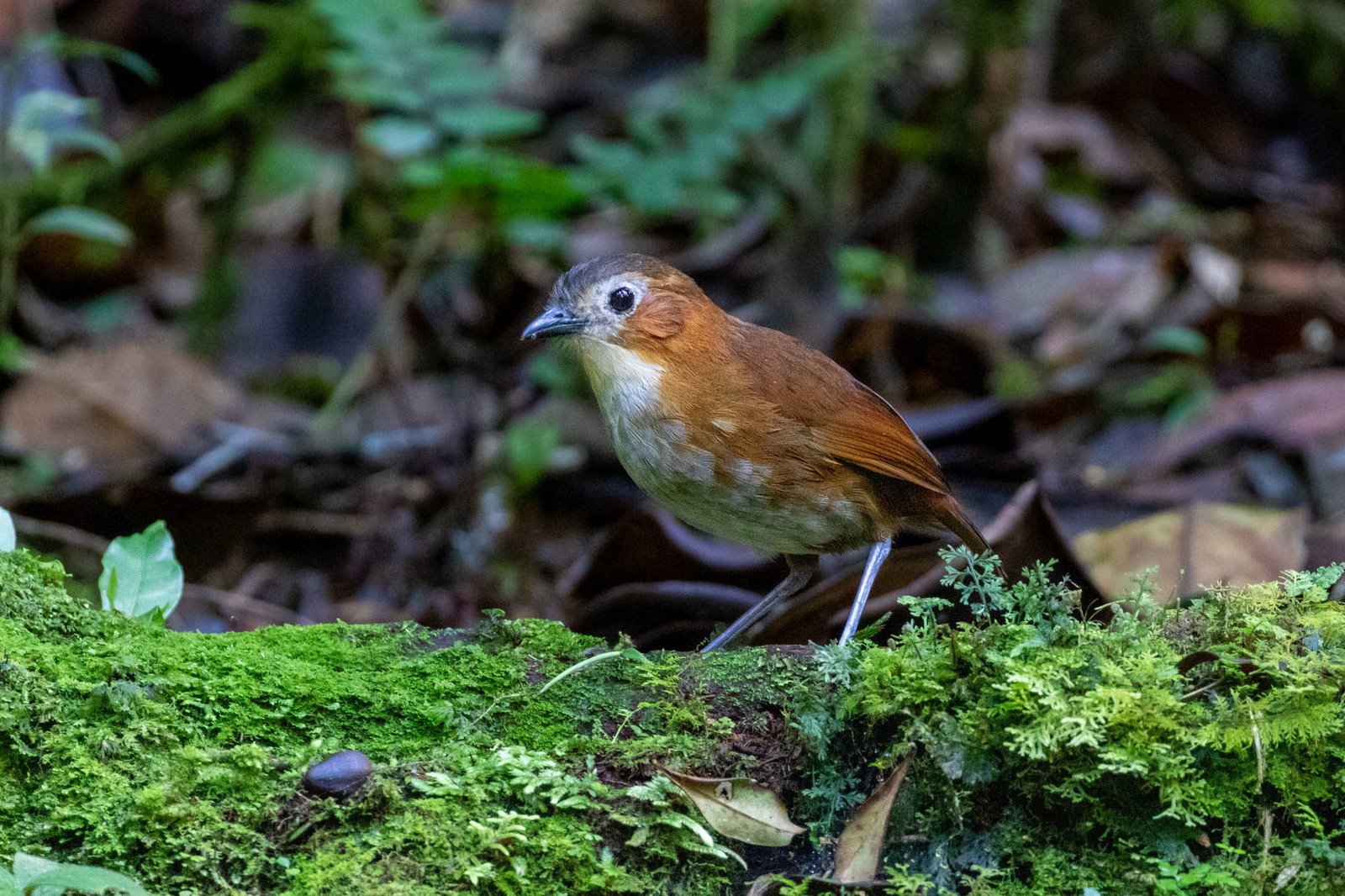
17–18 cm, round and short-tailed, on long blue-grey legs, with a black bill. The forecrown is pale grey, grading into a darker crown; a faint pale ring around the eye. The back, wings and tail are dark rufous. The throat and breast are bright rusty, the chin and belly centre white; the flanks and undertail coverts are dull rufous. The sexes are alike.
Confusion species
Bay Antpitta Grallaria capitalis, further south in Huánuco, Pasco and Junín, is uniformly dark chestnut, without a grey forecrown and white belly. White-bellied Antpitta Grallaria hypoleuca north of the Marañón has white underparts without a rusty breast. Chachapoyas Antpitta Grallaria gravesi is smaller, uniformly rufous and usually lives higher. Chestnut-crowned Antpitta Grallaria ruficapilla has a white, black-streaked belly.
Habitat
The floor and understorey of humid montane forest, especially with dense Chusquea bamboo, roughly between 1700 and 2750 m. It searches the ground for insects, earthworms and other invertebrates. Little is known about its breeding.
Where the bird is most at home, classified by the vegetation units of the Andes and the west coast.


Range and movements
Only in Peru, on the east slope of the Andes south of the Marañón, in Amazonas, San Martín and La Libertad. Absent from Colombia, Ecuador, Bolivia and the Galápagos. Does not occur outside the guide area.
- Resident
- dark = core range, pale = thinly spread
How and when to look
Listen at dawn for the three-note whistled song in bamboo-rich montane forest along roads and trails on the east slope in Amazonas and San Martín, for example around Abra Patricia. The bird often sings from the ground or a low branch in dense cover.
Conservation status
Least Concern. The population is considered stable, but the range is small, so deforestation on the east slope could become a threat in the long term.
Scientific name
Grallaria przewalskii | Taczanowski, 1882
Taczanowski described the species in 1882 and placed it straight away in the genus where it still stands. The genus Grallaria was introduced in 1816 by Vieillot. The genus name comes from New Latin grallarius, 'stilt-walker', referring to the long legs. The species name honours Nikolai Przhevalsky (1839–1888), Russian explorer of Central Asia. The specimen the first description was based on came from Ray-Urmana near Chirimoto, Amazonas, Peru.