All species › Passerines › Antpittas › White-bellied Antpitta
White-bellied Antpitta | Grallaria hypoleuca
Roodrugmierpitta | Tororoí ventriblanco | Tovacuçu-de-barriga-branca
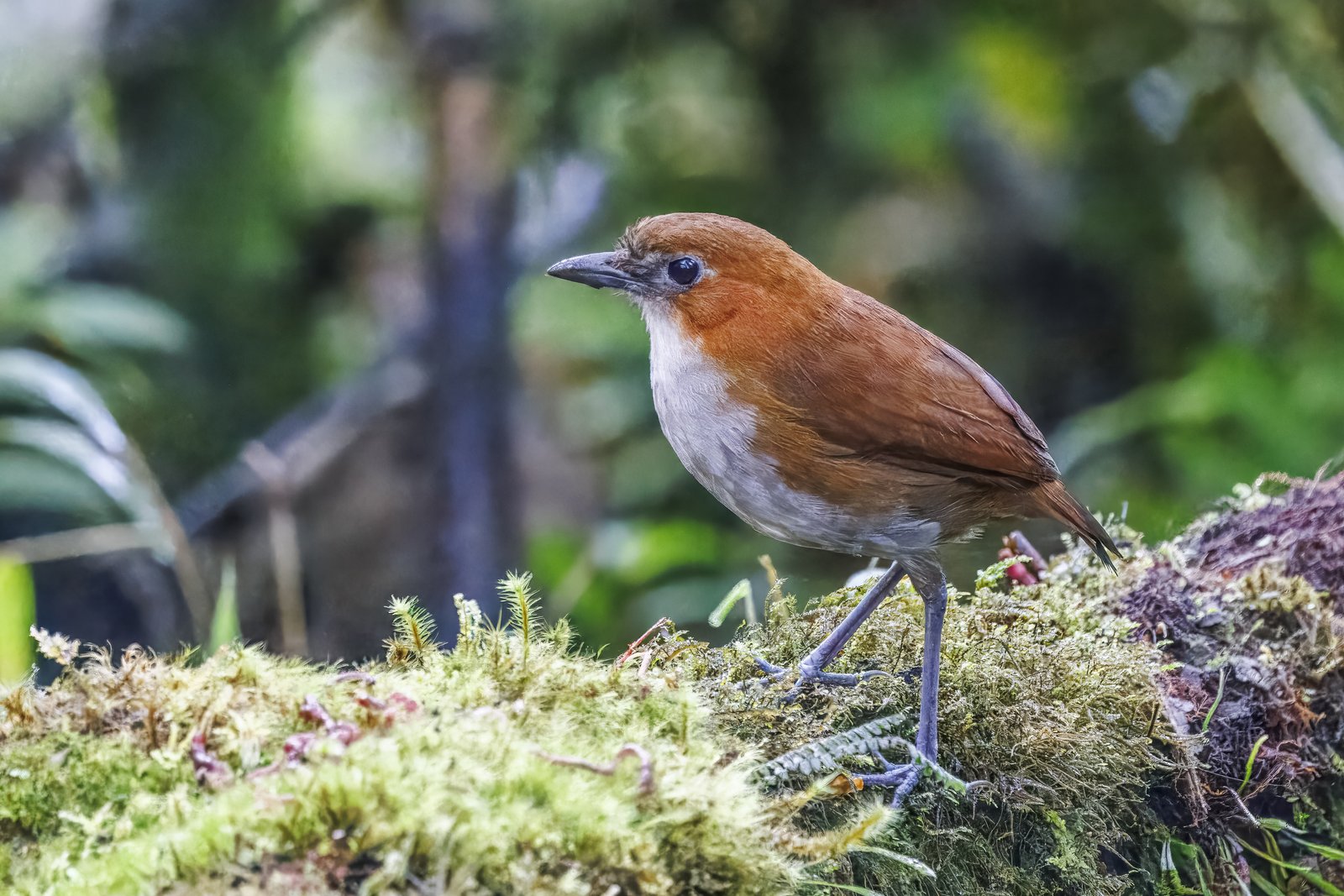
The White-bellied Antpitta is a medium-sized antpitta with rufous-brown upperparts, a white throat and belly and a grey breast. It lives in humid montane forest from Colombia to northern Peru and tolerates forest edges and young forest. Birds on the eastern slope, the form castanea, are deeper rufous.
Voice
The song is a simple, far-carrying series of a few clear whistles, repeated at long intervals, often of ten seconds or more. The call is a series of owl-like notes, recalling a pygmy owl. It usually sings from a perch up to about 2 m above the ground.
Recording: Juan Freile — CC BY-NC-SA 4.0 · xeno-canto
Identification
16–18 cm, round and short-tailed, on blue-grey legs, with a blackish bill. The crown is rufous-brown to dusky, with black streaks on the forecrown; the face is rufous with white or grey lores. The upperparts are rufous-brown. The throat is white, the breast mostly grey with rufous-brown sides, the belly white, the flanks olive to tawny-brown and the undertail coverts tawny. The form castanea is smaller, with deeper rufous upperparts that extend further down the sides and flanks. The sexes are alike.
Confusion species
Yellow-breasted Antpitta Grallaria flavotincta has a yellow-washed throat and breast and lives on the Pacific slope. Rusty-tinged Antpitta Grallaria przewalskii in Peru, south of this species' range, has rufous-tinged underparts. Bicolored Antpitta Grallaria rufocinerea in Colombia has wholly grey underparts and lives higher. Bay Antpitta Grallaria capitalis in central Peru is almost wholly rufous.
Habitat
Edges of humid montane forest and mature secondary forest, also the forest interior where treefalls or landslides have produced dense growth, in Colombia roughly between 1400 and 2700 m, in Ecuador between 1400 and 2200 m, in Peru between 1700 and 2100 m. It forages almost entirely on the ground in dense vegetation for insects; it sometimes follows army-ant swarms and people in the forest to catch disturbed prey. The nest is a cup of twigs and rootlets in a tree fork, about 1.25 m up, holding two pale greenish eggs.
Where the bird is most at home, classified by the vegetation units of the Andes and the west coast.


Range and movements
In Colombia in the Central Andes in Antioquia, in the Eastern Andes from Santander to Cundinamarca and at the head of the Magdalena valley. In Ecuador on the eastern slope. In Peru only in the north, into Cajamarca. Absent from Bolivia and the Galápagos. Does not occur outside the guide area.
- Resident
- dark = core range, pale = thinly spread
How and when to look
Listen along forest edges and trails on the eastern slope of Ecuador and in the Colombian Andes for the clear whistles at long intervals. The bird often sings from a low branch in dense growth and sometimes comes briefly onto a trail.
Conservation status
Least Concern. The range is large and the population is believed stable. Because the species uses young forest and edges, it may locally even benefit from small-scale clearing.
Scientific name
Grallaria hypoleuca | Sclater, 1855
Sclater described the species in 1855 and placed it straight away in the genus where it still stands. The genus Grallaria was introduced in 1816 by Vieillot. The genus name comes from New Latin grallarius, 'stilt-walker', referring to the long legs. The species name comes from Greek hupo, 'below', and leukos, 'white'. The specimen the first description was based on came from Bogotá, Colombia.