All species › Passerines › Antpittas › Yellow-breasted Antpitta
Yellow-breasted Antpitta | Grallaria flavotincta
Geelborstmierpitta | Tororoí pechiamarillo | Tovacuçu-de-peito-amarelo
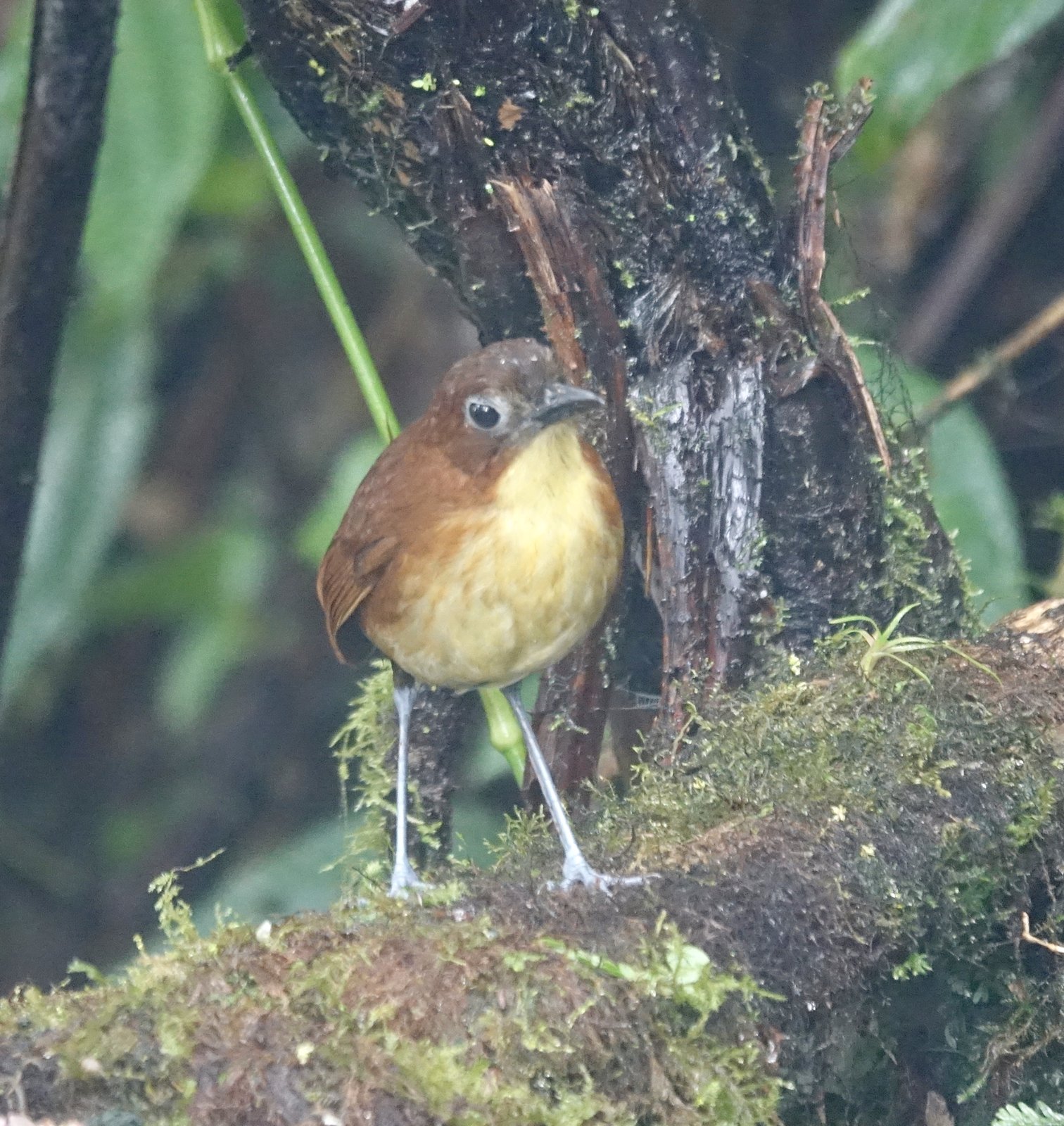
The Yellow-breasted Antpitta is a rufous-brown antpitta with a yellow-washed white throat and breast, found on the Pacific slope of the Andes in Colombia and Ecuador. It was long treated as a subspecies of White-bellied Antpitta. It lives on steep forested slopes and in ravines along streams.
Voice
The song consists of three hollow notes, the first two almost merged and the last higher, as poo-puuu-puu. In response to playback it sometimes gives a long, shrill call.
Recording: Nunes-de-Almeida — CC BY-NC-SA 4.0 · xeno-canto
Identification
17–18 cm, round and short-tailed, on blue-grey legs, with a black bill. The forecrown is dark grey, with pale blue-grey bare skin around the eye. The crown, back, wings and tail are plain rufous-brown. The underparts are mostly white with a yellow wash, strongest on the throat and upper breast. Juveniles have a dark grey head, yellowish-orange skin around the eye and yellow-and-grey mottled underparts with chestnut blotches. The sexes are alike.
Confusion species
White-bellied Antpitta Grallaria hypoleuca is very similar but has a grey breast and a white belly without yellow; it lives on the eastern slope and in the Central and Eastern Andes. Moustached Antpitta Grallaria alleni has a grey crown and a white moustachial stripe. Ochre-breasted Antpitta Grallaricula flavirostris is much smaller, with an ochre breast and a yellow bill.
Habitat
The understorey of the interior of humid montane forest, preferably on steep slopes and in ravines near streams, also at forest edges, in Colombia roughly between 1300 and 2100 m, in Ecuador between 1500 and 2350 m. It hops on the ground and probes soil and leaf litter, probably mainly for earthworms. The nest is a deep, bulky cup of moss and fern fronds, lined with rootlets, about 1.5 m up against a tree trunk, holding two eggs.
Where the bird is most at home, classified by the vegetation units of the Andes and the west coast.


Range and movements
In Colombia on the Pacific slope of the Western Andes, from Antioquia southwards. In Ecuador on the western slope in the north-west, south to Pichincha. Absent from Peru, Bolivia and the Galápagos. Does not occur outside the guide area.
- Resident
- dark = core range, pale = thinly spread
How and when to look
At a few sites in north-western Ecuador, such as near Mindo, the bird comes to places where earthworms are put out. Elsewhere, listen early in the morning in forested ravines for the three hollow whistles.
Conservation status
Least Concern. In Ecuador the species is local and scarce, in Colombia also local; because it prefers undisturbed forest, it is probably sensitive to logging.
Scientific name
Grallaria flavotincta | Sclater, 1877
Sclater described the species in 1877 and placed it straight away in the genus where it still stands. The genus Grallaria was introduced in 1816 by Vieillot. The genus name comes from New Latin grallarius, 'stilt-walker', referring to the long legs. The species name comes from Latin flavus, 'yellow', and tinctus, 'tinged'. The specimen the first description was based on came from Frontino, Antioquia, Colombia.