All species › Passerines › Antpittas › White-throated Antpitta
White-throated Antpitta | Grallaria albigula
Witkeelmierpitta | Tororoí gorjiblanco | Tovacuçu-de-garganta-branca
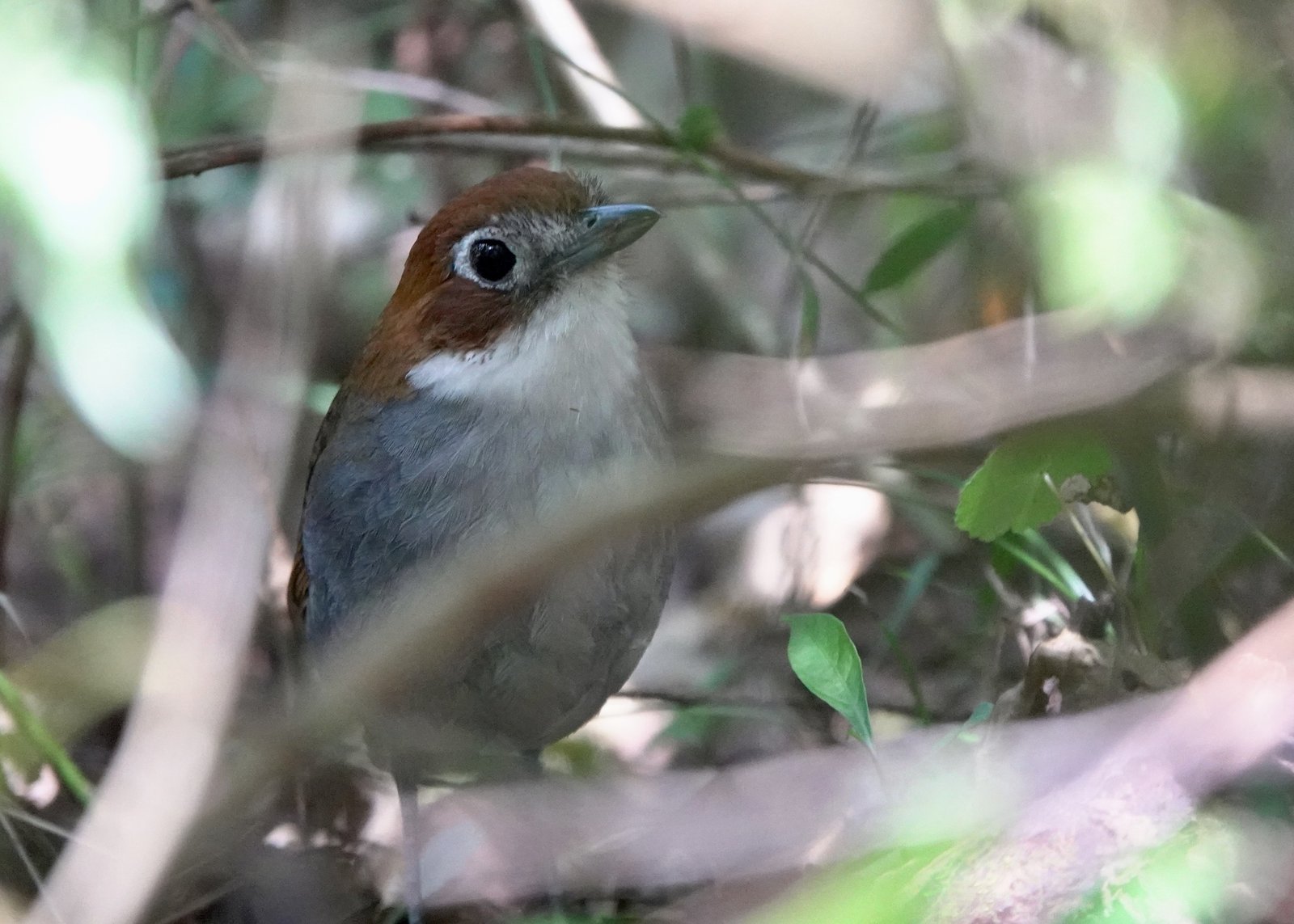
The White-throated Antpitta is an antpitta of the Yungas of south-eastern Peru and Bolivia, with a rufous head, a white throat and grey underparts. It lives on the floor of humid montane forest and, in the drier southern valleys, also in semi-deciduous forest. Its song is a simple, hollow two-note whistle.
Voice
The song is a hollow two-note whistle, the second note slightly higher. The call is a single descending hollow note; it also gives a series of three to twelve short, soft notes.
Recording: Richard Dunn — CC BY-NC-SA 4.0 · xeno-canto
Identification
18–20 cm, round and short-tailed, on blue-grey legs. The crown, nape and ear coverts are bright chestnut-rufous, with greyish lores and a ring of pale bluish-white bare skin around the eye. The upperparts are olive-brown, the tail and wings rufous-brown. The white throat extends below the ear coverts. The breast and belly are pale to mid grey, the flanks olive. The upper mandible is blackish grey, the lower mandible blue-grey. The sexes are alike.
Confusion species
Red-and-white Antpitta Grallaria erythroleuca in Cusco has a rufous head and upperparts and white underparts with rufous sides; it usually lives higher. Scaled Antpitta Grallaria guatimalensis has a scaled crown and back and buff to rufous underparts. Bolivian Antpitta Grallaria cochabambae is smaller, plain rufous-brown and lives higher, in cloud forest near the treeline.
Habitat
The understorey of humid montane forest, in Bolivia also semi-deciduous and deciduous forest, scrub and bamboo, in Peru mostly between 1150 and 2100 m, over the whole range from 600 to 2700 m. It forages almost entirely on the ground, usually in dense vegetation, for insects, spiders and probably earthworms. Nothing is known about its breeding.
Where the bird is most at home, classified by the vegetation units of the Andes and the west coast.


Range and movements
In Peru in the south-east, in Cusco and Puno. In Bolivia in the north-west (La Paz) and from Cochabamba south into Chuquisaca and Tarija. Absent from Colombia, Ecuador and the Galápagos. Outside the guide area in north-western Argentina (Jujuy and Salta).
- Resident
- dark = core range, pale = thinly spread
How and when to look
Walk early in the morning along roads and trails through Yungas montane forest, such as the road from Cusco to the Manú area at around 1500–2000 m, and listen for the hollow two-note whistle. The bird often sings from the ground in dense undergrowth.
Conservation status
Least Concern. The range is restricted and the population size is unknown, but believed stable. The species occurs in protected areas in Peru, Bolivia and Argentina.
Scientific name
Grallaria albigula | Chapman, 1923
Chapman described the species in 1923 and placed it straight away in the genus where it still stands. The genus Grallaria was introduced in 1816 by Vieillot. The genus name comes from New Latin grallarius, 'stilt-walker', referring to the long legs. The species name comes from Latin albus, 'white', and gula, 'throat'. The specimen the first description was based on came from Santo Domingo, Peru.