All species › Passerines › Antpittas › Pale-billed Antpitta
Pale-billed Antpitta | Grallaria carrikeri
Bleeksnavelmierpitta | Tororoí de Carriker | Tovacuçu-de-bico-claro
The Pale-billed Antpitta is a large, dark antpitta with an ivory bill that lives only on the eastern slope of the Andes in northern Peru. It was described only in 1982 and is closely tied to Chusquea bamboo in high montane forest. The scientific name honours the collector M.A. Carriker.
Voice
The song is a series of low, hollow hoots, beginning with a higher note and running into a stuttering series of lower notes. The call consists of a few high, metallic notes.
Recording: Iván Lau — CC BY-NC-SA 4.0 · xeno-canto
Identification
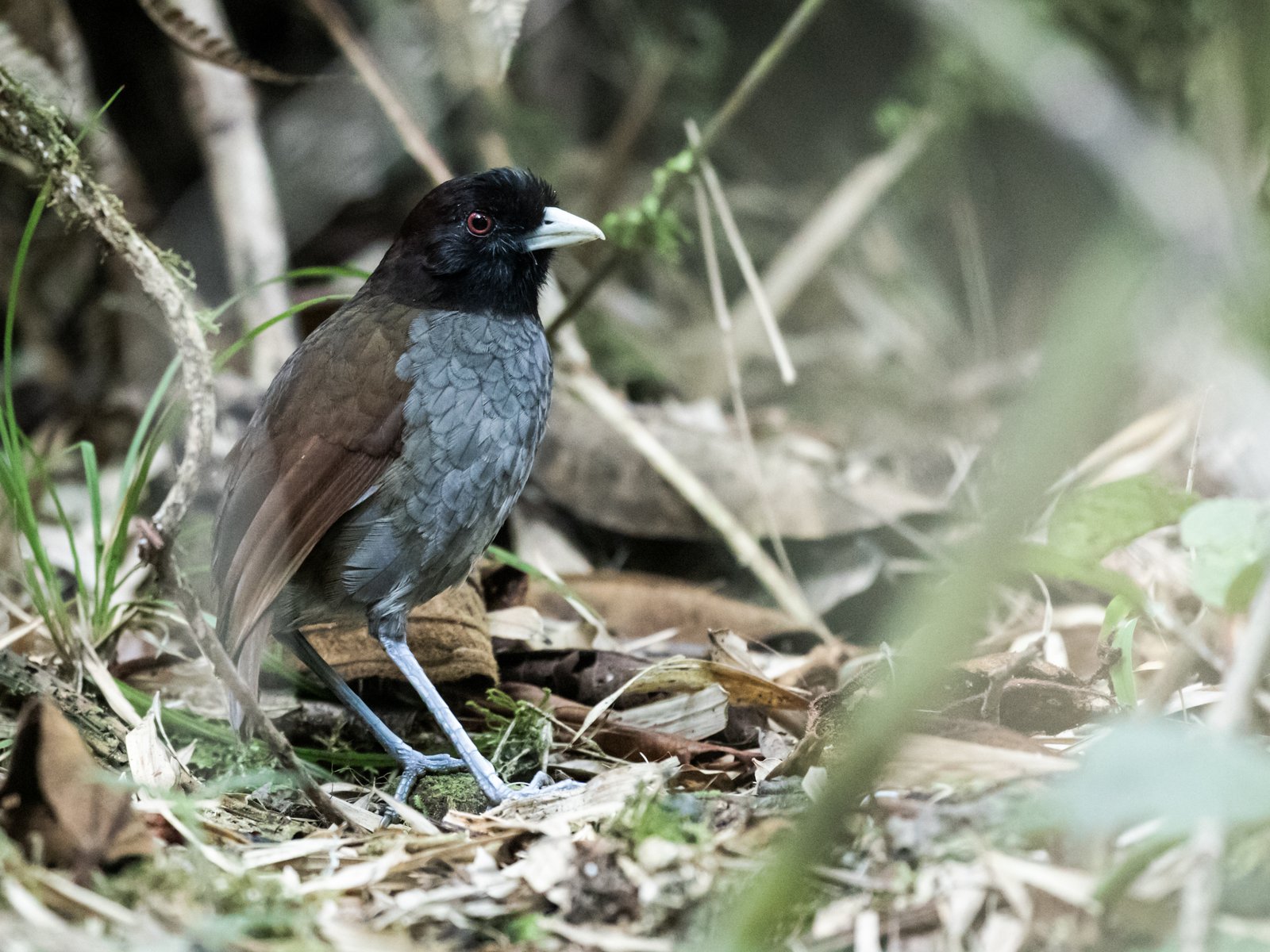
20–21 cm, round and short-tailed, on long legs. The bill is ivory, the iris pale reddish brown. The forecrown, lores, cheeks and chin are black, the crown blackish brown and the nape dark olive-brown. The back and rump are dark olive-brown with narrow black fringes, the wing coverts dark chestnut. The throat is blackish grey; the breast and belly are light grey, darker on the breast sides and almost white in the centre of the belly, with narrow black fringes on the breast. The flanks and undertail coverts are buffy olive. The sexes are alike.
Confusion species
Chestnut-naped Antpitta Grallaria nuchalis has a chestnut head and nape, a bare white skin patch behind the eye and a black bill; it lives in northern Peru to the west and north of this species' range. Undulated Antpitta Grallaria squamigera has a white throat and buff, black-scaled underparts. Chestnut-crowned Antpitta Grallaria ruficapilla has a rufous head and white, streaked underparts.
Habitat
The understorey of humid montane forest with a broken canopy, many epiphytes and dense stands of Chusquea bamboo, roughly between 2350 and 2900 m. It forages on the ground or up to about 1 m above it, mostly in dense vegetation, for arthropods and possibly small frogs. The only known nest was a shallow cup of twigs and decaying leaves, about 3 m up on a fallen trunk, holding two young.
Where the bird is most at home, classified by the vegetation units of the Andes and the west coast.


Range and movements
In Peru only on the eastern slope of the Andes east of the Marañón, from central Amazonas south to at least south-eastern La Libertad. Absent from Colombia, Ecuador, Bolivia and the Galápagos. Does not occur outside the guide area.
- Resident
- dark = core range, pale = thinly spread
How and when to look
Search bamboo-rich high montane forest in Amazonas and La Libertad, above 2300 m. Listen in the early morning for the series of hollow hoots; the bird usually stays hidden in the bamboo, but sometimes comes briefly to the edge of a trail.
Conservation status
Least Concern. The range is small, but forest at these elevations is still largely intact. Locally, forest is lost to clearing.
Scientific name
Grallaria carrikeri | Schulenberg & Williams, 1982
Schulenberg & Williams described the species in 1982 and placed it straight away in the genus where it still stands. The genus Grallaria was introduced in 1816 by Vieillot. The genus name comes from New Latin grallarius, 'stilt-walker', referring to the long legs. The species name honours Melbourne Armstrong Carriker Jr. (1879–1965), American ornithologist and collector in Central and South America. The specimen the first description was based on came from Cordillera de Colán, Amazonas, Peru.