All species › Swifts › Hummingbirds › Bearded Mountaineer
Bearded Mountaineer | Oreonympha nobilis
Bergnimf | Montañés barbudo | Montanhês-barbudo
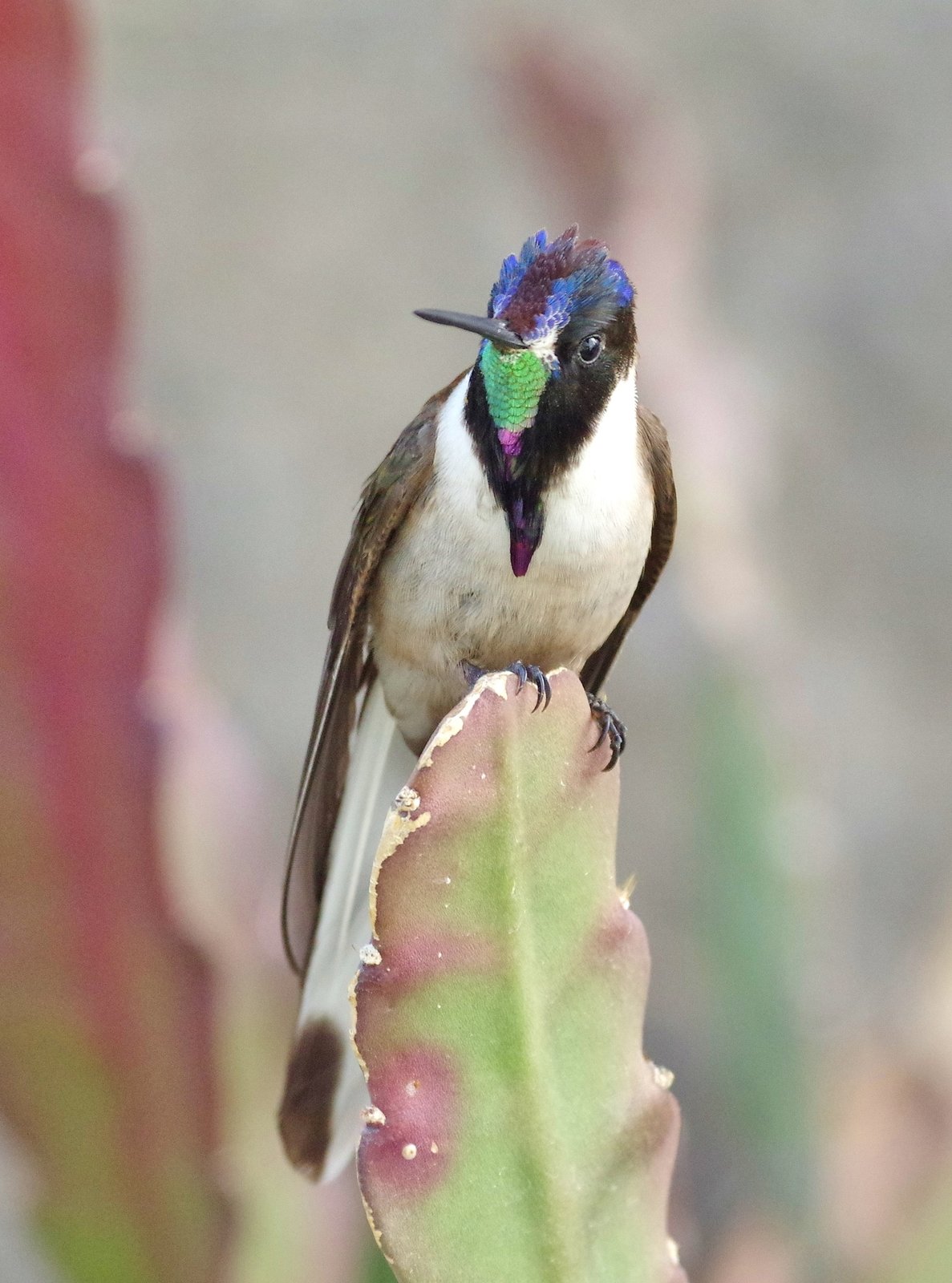
The Bearded Mountaineer is a large, long-tailed hummingbird of the dry Andean valleys of southern Peru. The male has a long, narrow beard of glittering feathers, green under the chin and purple below. The species readily uses man-made landscapes with agaves and tree tobacco, including villages and roadsides.
Voice
A descending, squeaky series followed by a rich, chattering run; also a dry, buzzy call.
No recording with a suitable Creative Commons licence is available for this species yet.
Identification
14–16 cm, with a straight black bill of just over 2 cm. The male has a deep purplish-blue forecrown and crown with a narrow black central stripe, a bronzy black face with a narrow white band behind it and a long, narrow beard, emerald green under the chin and purple below. The upperparts are bronzy, the underparts white. The long, deeply forked tail is bronzy, with increasing white towards the outer feathers. In the western subspecies white bands run along the sides of the crown and the tail is more coppery. The female is duller and dingier below, with a smaller, mostly white beard and a less deeply forked tail. Juveniles have a scaly green crown.
Confusion species
Red-tailed Comet Sappho sparganurus has a long, forked tail with a reddish-copper gloss, green underparts and no beard. Bronze-tailed Comet Polyonymus caroli is green, with a forked bronzy tail and a pink to purple throat. Giant Hummingbird Patagona gigas is much larger and dull brownish grey, with a white rump.
Habitat
Dry Andean valleys with rocky, scrubby slopes and open woodland, also plantings of tree tobacco (Nicotiana) and eucalyptus along roads and in villages, between 2500 and 3900 m. It feeds mainly on nectar from agaves, cacti, tree tobacco and eucalyptus, and catches small arthropods.
Where the bird is most at home, classified by the vegetation units of the Andes and the west coast.


Range and movements
Only in Peru, in the dry valleys of the south-central part of the country: the nominate form in Apurímac and Cusco, in the Urubamba and upper Apurímac drainages; the western subspecies in Huancavelica, Ayacucho and Apurímac, in the Mantaro, Pampas and Chalhuanca valleys. Absent from Colombia, Ecuador, Bolivia and the Galápagos. Does not occur outside the guide area.
- Resident
- dark = core range, pale = thinly spread
How and when to look
Around Cusco and in the Sacred Valley of the Urubamba, at flowering tree tobacco and agaves on dry slopes and along roads.
Conservation status
Not Evaluated in this treatment. Both forms are assessed separately and are not threatened: their ranges are small, but the populations are thought to be stable and the species adapts to man-made landscapes.
Scientific name
Oreonympha nobilis | Gould, 1869
Gould described the species in 1869 and placed it straight away in the genus where it still stands. He introduced the genus Oreonympha in that same work. The genus name combines Greek oros, 'mountain', with numphē, 'nymph'. The species name comes from Latin nobilis, 'noble, renowned'. The specimen the first description was based on came from Tinta, Cusco, Peru.