All species › Swifts › Hummingbirds › Black Metaltail
Black Metaltail | Metallura phoebe
Zwarte glansstaartkolibrie | Metalura negra | Metalura-preta
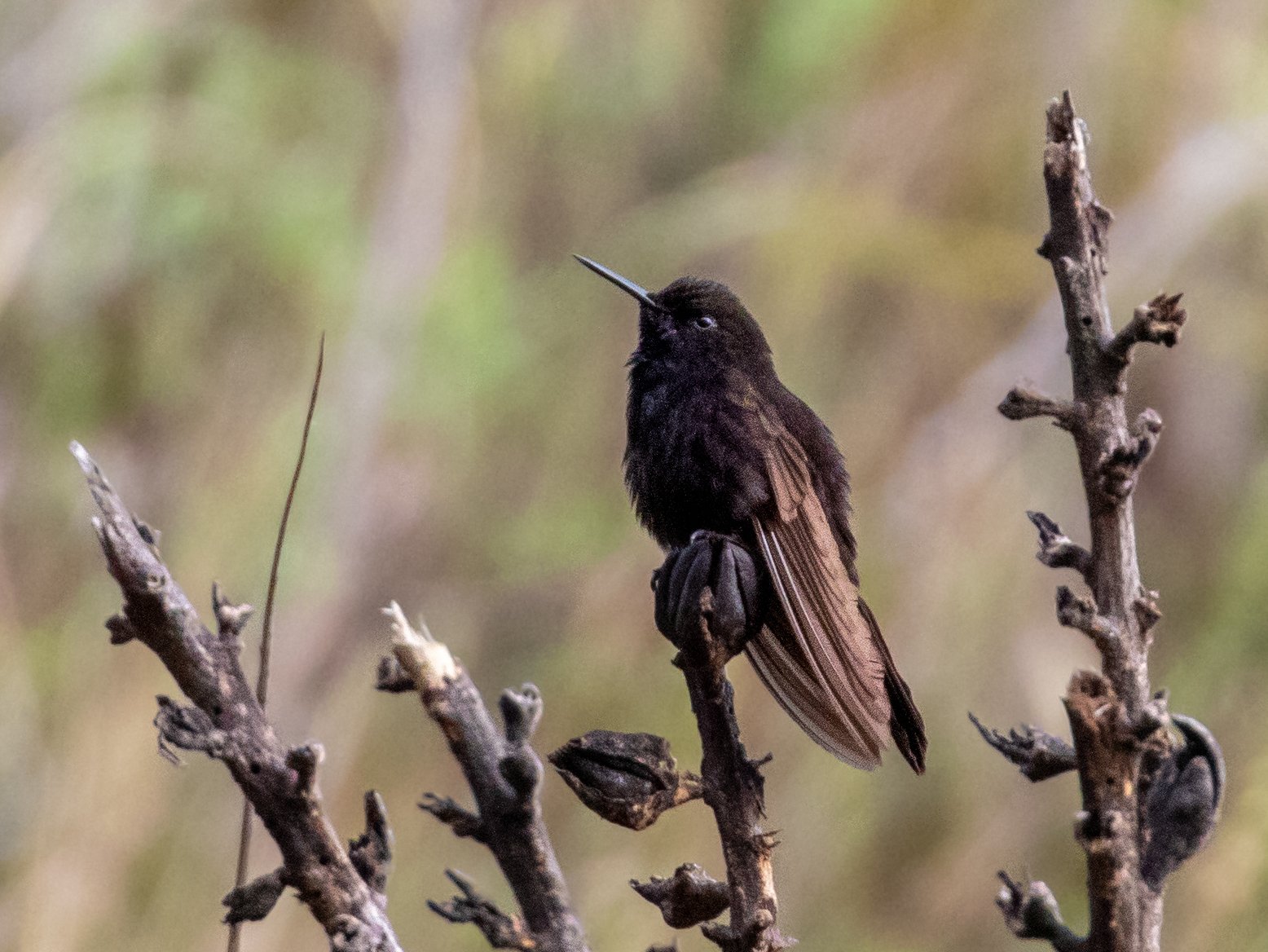
The Black Metaltail is an almost black hummingbird of the dry western slope of the Andes in Peru. Unlike most metaltails it lives in dry scrub, ravines and Polylepis woodland, not at the edge of humid forest. It is the largest species of the genus.
Voice
Presumed song: a high, repeated single note. In chases a descending series of four to six high notes; also a short, dry trill and longer dry chatters.
Recording: Niels Krabbe — CC BY-NC-SA 3.0 · xeno-canto
Identification
12 cm, with a short, straight black bill. The male is black with a purplish or rosy-grey sheen, with a conspicuous white spot behind the eye and a glittering turquoise-green gorget. The slightly forked tail is bronzy gold and rosy grey above and golden orange below. The female is dark smoky grey, with a smaller gorget. Juveniles resemble the female but lack a gorget.
Confusion species
Tyrian Metaltail Metallura tyrianthina is smaller and green, with a coppery-red tail, and lives mainly in more humid forest. Bronze-tailed Comet Polyonymus caroli lives in the same dry scrub, but is green, with a long, deeply forked tail and a pink to purple throat.
Habitat
Dry montane scrub, open woodland and ravines, especially with Polylepis and Puya, also near fields and gardens, between 1500 and 4500 m, mostly above 2700 m. It takes nectar at flowering shrubs and catches small insects. The nest is a cup of moss lined with feathers, on a mossy bank or built into the base of an old nest of another bird; the clutch is two eggs.
Where the bird is most at home, classified by the vegetation units of the Andes and the west coast.


Range and movements
Only in Peru, on the western slope of the Andes from southern Cajamarca almost to the Chilean border, and in some dry inter-Andean valleys. Absent from Colombia, Ecuador, Bolivia and the Galápagos. Not known outside the guide area; it might occur in northern Chile.
- Resident
- dark = core range, pale = thinly spread
How and when to look
In the Santa Eulalia valley above Lima and in the Colca Canyon in Arequipa, at flowering shrubs on dry, rocky slopes.
Conservation status
Least Concern. The species is fairly common in many places and occurs in some protected areas, but the population is probably declining because of human pressure on its habitat.
Scientific name
Metallura phoebe | (Lesson & Delattre, 1839)
Lesson & Delattre described the species in 1839 as Ornismya Phoebe; because it was later moved to another genus, the author and year stand in brackets. The genus Metallura was introduced in 1847 by Gould. The genus name combines Latin metallum, 'metal', with Greek oura, 'tail', after the metallic tail. The species name refers to Phoibe (Phoebe), a figure from Greek mythology. The specimen the first description was based on came from Andes of Peru.