All species › Swifts › Hummingbirds › Scaled Metaltail
Scaled Metaltail | Metallura aeneocauda
Geschubde glansstaartkolibrie | Metalura escamosa | Metalura-escamosa
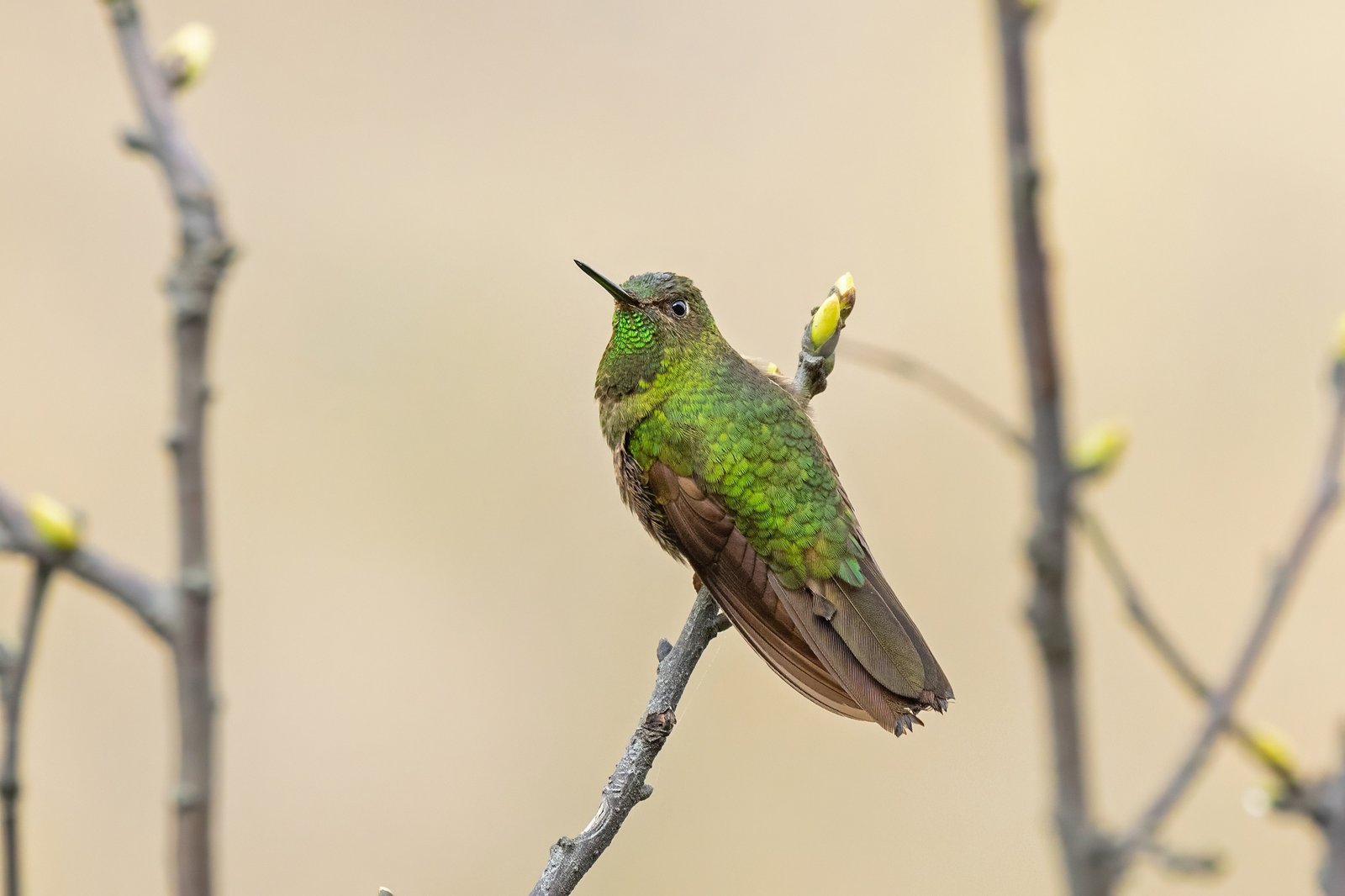
The Scaled Metaltail is the largest green metaltail of southern Peru and Bolivia. It owes its name to the pale fringes of the underpart feathers, which give a scaly pattern. It lives alongside the smaller Tyrian Metaltail at the treeline.
Voice
In chases a descending series of three to six squeaky notes, followed by a repeated, buzzy, jumbled phrase.
Recording: Sjoerd Mayer — CC BY-NC-SA 3.0 · xeno-canto
Identification
12–13 cm, with a medium-length, straight black bill. The male is bottle-green above, green below with buff feather fringes that give a scaly pattern, and has a glittering bright green gorget. The slightly forked tail is sky-blue, with a bronze-green gloss above and glittering green below. The female has a smaller gorget and more heavily mottled underparts.
Confusion species
Tyrian Metaltail Metallura tyrianthina is about a quarter smaller, with a shorter bill and plainer green underparts; in this region that species also has a bluish tail. Fiery-throated Metaltail Metallura eupogon lives further north and has an orange throat and no scaly underparts.
Habitat
Glades and edges of cloud forest and elfin forest, Polylepis groves and rocky slopes with herbs and shrubs, between 2500 and 3600 m, mostly above 3000 m. It takes nectar at flowering shrubs and herbs and catches small insects.
Where the bird is most at home, classified by the vegetation units of the Andes and the west coast.


Range and movements
In Peru on the eastern slope of the Andes in the south-east, from the Cordillera Vilcabamba in Cusco into Puno. In Bolivia in the north-west in La Paz, with a separate subspecies in Cochabamba. Absent from Colombia, Ecuador and the Galápagos. Does not occur outside the guide area.
- Resident
- dark = core range, pale = thinly spread
How and when to look
At Abra Málaga in Cusco and on the upper part of the Manu road, around Wayqecha, at flowering shrubs near the treeline.
Conservation status
Least Concern. The range is fairly large and the species is unspecialised, but regular burning of grassland can cause local damage. It occurs in a protected area in both countries.
Scientific name
Metallura aeneocauda | (Gould, 1846)
Gould described the species in 1846 as Trochilus (--?) aeneocauda; because it was later moved to another genus, the author and year stand in brackets. The genus Metallura was introduced in 1847 by Gould. The genus name combines Latin metallum, 'metal', with Greek oura, 'tail', after the metallic tail. The species name comes from Latin aeneus, 'bronze', and cauda, 'tail'. The specimen the first description was based on came from Bolivia.