All species › Swifts › Hummingbirds › Fiery-throated Metaltail
Fiery-throated Metaltail | Metallura eupogon
Vuurkeelglansstaartkolibrie | Metalura barbafuego | Metalura-de-garganta-de-fogo
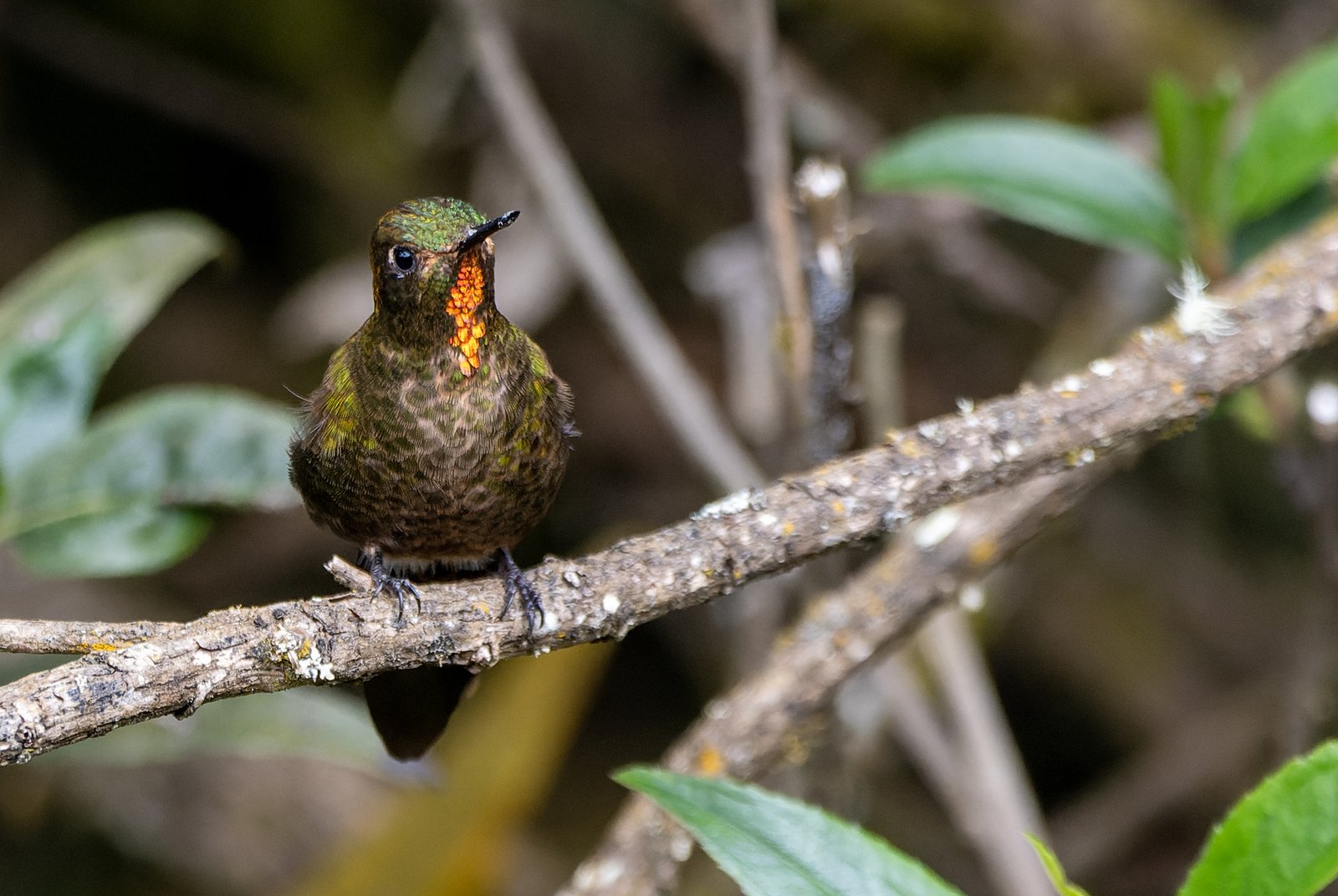
The Fiery-throated Metaltail is a Peruvian endemic of the treeline on the eastern slope of the Andes in the centre of the country. The male has an orange gorget that looks dark in poor light. It lives higher than most other hummingbirds in its area, often above 3500 m.
Voice
In chases a descending series of three to six squeaky notes, followed by a repeated, buzzy, jumbled phrase.
Recording: Andrew Spencer — CC BY-NC-SA 4.0 · xeno-canto
Identification
11 cm, with a short, straight black bill. The male is almost entirely yellowish olive-green with a bronzy gloss, with a glittering orange gorget. The slightly forked tail is greenish sky-blue above and yellow-green below. The female resembles the male, but has a smaller gorget.
Confusion species
Tyrian Metaltail Metallura tyrianthina is smaller, with a green throat. Coppery Metaltail Metallura theresiae lives north of the Huallaga and is reddish bronze, with a green gorget. Scaled Metaltail Metallura aeneocauda lives south of the Apurímac and is larger, with scaly underparts and a green gorget.
Habitat
Edges of elfin and dwarf montane forest, glades in the forest and humid páramo or puna with shrubs and small trees, between 2900 and 4000 m, mostly above 3500 m. It takes nectar at flowering shrubs and catches small insects.
Where the bird is most at home, classified by the vegetation units of the Andes and the west coast.


Range and movements
Only in Peru, on the eastern slope of the Andes in the centre of the country, from just south of the Huallaga in Huánuco through Pasco and Junín to the Apurímac in Cusco. Absent from Colombia, Ecuador, Bolivia and the Galápagos. Does not occur outside the guide area.
- Resident
- dark = core range, pale = thinly spread
How and when to look
In the highest sections of the roads that descend from the Andes to the eastern lowlands of Junín, such as the road to Satipo, at flowering shrubs near the treeline.
Conservation status
Least Concern. The range is small and the population is probably declining; burning of páramo to create pasture is a threat.
Scientific name
Metallura eupogon | (Cabanis, 1874)
Cabanis described the species in 1874 as Urolampra eupogon; because it was later moved to another genus, the author and year stand in brackets. The genus Metallura was introduced in 1847 by Gould. The genus name combines Latin metallum, 'metal', with Greek oura, 'tail', after the metallic tail. The species name comes from Greek eu, 'well', and pōgōn, 'beard', after the coloured throat patch. The specimen the first description was based on came from Maraynioc, Junín, Peru.