All species › Swifts › Hummingbirds › Coppery Metaltail
Coppery Metaltail | Metallura theresiae
Koperglansstaartkolibrie | Metalura cobriza | Metalura-acobreada
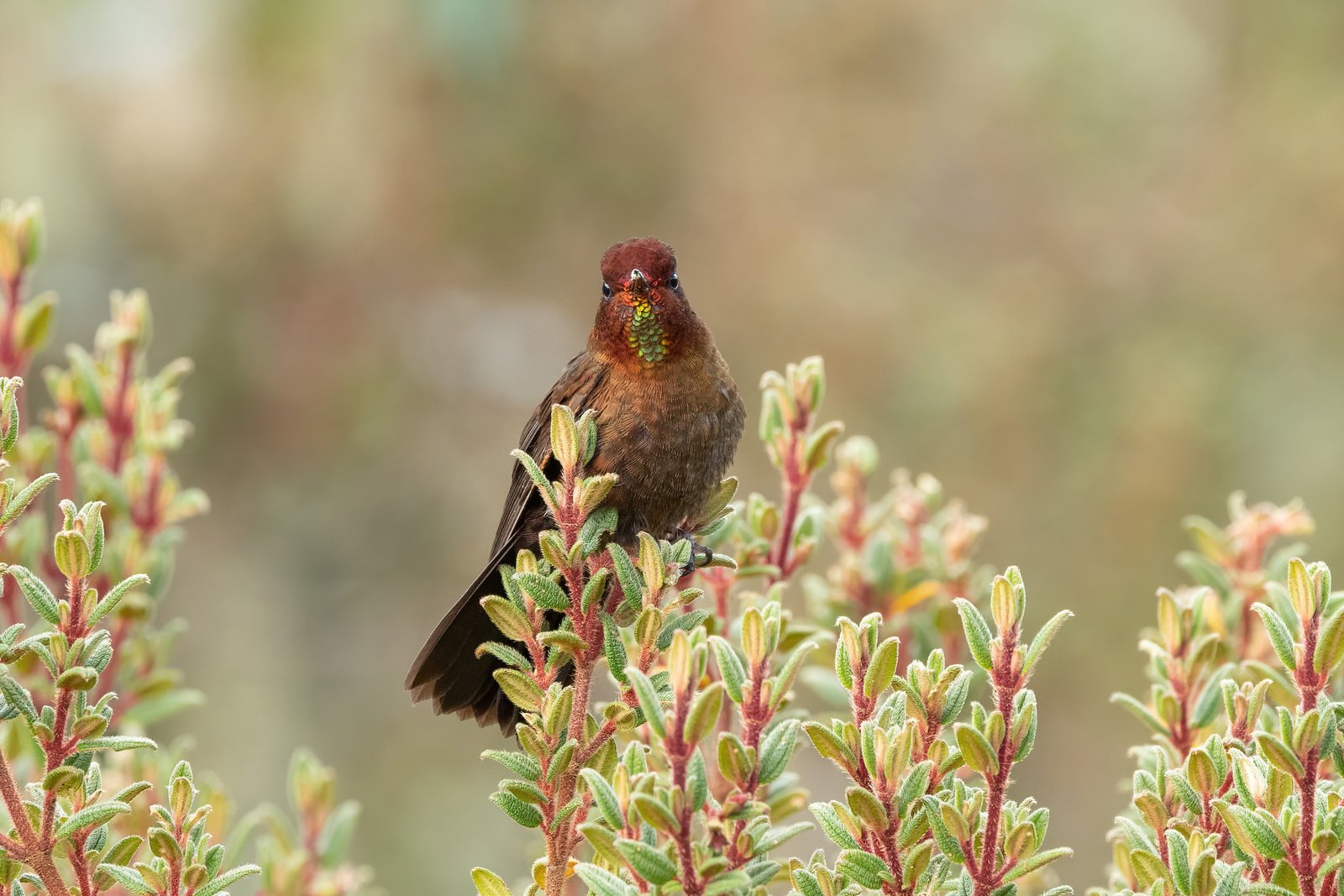
The Coppery Metaltail is a Peruvian endemic of the treeline on the eastern slope of the Andes in the north and centre of the country. It is the only metaltail with a largely coppery-red plumage. Locally it is fairly common to very common.
Voice
A series of faint, drawn-out zeee notes, often alternated with ttrrrt; also a jerky, wiry chatter, softer and buzzier than that of Tyrian Metaltail.
Recording: Jerome Fischer — CC BY-NC-SA 4.0 · xeno-canto
Identification
10 cm, with a short, straight black bill. The male is reddish bronze to coppery red above, with a greenish rump, and slightly less reddish bronze-green below. The narrow gorget is glittering golden green. The slightly forked tail is bronze-green with a violet gloss above and shining bronze-green below. The female resembles the male but is duller and has a smaller gorget. The subspecies of the Cordillera de Colán is less reddish above.
Confusion species
Tyrian Metaltail Metallura tyrianthina is smaller and green, without a coppery tone, with a coppery-red tail; the female has a rufous throat. Fiery-throated Metaltail Metallura eupogon lives further south and is olive-green, with an orange gorget and a blue tail. Neblina Metaltail Metallura odomae lives west of the Marañón and has a rosy-red throat.
Habitat
Edges of elfin forest and humid páramo or jalca, with shrubs and small trees, between 2800 and 3550 m. It takes nectar at flowering shrubs and catches small insects.
Where the bird is most at home, classified by the vegetation units of the Andes and the west coast.


Range and movements
Only in Peru, on the eastern slope of the Andes east of the Marañón, from Amazonas (with a separate subspecies in the Cordillera de Colán) south into Huánuco. Absent from Colombia, Ecuador, Bolivia and the Galápagos. Does not occur outside the guide area.
- Resident
- dark = core range, pale = thinly spread
How and when to look
At the Unchog pass above the Carpish mountains in Huánuco and at Abra Barro Negro in Amazonas, at flowering shrubs along the edge of the elfin forest.
Conservation status
Least Concern. The population is probably declining; burning of páramo to create pasture is the main threat.
Scientific name
Metallura theresiae | Simon, 1902
Simon described the species in 1902 and placed it straight away in the genus where it still stands. The genus Metallura was introduced in 1847 by Gould. The genus name combines Latin metallum, 'metal', with Greek oura, 'tail', after the metallic tail. The species name honours Marie Thérèse Baer, née Simon, wife of the French natural history dealer and collector Gustave A. Baer. The specimen the first description was based on came from Tayabamba, La Libertad, Peru.