All species › Passerines › Tanagers and allies › Bicolored Conebill
Bicolored Conebill | Conirostrum bicolor
Tweekleurige spitssnavel | Conirrostro bicolor | Figuinha-do-mangue
The Bicolored Conebill is a small, grey-blue and pale brown conebill of mangroves on the Caribbean coast and of young woodland on river islands in Amazonia. It lives in pairs or small groups in the canopy and searches for insects with its fine, pointed bill. Two forms occur in the guide area, each tied to its own habitat.
Voice
Gives high, thin tsit notes. The song is a fast, high, twittering series, often sustained for a long time.
Recording: JAYRSON ARAUJO DE OLIVEIRA — CC BY-NC-SA 4.0 · xeno-canto
Identification
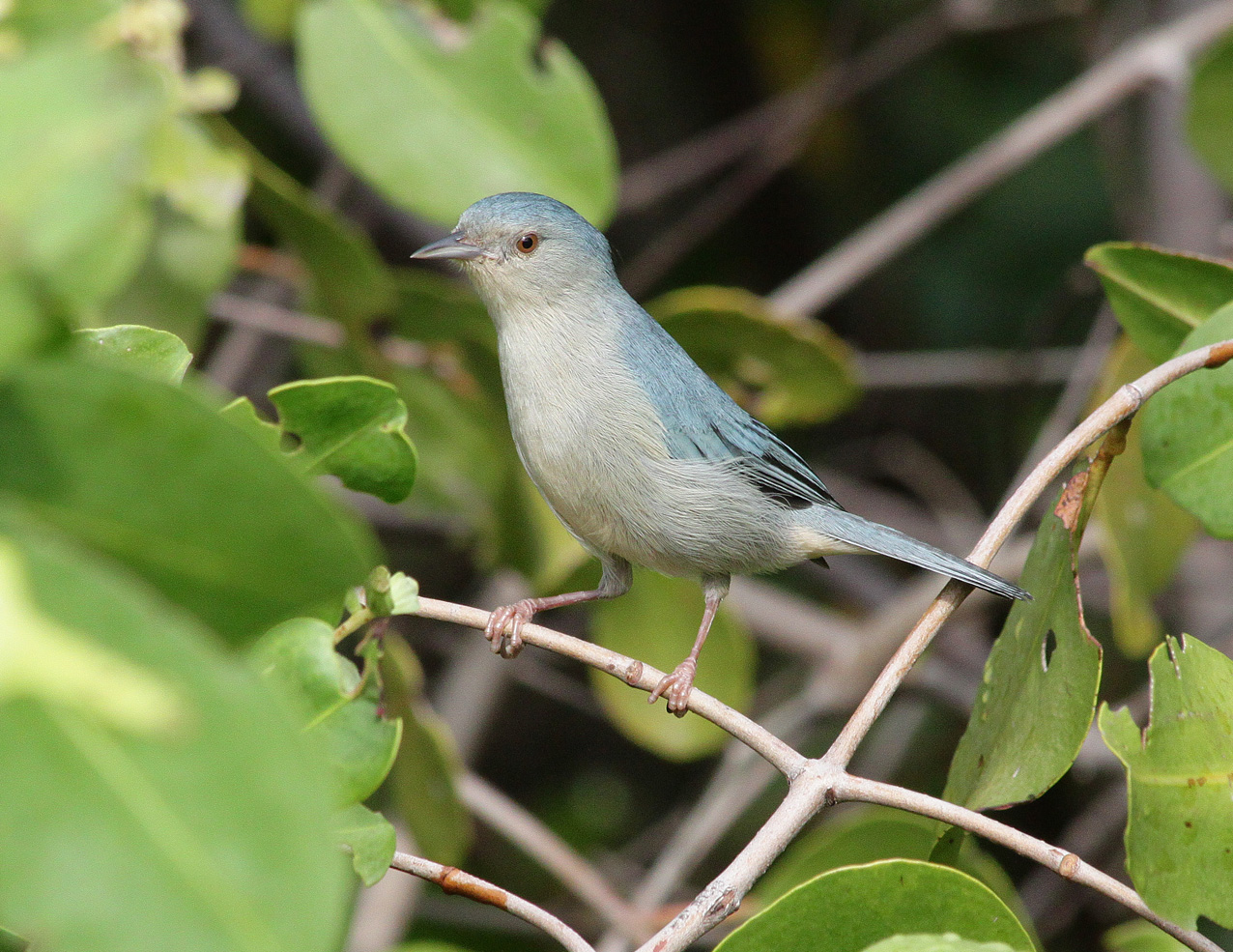
11.5 cm, with a fine, pointed, slightly conical bill. The upperparts are dull grey-blue, the underparts pale greyish brown to ochre-grey, palest on the throat and belly. The iris is reddish brown and the legs are pinkish. The sexes are alike. Juveniles are greenish above and yellowish below.
Confusion species
Pearly-breasted Conebill Conirostrum margaritae lives on the same river islands, but is bluer above and uniformly pearly grey below, without a brown or ochre tone; its song is faster. The male Chestnut-vented Conebill Conirostrum speciosum has chestnut undertail coverts and a white wing patch. Hooded Tanager Nemosia pileata has a pale yellow iris and, in the male, a black hood.
Habitat
On the Caribbean coast in mangroves and adjacent coastal woodland. In Amazonia in young woodland on river islands and along banks, especially with Cecropia and willow-like shrubs, below 300 m. It searches leaves and twigs for insects and spiders. The nest is a small cup in a tree or shrub.
Where the bird is most at home, classified by the vegetation units of the Andes and the west coast.


Range and movements
In Colombia in mangroves along the Caribbean coast, such as at the Ciénaga Grande de Santa Marta, and on river islands in the Amazon near Leticia. In Ecuador rare on river islands in the Napo. In Peru on river islands along the Amazon and the large tributaries in the north-east. Not known from Bolivia and not on the Galápagos. Outside the guide area in Venezuela, Trinidad, the Guianas and along the coast and the Amazon in Brazil.
- Resident
- dark = core range, pale = thinly spread
How and when to look
Search the mangroves of Isla de Salamanca park near Barranquilla, or river islands near Iquitos and Leticia, in the crowns of young Cecropia trees; groups draw attention with their sustained, high twittering.
Conservation status
Near Threatened. Coastal mangroves are being cleared and degraded, and the population is declining as a result.
Scientific name
Conirostrum bicolor | (Vieillot, 1809)
Vieillot described the species in 1809 as Sylvia bicolor; because it was later moved to another genus, the author and year stand in brackets. The genus Conirostrum was introduced in 1838 by D'Orbigny, ACVMD & de Lafresnaye. The genus name combines Latin conus, 'cone', and rostrum, 'bill'. The species name is Latin bicolor, 'two-coloured'. The specimen the first description was based on came from Cayenne, French Guiana.