All species › Passerines › Tanagers and allies › Pearly-breasted Conebill
Pearly-breasted Conebill | Conirostrum margaritae
Parelborstspitssnavel | Picocono pechiperla | Figuinha-amazônica
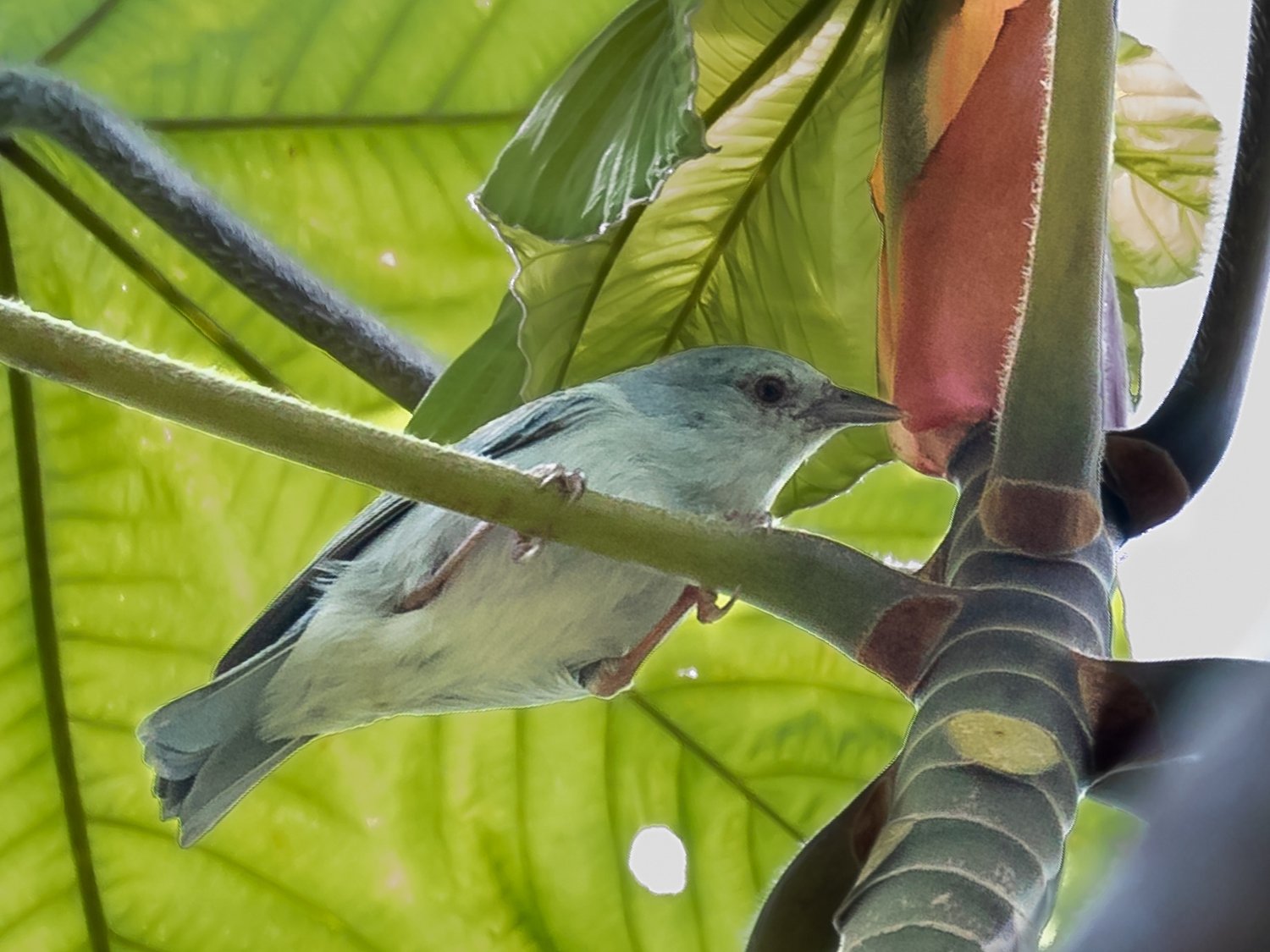
The Pearly-breasted Conebill is a small, blue-grey conebill that lives almost exclusively in young woodland on river islands in the Amazon basin. In pairs or small groups it searches the crowns of Cecropia trees for insects. Because it is tied to a habitat that keeps shifting with the river, it is local and sparsely distributed.
Voice
Gives high, thin tsit notes. The song is a fast, high, twittering series, faster than that of Bicolored Conebill.
Recording: Juan Freile — CC BY-NC-SA 4.0 · xeno-canto
Identification
11.5 cm, with a fine, pointed bill. The upperparts are pale blue-grey, the underparts uniformly pearly grey to greyish white, without a brown or ochre tone. The iris is reddish brown. The sexes are alike. Juveniles have a yellowish breast.
Confusion species
Bicolored Conebill Conirostrum bicolor lives in the same woodland, but is duller and greyer above and pale greyish brown to ochre-grey below; its song is slower. The male Chestnut-vented Conebill Conirostrum speciosum has chestnut undertail coverts and a white wing patch, and lives mainly in mainland forest.
Habitat
Young woodland on river islands and accreting banks along large, silt-laden rivers, especially in stands of Cecropia, below 300 m. It searches the canopy for insects and spiders among leaves and twigs. Little is known about the nest.
Where the bird is most at home, classified by the vegetation units of the Andes and the west coast.


Range and movements
In Colombia only on river islands in the Amazon near Leticia. In Ecuador rare on river islands in the Napo, in Orellana. In Peru on river islands along the Amazon, Napo, Marañón and Ucayali in the north-east. In Bolivia locally in the north, along the Beni, Mamoré and Madre de Dios. Does not occur on the Galápagos. Outside the guide area along the Amazon and the large tributaries in Brazil.
- Resident
- dark = core range, pale = thinly spread
How and when to look
Search river islands near Iquitos, reached by boat, in the crowns of young Cecropia trees; use the uniformly grey underparts and the fast song to separate it from Bicolored Conebill.
Conservation status
Vulnerable. The range is small and limited to a specialised habitat; river islands are locally cleared for farming and logging.
Scientific name
Conirostrum margaritae | (Holt, 1931)
Holt described the species in 1931 as Ateleodacnis margaritae; because it was later moved to another genus, the author and year stand in brackets. The genus Conirostrum was introduced in 1838 by D'Orbigny, ACVMD & de Lafresnaye. The genus name combines Latin conus, 'cone', and rostrum, 'bill'. The species name honours Margaret Hall Holt, née Lander (born 1894), wife of the American ornithologist Ernest G. Holt. The specimen the first description was based on came from Parintins, Amazonas, Brazil.