All species › Passerines › Tanagers and allies › Chestnut-vented Conebill
Chestnut-vented Conebill | Conirostrum speciosum
Roodbuikspitssnavel | Picocono culicastaño | Figuinha-de-rabo-castanho
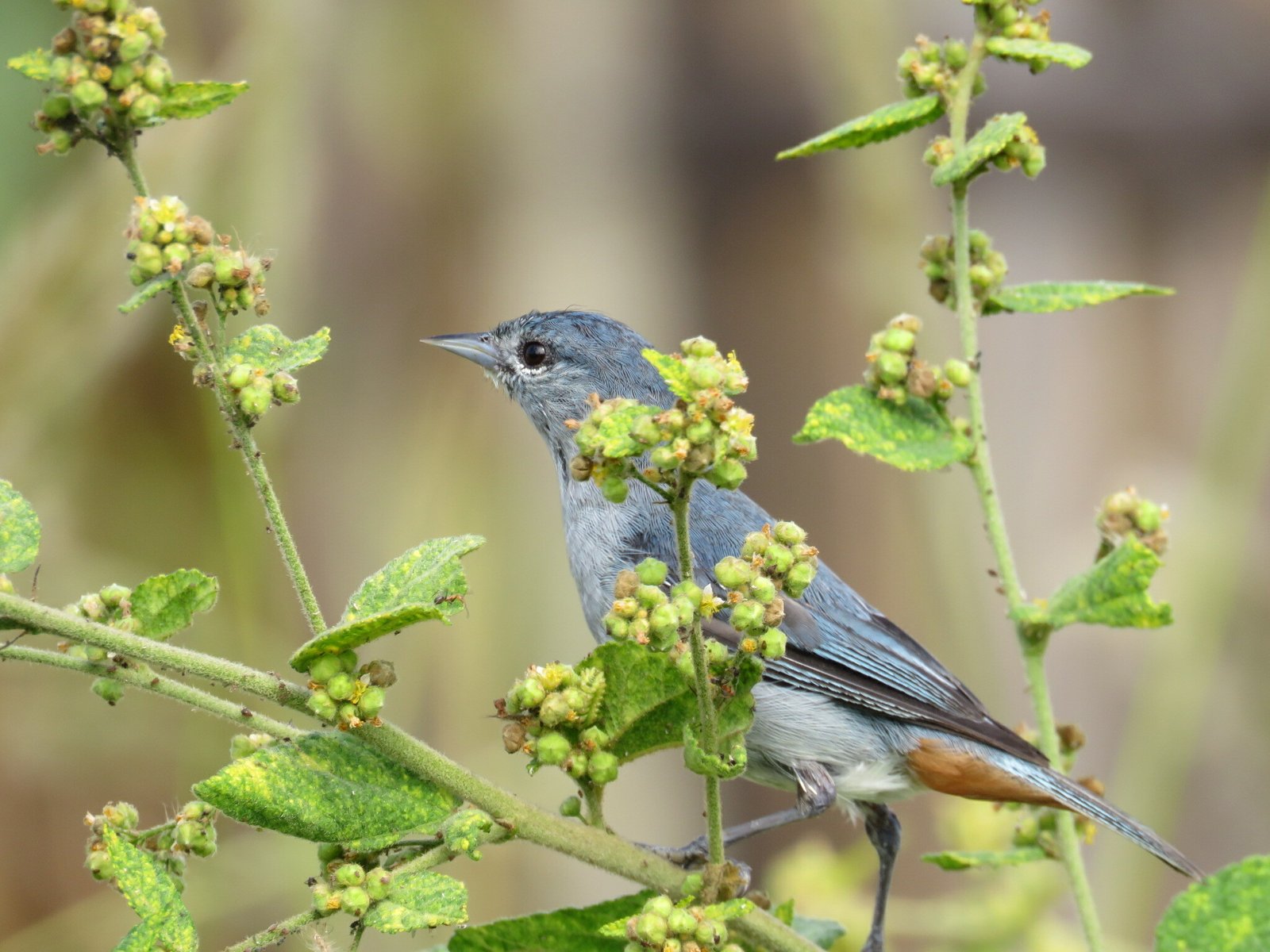
The Chestnut-vented Conebill is a small conebill of the canopy of lowland forest east of the Andes. The male is blue-grey with chestnut undertail coverts, the female greenish with a blue-grey head. It often travels with mixed flocks high in the canopy and there often first reveals itself by its high calls.
Voice
Gives thin, high tsit notes. The song is a short, high, rapidly delivered series of notes.
Recording: Robson Silva e Silva — CC BY-NC-SA 4.0 · xeno-canto
Identification
10.5 cm, with a fine, pointed bill. The male is dark blue-grey above and paler grey below, with a whitish belly, chestnut undertail coverts and a small white patch at the base of the primaries. The female has a blue-grey crown and nape, olive-green upperparts and pale greyish to yellowish white underparts, without chestnut. Juveniles resemble the female.
Confusion species
The male Bicolored Conebill Conirostrum bicolor lacks the chestnut undertail coverts and white wing patch, and lives on river islands and in mangroves. Pearly-breasted Conebill Conirostrum margaritae is uniformly pearly grey below, without chestnut. Female dacnises (Dacnis) are greener and have a shorter, thicker bill; the female Turquoise Dacnis Dacnis hartlaubi has paler eyes.
Habitat
Canopy and edges of humid and semi-humid lowland forest, várzea, riverine forest, gallery forest and old secondary growth, mostly below 1000 m, locally higher in the foothills. It searches actively among leaves and twigs for insects and spiders, often in mixed flocks with tanagers. The nest is a small cup high in a tree.
Where the bird is most at home, classified by the vegetation units of the Andes and the west coast.


Range and movements
In Colombia in the lowlands east of the Andes, locally also in the Magdalena Valley. In Ecuador in the eastern lowlands and foothills. In Peru widespread in the Amazonian lowlands. In Bolivia in the north and east, into the Chiquitano dry forest. Does not occur on the Galápagos. Outside the guide area in Venezuela, the Guianas, much of Brazil, Paraguay and north-eastern Argentina.
- Resident
- dark = core range, pale = thinly spread
How and when to look
Watch from canopy platforms and towers in the Amazonian lowlands, or along open forest edges, for mixed flocks high in the trees; in the male, look for the chestnut undertail coverts.
Conservation status
Least Concern. Widespread and tolerates edges and old secondary forest.
Scientific name
Conirostrum speciosum | (Temminck, 1824)
Temminck described the species in 1824 as Sylvia speciosa; because it was later moved to another genus, the author and year stand in brackets. The genus Conirostrum was introduced in 1838 by D'Orbigny, ACVMD & de Lafresnaye. The genus name combines Latin conus, 'cone', and rostrum, 'bill'. The species name is Latin speciosus, 'showy'. The specimen the first description was based on came from Rio de Janeiro, Brazil.