All species › Passerines › Tanagers and allies › White-eared Conebill
White-eared Conebill | Conirostrum leucogenys
Witoorspitssnavel | Conirrostro orejiblanco | Figuinha-de-orelha-branca
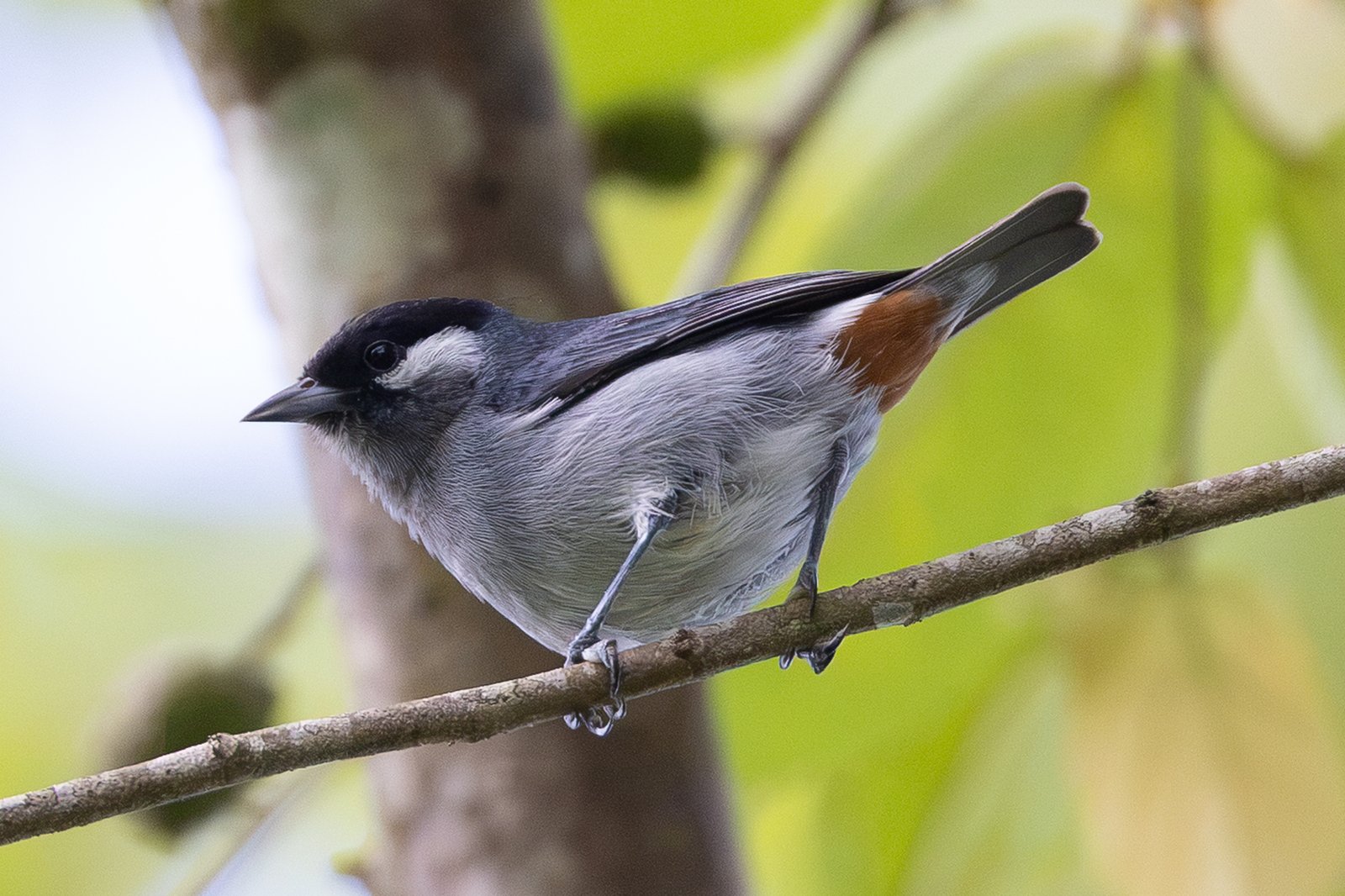
The White-eared Conebill is the smallest conebill, a blue-grey bird with a black cap and a white ear patch from northern Colombia. Pairs and small groups search the crowns of forest edges and trees in open country for insects. In the guide area it occurs only in Colombia.
Voice
Gives high, thin tsip notes. The song is a short, high, rapid series of chip notes.
Recording: Jerome Fischer — CC BY-NC-SA 4.0 · xeno-canto
Identification
9 cm, with a short tail and a fine, pointed bill. The male has a black crown, a prominent white ear patch, blue-grey upperparts and grey underparts with chestnut undertail coverts. The female is greyish blue above, with a pale, buffy head and underparts, no black cap and a less distinct ear patch. Juveniles resemble the female.
Confusion species
Bicolored Conebill Conirostrum bicolor is larger, without a black cap or white ear patch, and lives in mangroves. The female Blue Dacnis Dacnis cayana is green with a blue head and lacks buffy underparts.
Habitat
Canopy and edges of dry and humid forest, gallery forest, open country with scattered trees, pastures with shade trees and plantations, from the lowlands up to about 1000 m. It searches leaves and twigs for small insects, often in mixed flocks. The nest is a small cup high in a tree.
Where the bird is most at home, classified by the vegetation units of the Andes and the west coast.


Range and movements
In Colombia in the Caribbean lowlands, the foothills of the Sierra Nevada de Santa Marta and the Magdalena, Cauca and Sinú valleys. Not in Ecuador, Peru, Bolivia or the Galápagos. Outside the guide area in eastern Panama and north-western Venezuela.
- Resident
- dark = core range, pale = thinly spread
How and when to look
Search the foothills of the Sierra Nevada de Santa Marta and around Minca in the crowns of trees bordering open country; look for a very small grey bird with a white ear patch in mixed flocks.
Conservation status
Least Concern. Tolerates semi-open farmland with trees.
Scientific name
Conirostrum leucogenys | (de Lafresnaye, 1852)
De Lafresnaye described the species in 1852 as Dacnis leucogenys; because it was later moved to another genus, the author and year stand in brackets. The genus Conirostrum was introduced in 1838 by D'Orbigny, ACVMD & de Lafresnaye. The genus name combines Latin conus, 'cone', and rostrum, 'bill'. The species name comes from Greek leukos, 'white', and genus, 'cheek'. The specimen the first description was based on came from Bogotá, Colombia.