All species › Passerines › Tanagers and allies › Giant Conebill
Giant Conebill | Conirostrum binghami
Reuzenspitssnavel | Picocono gigante | Figuinha-gigante
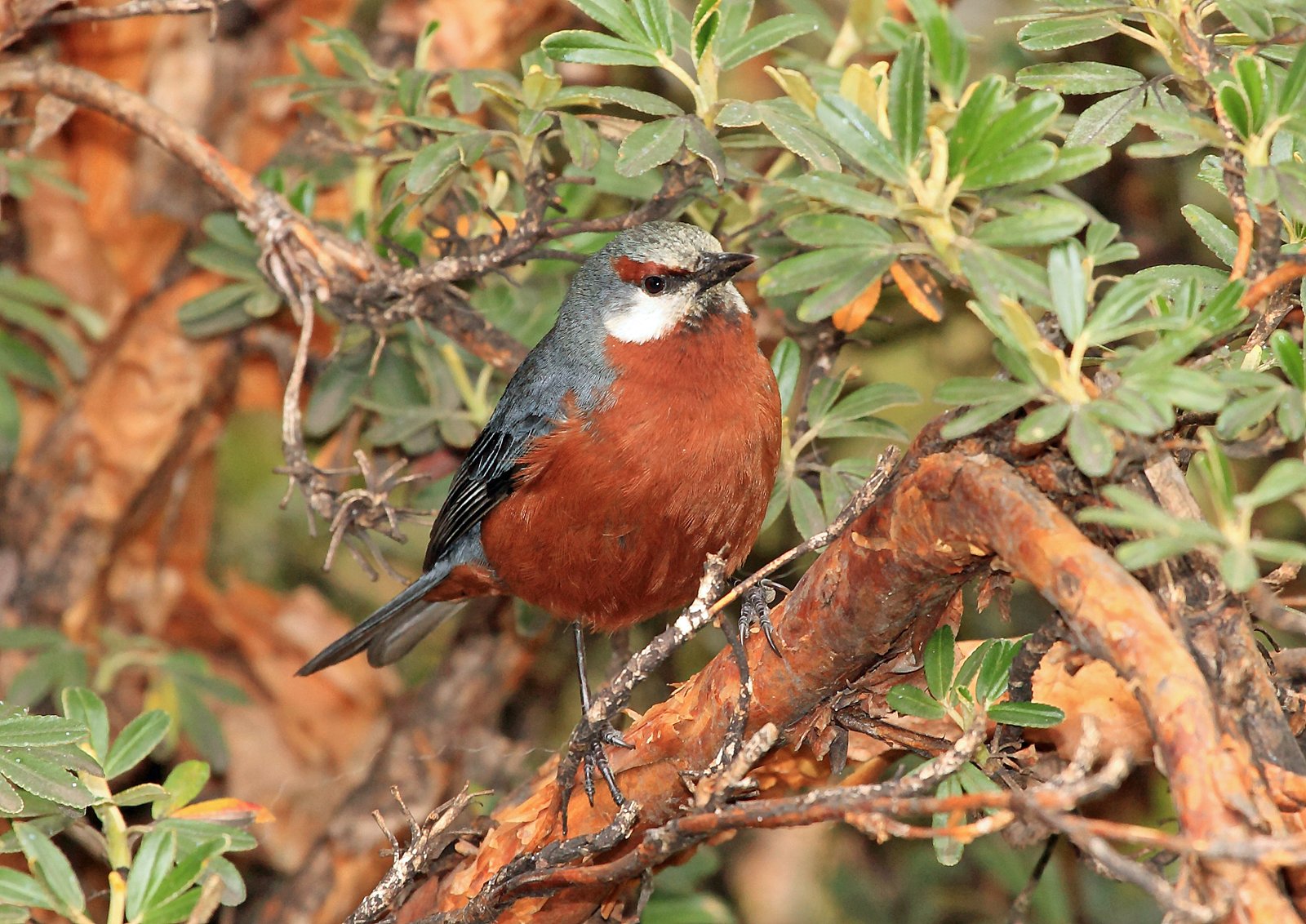
The Giant Conebill is the largest conebill, a blue-grey and chestnut bird that lives almost exclusively in Polylepis woodland high in the Andes. Like a nuthatch it climbs along trunks and branches and prises off the thin, peeling flakes of bark with its bill to find insects. It was formerly placed in a genus of its own, Oreomanes.
Voice
Gives thin, high tsip notes. The song is a fast, high, twittering series, often in duets.
Recording: Cristian Pinto — CC BY-NC-SA 4.0 · xeno-canto
Identification
15 cm, with a straight, pointed, grey bill. The upperparts are blue-grey. The forehead, supercilium and underparts are chestnut to rufous; the cheek is white. The sexes are alike. Juveniles are duller, with paler, less rufous underparts and a less distinct head pattern.
Confusion species
Cinereous Conebill Conirostrum cinereum is much smaller, grey with a white supercilium and wing patch, without chestnut. Tit-like Dacnis Xenodacnis parina is smaller and blue, with a short bill. White-browed Conebill Conirostrum ferrugineiventre is smaller, with a white supercilium and a dark cheek, and lives mainly lower in humid montane forest.
Habitat
Polylepis woodland and scrub on the puna and páramo, including small fragments and scattered trees, mostly between 3500 and 4600 m. It climbs along trunks and branches and searches under bark flakes for insects and larvae; it sometimes joins mixed flocks. The nest is a cup in a Polylepis tree.
Where the bird is most at home, classified by the vegetation units of the Andes and the west coast.


Range and movements
In Colombia only a few records from Nariño, near the Ecuador border. In Ecuador locally in the central and southern Andes, for example in Cajas. In Peru scattered in the Andes from north to south. In Bolivia in the western Andes and on the altiplano. Does not occur on the Galápagos. Outside the guide area in the far north of Chile and north-western Argentina.
- Resident
- dark = core range, pale = thinly spread
How and when to look
Visit Polylepis woodland in Cajas National Park in Ecuador or in the Cordillera Blanca in Peru, and listen for tapping and twittering among the trees; birds usually climb along the trunks.
Conservation status
Near Threatened. Polylepis woodland is heavily fragmented by logging, burning and grazing.
Scientific name
Conirostrum binghami | (Chapman, 1919)
Chapman described the species in 1919 as Oreomanes binghami; because it was later moved to another genus, the author and year stand in brackets. The genus Conirostrum was introduced in 1838 by D'Orbigny, ACVMD & de Lafresnaye. The genus name combines Latin conus, 'cone', and rostrum, 'bill'. The species name honours Hiram Bingham (1875–1956), American explorer and academic who brought Machu Picchu to international attention in 1911 and later became a senator. The specimen the first description was based on came from Machu Picchu, Cusco, Peru.