All species › Passerines › Tanagers and allies › White-browed Conebill
White-browed Conebill | Conirostrum ferrugineiventre
Witbrauwspitssnavel | Picocono cejiblanco | Figuinha-de-sobrancelha-branca
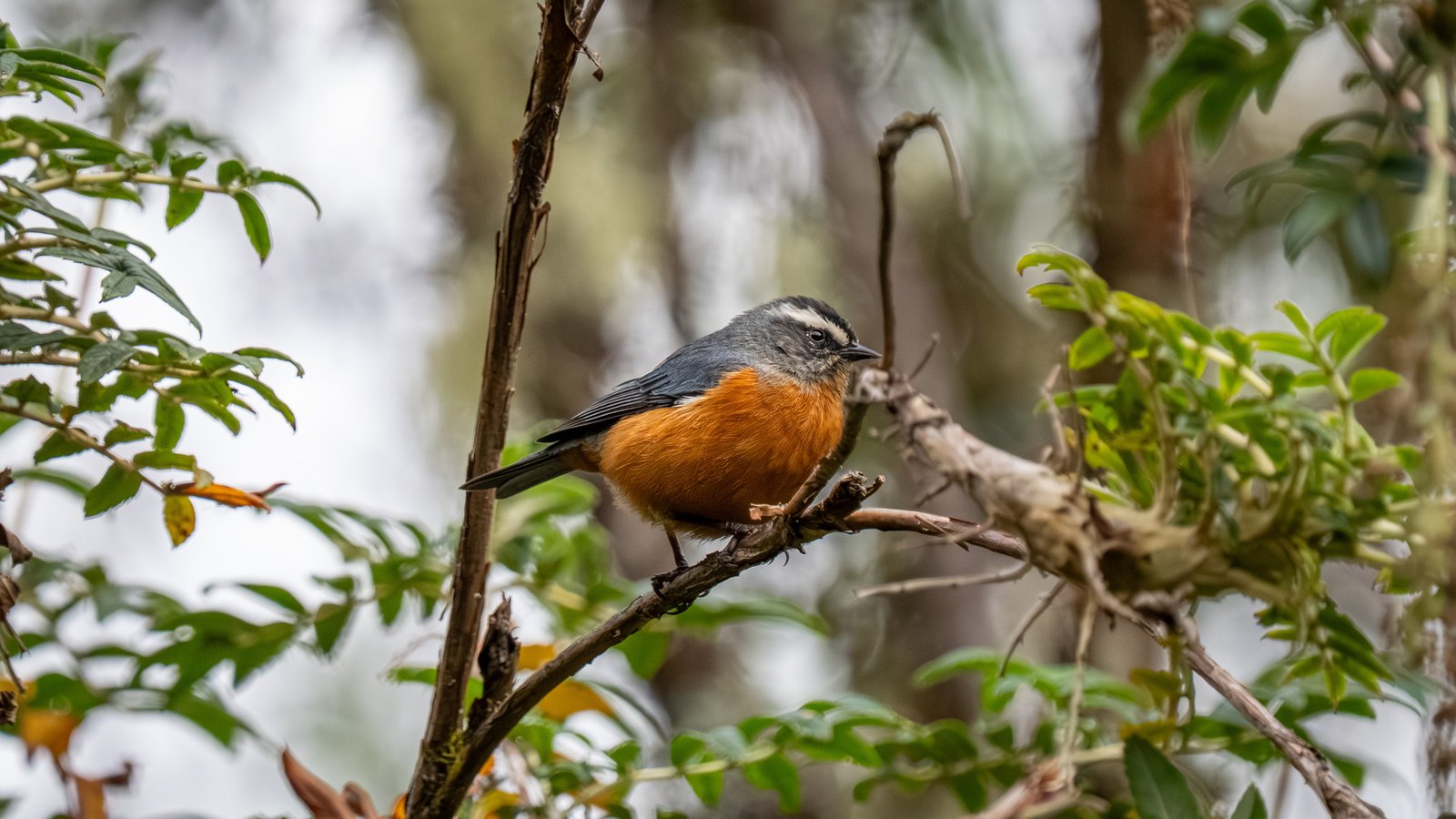
The White-browed Conebill is a slate-grey conebill with a long white supercilium and rufous underparts, from the high montane forests of southern Peru and Bolivia. Pairs and small groups search elfin forest near the treeline for insects, often in mixed flocks. It is tied to the humid montane forest of the eastern slope.
Voice
Gives thin, high tsit notes. The song is a fast, high, twittering series.
Recording: Joseph Tobias and Nathalie Seddon — CC BY-NC-SA 3.0 · xeno-canto
Identification
12.5 cm, with a fine, pointed bill. The upperparts are dark slate-grey to blue-grey, with a long white supercilium and a dark cheek. The throat, breast and belly are rufous to orange-brown. The sexes are alike. Juveniles are duller, with a less distinct supercilium.
Confusion species
Blue-backed Conebill Conirostrum sitticolor has a black head and throat, a blue back and a short, pale blue supercilium. Capped Conebill Conirostrum albifrons is blue to blackish blue, without rufous. Giant Conebill Conirostrum binghami is larger, with a white cheek, and lives in Polylepis woodland. Black-throated Flowerpiercer Diglossa brunneiventris has a black throat and a hooked bill.
Habitat
Humid montane forest, elfin forest and scrub near the treeline, also edges of Polylepis woodland, between about 2500 and 3800 m. It searches leaves, twigs and mosses for insects, often in mixed flocks with tanagers and flowerpiercers. Little is known about the nest.
Where the bird is most at home, classified by the vegetation units of the Andes and the west coast.


Range and movements
In Peru on the eastern slope of the Andes in the centre and south. In Bolivia in the Andes of La Paz and Cochabamba. Not known from Colombia, Ecuador or the Galápagos. It does not occur outside the guide area.
- Resident
- dark = core range, pale = thinly spread
How and when to look
Search along the Manu road above Wayqecha in Peru, or in the yungas above La Paz, in mixed flocks near the treeline; the long white supercilium and rufous underparts stand out.
Conservation status
Least Concern. The range is limited, but montane forest on the high eastern slope is still largely intact.
Scientific name
Conirostrum ferrugineiventre | Sclater, 1855
Sclater described the species in 1855 and placed it straight away in the genus where it still stands. The genus Conirostrum was introduced in 1838 by D'Orbigny, ACVMD & de Lafresnaye. The genus name combines Latin conus, 'cone', and rostrum, 'bill'. The species name comes from Latin ferrugineus, 'rust-coloured', and venter, 'belly'. The specimen the first description was based on came from Bolivia.