All species › Passerines › Tanagers and allies › Blue-backed Conebill
Blue-backed Conebill | Conirostrum sitticolor
Blauwrugspitssnavel | Picocono dorsiazul | Figuinha-de-dorso-azul
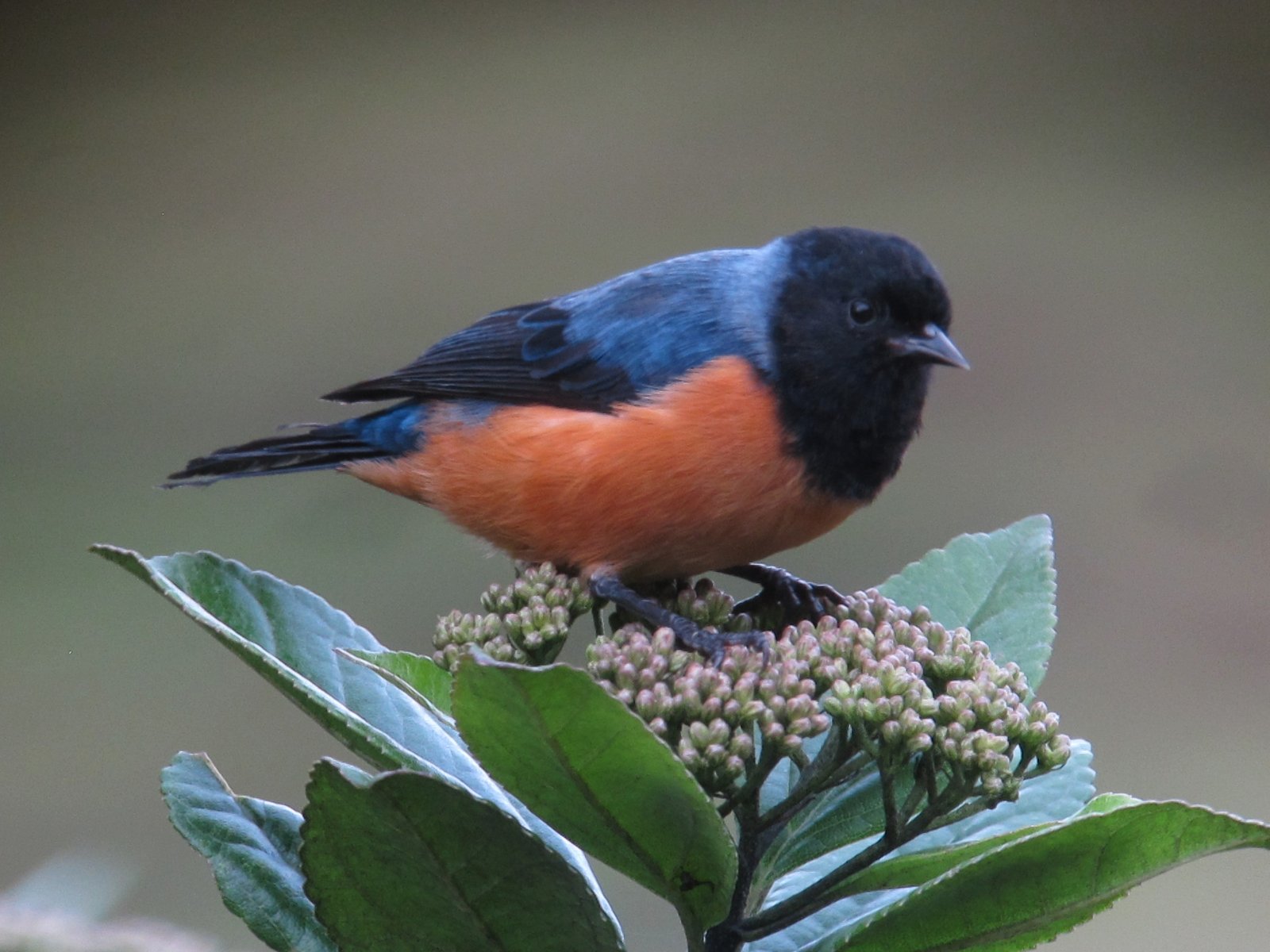
The Blue-backed Conebill is a small conebill of high montane forest and the treeline in the Andes, with a black head, a blue back and rufous underparts. It moves in pairs or small groups with mixed flocks through the outer branches of trees and shrubs. With its fine, pointed bill it picks insects from leaves and twigs.
Voice
High, thin tsit calls, often in short series. The song is a rapid series of high, squeaky twittering notes.
Recording: Alonso Quevedo — CC BY-NC-SA 4.0 · xeno-canto
Identification
12–13 cm, with a short, fine, pointed bill. The head, throat and upper breast are black. The back, scapulars and rump are bright blue, and the wings and tail blackish with blue edges. The rest of the underparts are uniform rufous to cinnamon. Birds in southern Peru and Bolivia (cyaneum) have a short blue stripe behind the eye. The sexes are alike. Juveniles are duller, with less blue on the back and paler underparts.
Confusion species
Giant Conebill Conirostrum binghami is larger, grey above with a white face, and lives almost only in Polylepis woodland. Rufous-browed Conebill Conirostrum rufum in Colombia has a rufous face and grey-blue upperparts, without a black head. Rusty Flowerpiercer Diglossa sittoides also has cinnamon underparts, but a grey-blue head and an upturned, hook-tipped bill. Masked Flowerpiercer Diglossa cyanea is entirely blue, with a black mask and a red eye.
Habitat
Upper montane forest, cloud forest, elfin forest at the treeline, Polylepis groves and scrub along forest edges, roughly between 2500 and 3800 m, locally lower. It searches the outer branches and foliage for insects and spiders, often in mixed flocks with tanagers, flowerpiercers and other small passerines. The nest is a cup in a shrub or tree.
Where the bird is most at home, classified by the vegetation units of the Andes and the west coast.


Range and movements
In Colombia in the Andes and the Sierra de Perijá. In Ecuador on both slopes of the Andes. In Peru along the eastern slope throughout the country and locally on the western slope in the north. In Bolivia on the eastern slope in La Paz and Cochabamba. Absent from the Galápagos. Outside the guide area in the Andes of western Venezuela.
- Resident
- dark = core range, pale = thinly spread
How and when to look
Follow mixed flocks along forest edges just below the treeline, for example along roads over high passes. The birds often sit in the upper branches of shrubs and small trees and call constantly.
Conservation status
Least Concern. Fairly common over most of its range; locally, habitat at the treeline is lost to cutting and fires.
Scientific name
Conirostrum sitticolor | de Lafresnaye, 1840
De Lafresnaye described the species in 1840 and placed it straight away in the genus where it still stands. The genus Conirostrum was introduced in 1838 by D'Orbigny, ACVMD & de Lafresnaye. The genus name combines Latin conus, 'cone', and rostrum, 'bill'. The species name combines Sitta, the nuthatch genus, with Latin color, 'colour': 'nuthatch-coloured'. The specimen the first description was based on came from Bogotá, Colombia.