All species › Passerines › Tanagers and allies › Capped Conebill
Capped Conebill | Conirostrum albifrons
Witkopspitssnavel | Picocono coronado | Figuinha-de-boné
The Capped Conebill is a dark blue conebill of humid montane forest in the Andes. Only males in Colombia have the white crown; further south the crown is glossy blue. It lives high in the canopy and travels with mixed flocks.
Voice
High, thin, hissing tsi calls and a rapid, high, rather shrill twitter.
Recording: Alonso Quevedo — CC BY-NC-SA 4.0 · xeno-canto
Identification
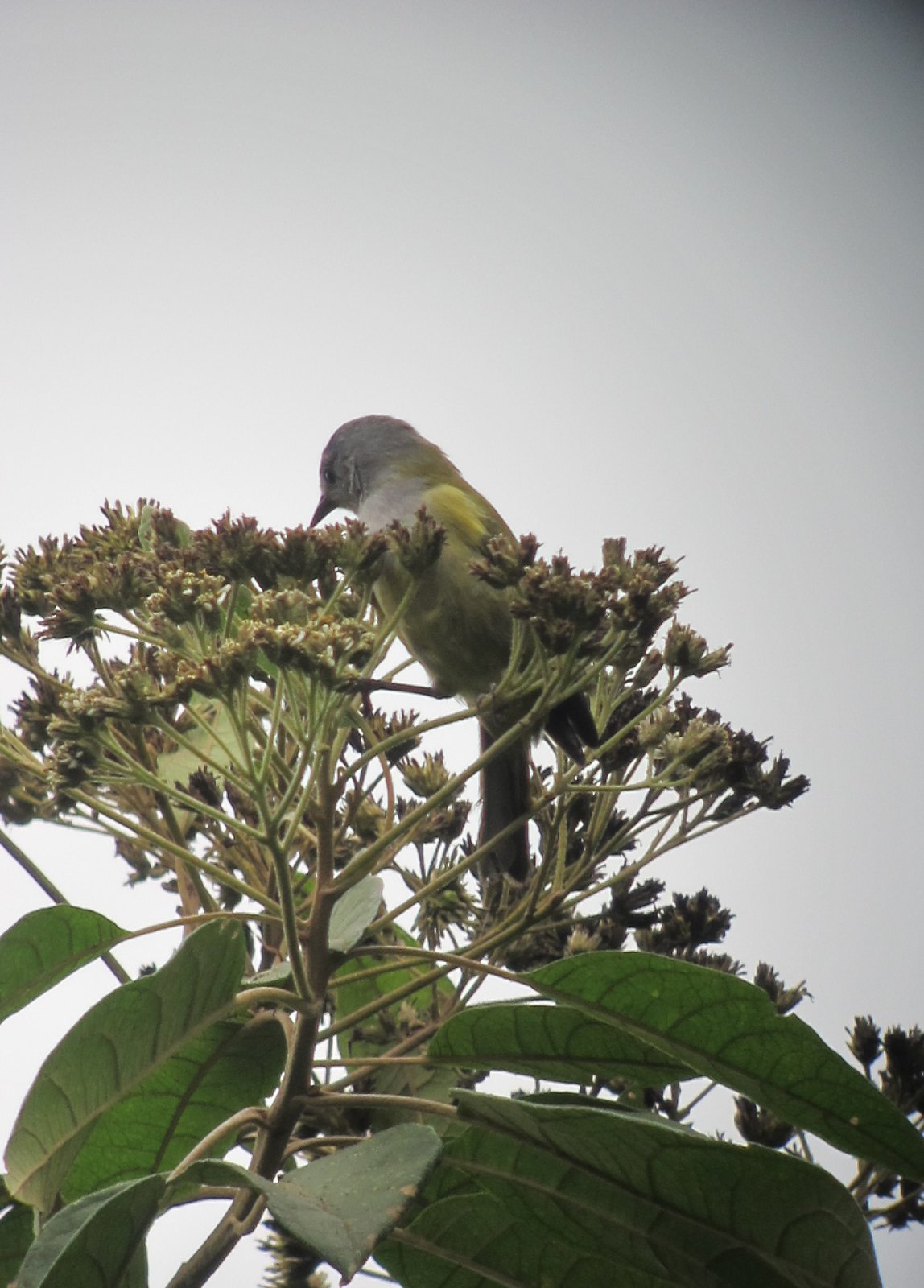
13 cm, with a pointed, conical bill. The male is mostly dark blue-black, with a blue gloss on the back and underparts. In Colombia (albifrons and centralandium) the male has a white crown; from south-western Colombia to Bolivia (atrocyaneum and related forms) a glossy sky-blue crown. The female is very different: head and nape grey-blue, back and wings olive-green, underparts greyish with a yellowish-green wash. Juveniles resemble the female.
Confusion species
Blue-backed Conebill Conirostrum sitticolor has a black head and rufous underparts. Masked Flowerpiercer Diglossa cyanea is brighter blue, with a black mask, a red eye and a hook-tipped bill. Bluish Flowerpiercer Diglossa caerulescens is uniformly paler grey-blue and also has a hooked bill. The female can suggest a small warbler; note the grey-blue head, the pointed bill and the company of a male.
Habitat
Humid montane forest and cloud forest, forest edges and tall secondary forest, roughly between 1800 and 3300 m. It searches the canopy and outer twigs for insects, usually in pairs or small groups in mixed flocks of tanagers and other passerines.
Where the bird is most at home, classified by the vegetation units of the Andes and the west coast.


Range and movements
In Colombia in all three Andean cordilleras. In Ecuador on both slopes of the Andes. In Peru along the eastern slope throughout the country. In Bolivia on the eastern slope in La Paz and Cochabamba. Absent from the Galápagos. Outside the guide area in the Andes and coastal cordillera of Venezuela.
- Resident
- dark = core range, pale = thinly spread
How and when to look
Look high in the crowns along forest edges and clearings in cloud forest, where mixed flocks pass. Males stand out as dark shapes against the sky; check the colour of the crown.
Conservation status
Least Concern. Fairly common; the species tolerates forest edges and secondary forest, but depends on forest in the montane belt.
Scientific name
Conirostrum albifrons | de Lafresnaye, 1842
De Lafresnaye described the species in 1842 and placed it straight away in the genus where it still stands. The genus Conirostrum was introduced in 1838 by D'Orbigny, ACVMD & de Lafresnaye. The genus name combines Latin conus, 'cone', and rostrum, 'bill'. The species name comes from Latin albus, 'white', and frons, 'forehead'. The specimen the first description was based on came from Bogotá, Colombia.