All species › Birds of prey › Kites, Old World vultures, eagles and hawks › Black-and-white Hawk-Eagle
Black-and-white Hawk-Eagle | Spizaetus melanoleucus
Zwart-witte kuifarend | Águila blanquinegra | Gavião-pato
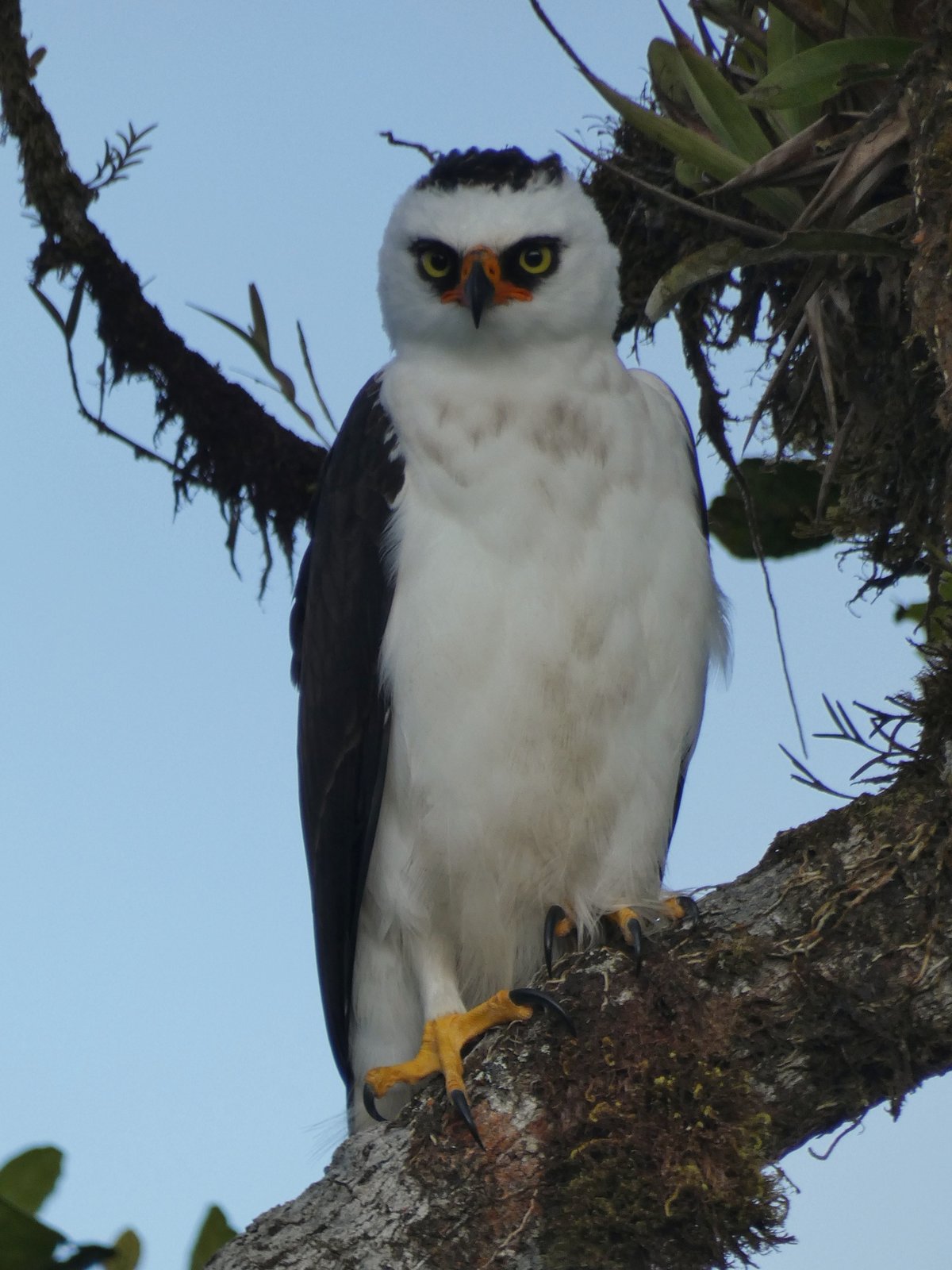
The Black-and-white Hawk-Eagle is a compact eagle with a white head and underside, a black back and a black mask around the eye. It is scarce throughout its range and is usually seen circling high over forest edges. It hunts mainly birds, which it takes in a fast stoop.
Voice
Seldom heard. A high, whistled kwee-oo and series of shrill whistles, mainly in flight and around the nest.
Recording: Douglas Meyer — CC BY-NC-SA 3.0 · xeno-canto
Identification
51–61 cm, with broad wings and a fairly long tail. The head, neck and underparts are white, with a narrow black mask around the eye and a short black crest. The cere is bright orange and the legs are feathered white to the toes. The back and upperwings are black; the tail is black with three or four grey bands. In flight the underwings are white, with lightly barred flight feathers, and the leading edge of the wing is white. The sexes are alike. Juveniles have brownish-black upperparts with pale feather fringes.
Confusion species
The pale form of juvenile Grey-headed Kite Leptodon cayanensis is very similar, but has a black crown patch instead of a mask, a grey cere and bare, bluish-grey legs. White Hawk Pseudastur albicollis has white upperparts with black on the wings and a short white tail with a black band. Juvenile Ornate Hawk-Eagles Spizaetus ornatus have barred flanks and thighs, a longer crest and no black mask.
Habitat
Humid lowland and foothill forest, especially along forest edges, rivers and clearings, also forest–farmland mosaics, from sea level to about 1500 m, locally higher. It hunts mainly medium-sized birds such as pigeons, toucans, oropendolas and guans, taken after a fast stoop. The nest is a large stick nest high in a tree.
Where the bird is most at home, classified by the vegetation units of the Andes and the west coast.


Range and movements
In Colombia scattered in the lowlands of the Pacific coast, the Caribbean region, the Magdalena valley and Amazonia. In Ecuador in the western and eastern lowlands. In Peru east of the Andes. In Bolivia in the lowlands of the north and east. Scarce everywhere. Absent from the Galápagos. Outside the guide area from southern Mexico to Venezuela, the Guianas, Brazil, Paraguay and north-eastern Argentina.
- Resident
- dark = core range, pale = thinly spread
How and when to look
From viewpoints over forest edges and river valleys in the late morning, look for a white eagle with a black back circling high. Check the mask and the orange cere carefully to rule out juvenile Grey-headed Kite.
Conservation status
Least Concern, but scarce and dependent on large forest tracts; the species is declining locally through deforestation.
Scientific name
Spizaetus melanoleucus | (Vieillot, 1816)
Vieillot described the species in 1816 as Buteo melanoleucus; because it was later moved to another genus, the author and year stand in brackets. The genus Spizaetus was introduced in 1816 by Vieillot. The genus name comes from Ancient Greek spizias, 'hawk', and aetos, 'eagle'. The species name combines Greek melas, 'black', with leukos, 'white', after the black-and-white plumage. The specimen the first description was based on came from The Guianas.