All species › Birds of prey › Kites, Old World vultures, eagles and hawks › Ornate Hawk-Eagle
Ornate Hawk-Eagle | Spizaetus ornatus
Bonte kuifarend | Águila elegante | Gavião-de-penacho
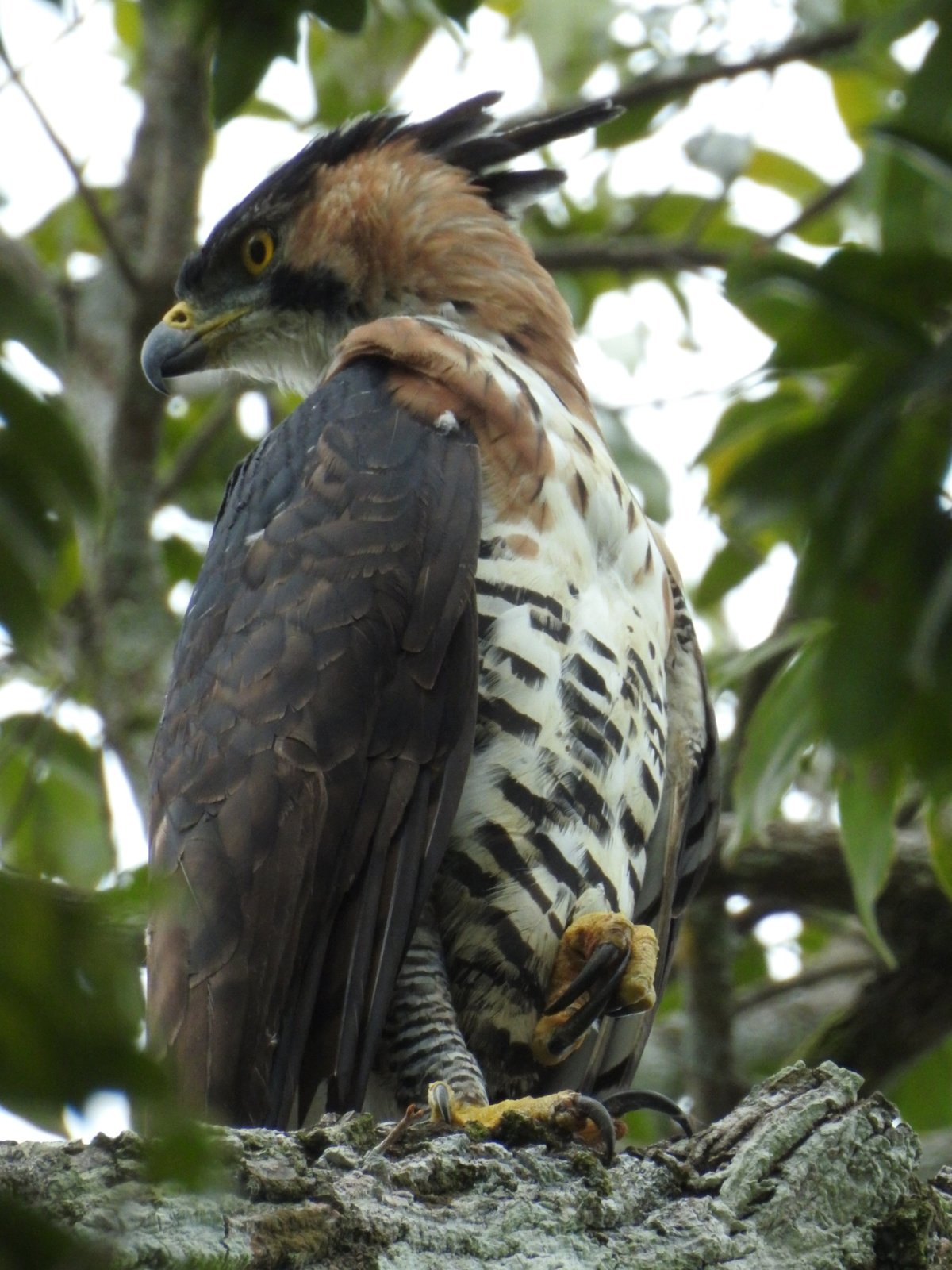
The Ornate Hawk-Eagle is a medium-sized forest eagle with a long, pointed black crest, a rufous neck and black-and-white barred underparts. It hunts birds and mammals from the canopy and in the morning often soars high over the forest, calling loudly. It occurs from the lowlands up into the lower montane forest.
Voice
Calls mainly in flight and around the nest: a series of clear whistles, wheep, whee-whee-whee-whee, often with a longer first note. Juveniles beg with repeated, plaintive whistles.
Recording: JAYRSON ARAUJO DE OLIVEIRA — CC BY-NC-SA 4.0 · xeno-canto
Identification
58–64 cm; the female is larger than the male. The adult has a black crown with a long, pointed crest that often lies flat but is raised when excited. The sides of the head and neck are bright rufous, and the throat is white, bordered by a black malar stripe. The back and wings are blackish. The breast is white; the flanks, belly and the legs, feathered to the toes, are densely barred black and white. The fairly long tail has three or four broad dark bands. In flight the wings are broad and rounded, with barred flight feathers. Juveniles have a white head, neck and underparts with only the flanks and thighs barred, and a browner back; adult plumage is reached after about three years.
Confusion species
Black-and-white Hawk-Eagle Spizaetus melanoleucus has a white head and unbarred white underparts, a short black crest, black lores and an orange cere. Juvenile Black Hawk-Eagles Spizaetus tyrannus are darker, with a streaked head and dark-barred underparts. Black-and-chestnut Eagle Spizaetus isidori is larger, with chestnut underparts, and lives higher in the mountains. Juvenile Grey-bellied Hawks Accipiter poliogaster closely resemble the adult Ornate Hawk-Eagle, but are smaller, lack the crest and have bare yellow legs.
Habitat
Tall humid forest of the lowlands and foothills, also montane forest up to about 2000 m, locally higher; it needs large forest tracts. It hunts from a concealed perch in the canopy, taking medium-sized birds such as curassows and guans, and mammals such as squirrels. The nest is a large stick nest high in a tree; a single egg is laid.
Where the bird is most at home, classified by the vegetation units of the Andes and the west coast.


Range and movements
In Colombia in the Pacific lowlands, the north, the Magdalena Valley and Amazonia, also on the lower mountain slopes. In Ecuador in the west and in the east up into the Andean foothills. In Peru in Amazonia and along the base of the Andes. In Bolivia in the northern and eastern lowlands and the lower Yungas. Outside the guide area from Mexico to northern Argentina.
- Resident
- dark = core range, pale = thinly spread
How and when to look
Search in the morning from a viewpoint or canopy tower above the rainforest, when raptors start to soar; the whistled call often gives it away first. At Amazonian lodges it sometimes sits for long periods on a favourite branch at the forest edge.
Conservation status
Near Threatened. The species needs large, continuous forest and is declining through deforestation; locally it is shot because it is believed to take poultry.
Scientific name
Spizaetus ornatus | (Daudin, 1800)
Daudin described the species in 1800 as Falco ornatus; because it was later moved to another genus, the author and year stand in brackets. The genus Spizaetus was introduced in 1816 by Vieillot. The genus name comes from Ancient Greek spizias, 'hawk', and aetos, 'eagle'. The species name is Latin ornatus, 'adorned', after the patterned plumage and crest. The specimen the first description was based on came from Cayenne, French Guiana.