All species › Birds of prey › Kites, Old World vultures, eagles and hawks › Black-and-chestnut Eagle
Black-and-chestnut Eagle | Spizaetus isidori
Andeskuifarend | Águila andina | Águia-preta-e-castanha
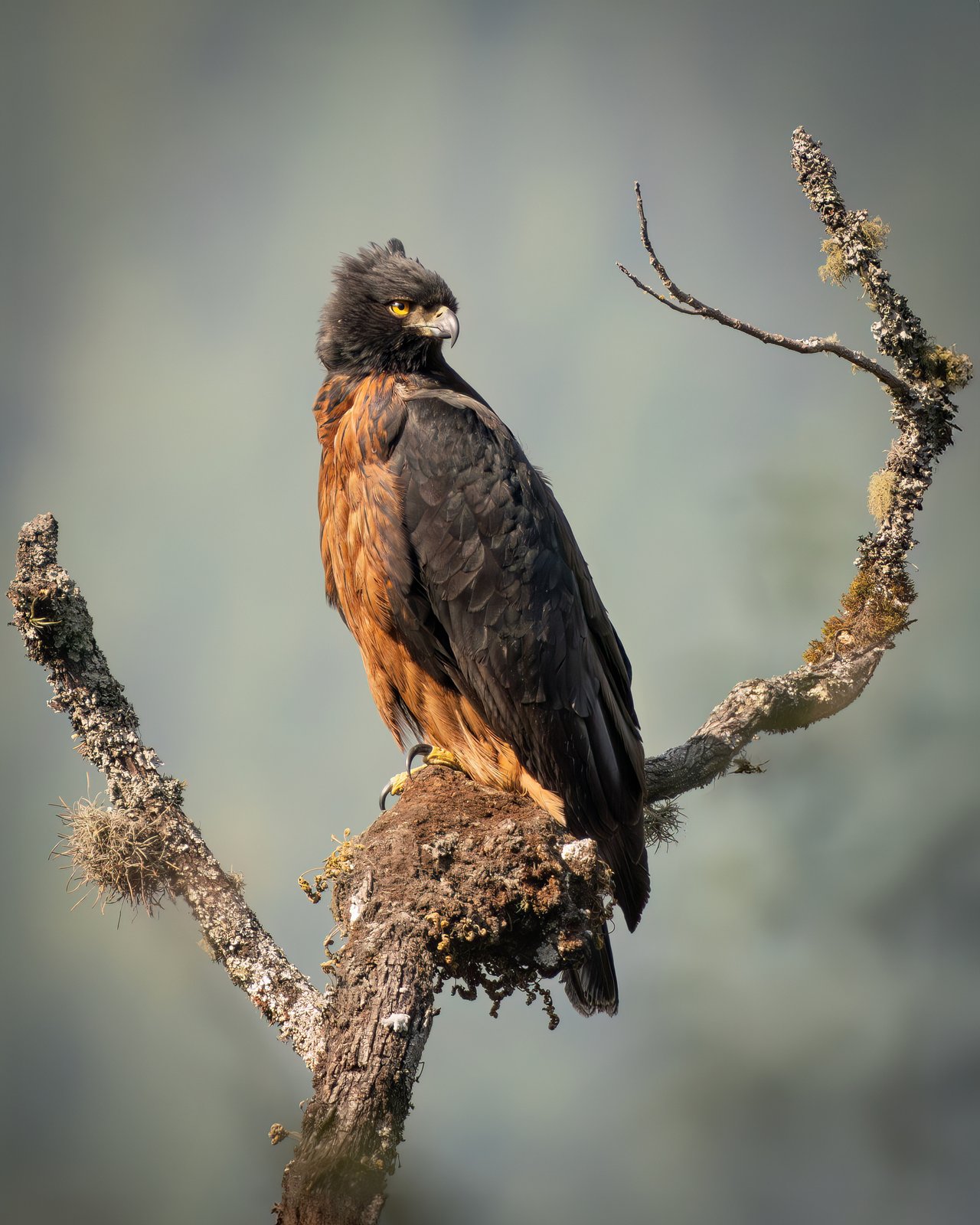
The Black-and-chestnut Eagle is the large eagle of the Andean montane forests: black and chestnut, with a long, pointed crest. It hunts over steep forested slopes and is scarce everywhere. Because it sometimes takes chickens it is persecuted, and together with the loss of montane forest this makes it one of the most threatened raptors in the region.
Voice
Seldom heard. Calls mainly around the nest and in flight, with high, piercing whistles.
Recording: Uillian — CC BY-NC-SA 4.0 · xeno-canto
Identification
63–80 cm; the female is clearly larger than the male. The adult has a black head with a long, pointed black crest, a black back and wings, and chestnut underparts and thighs streaked black. The tail is grey with a broad black terminal band. In flight the wings are long and broad, with chestnut and black underwing coverts and pale grey flight feathers with dark tips. The legs are feathered to the toes. Juveniles are much paler: head and underparts pale buff to whitish with dark streaks, the back grey-brown, and they too already have a crest. Adult plumage is only reached after several years.
Confusion species
Black Hawk-Eagle Spizaetus tyrannus is smaller, all blackish with a barred tail and barred flight feathers, and usually lives lower down. Juvenile Ornate Hawk-Eagles Spizaetus ornatus are whiter below, with barred flanks and thighs, and smaller. Black-chested Buzzard-Eagle Geranoaetus melanoleucus lives in open country and has a short, wedge-shaped tail. Solitary Eagle Buteogallus solitarius is uniform slate grey with a very short tail and has no crest.
Habitat
Extensive, undisturbed montane forest on steep slopes, especially upper montane and cloud forest, also at forest edges and over open valleys between forest tracts; mainly between about 1500 and 3000 m, sometimes higher or lower. It hunts by soaring over the slopes or from the canopy, taking medium-sized mammals such as squirrels and coatis, and large birds such as guans. The nest is a large stick nest in a tall tree, often on a slope.
Where the bird is most at home, classified by the vegetation units of the Andes and the west coast.


Range and movements
In Colombia in all three cordilleras. In Ecuador on both slopes of the Andes. In Peru along the east slope of the Andes. In Bolivia in the Yungas. Scarce and local everywhere. Outside the guide area in the Andes of Venezuela and in north-western Argentina.
- Resident
- dark = core range, pale = thinly spread
How and when to look
Best seen from a viewpoint above a forested valley, in the late morning when the air warms and raptors start to soar. At a distance the chestnut underside and the long, broad wings with pale flight feathers stand out.
Conservation status
Endangered. The population is small and declining through clearance of montane forest and persecution by farmers who regard it as a chicken thief.
Scientific name
Spizaetus isidori | (des Murs, 1845)
Des Murs described the species in 1845 as Falco Isidori; because it was later moved to another genus, the author and year stand in brackets. The genus Spizaetus was introduced in 1816 by Vieillot. The genus name comes from Ancient Greek spizias, 'hawk', and aetos, 'eagle'. The species name honours Isidore Geoffroy Saint-Hilaire (1805–1861), a French zoologist. The specimen the first description was based on came from Bogotá, Colombia.