All species › Birds of prey › Kites, Old World vultures, eagles and hawks › Harpy Eagle
Harpy Eagle | Harpia harpyja
Harpij | Águila arpía | Gavião-real
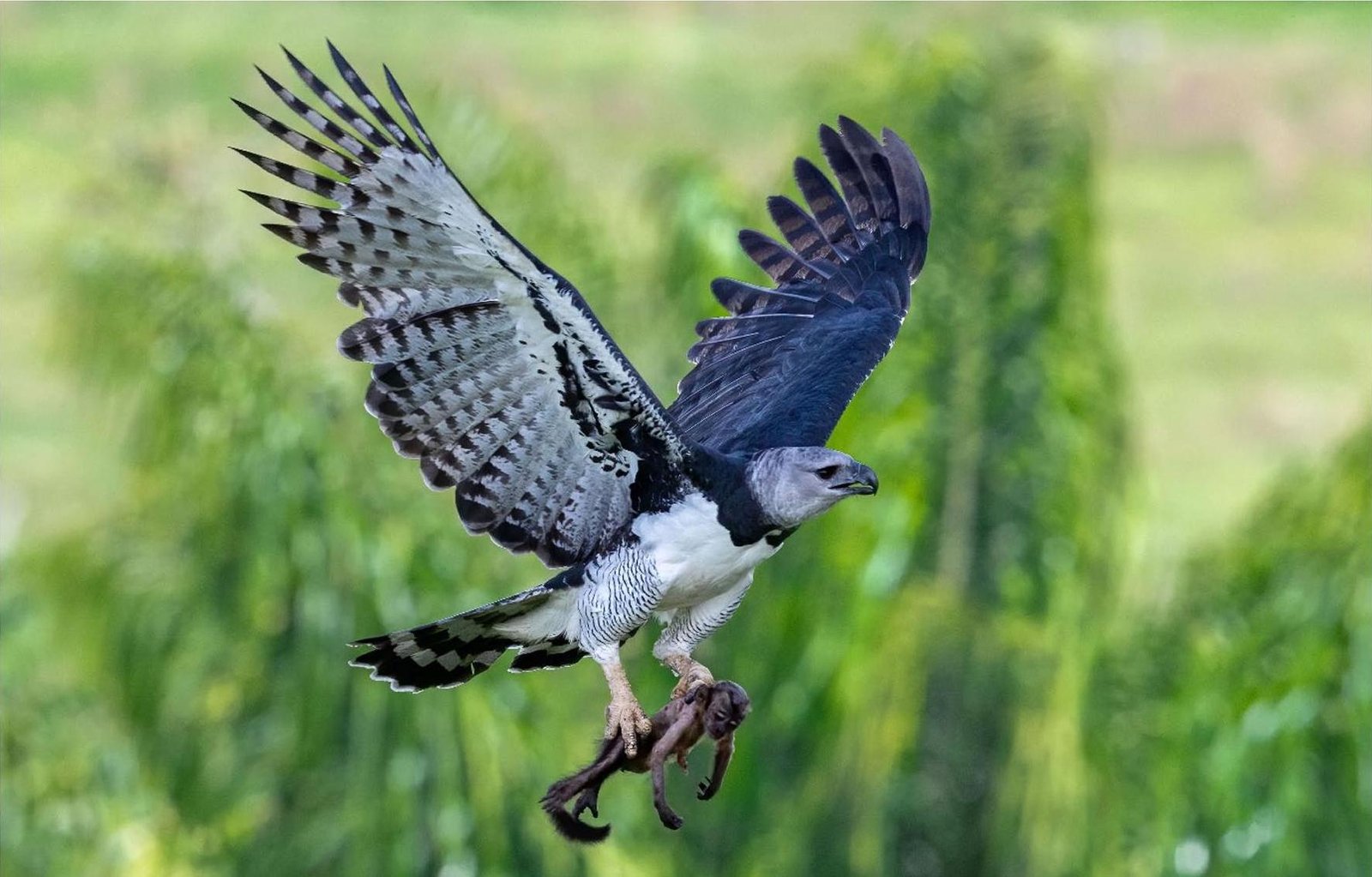
The Harpy Eagle is the heaviest raptor in the Americas and one of the largest eagles in the world. With short, broad wings and huge talons it hunts sloths and monkeys in the rainforest canopy. A pair raises only one young every two to three years, so the species is hit hard by forest loss and hunting.
Voice
A long, weak, plaintive whistle, wheeeee-oo, mainly around the nest. Juveniles beg for long periods with high, squealing calls.
Recording: Felipe Arantes — CC BY-NC-SA 4.0 · xeno-canto
Identification
89–102 cm; the female is much larger and heavier than the male. The head and neck are pale grey, with a split, dark crest that is raised like a ruff when excited. The back, wings and a broad breast band are blackish, the rest of the underparts white, with finely black-barred thighs. The long tail is black with three grey bands. The legs are very thick and yellow, with huge talons. In flight the wings are short and broad, with barred flight feathers. Juveniles are much paler: white head and underparts, pale grey upperparts and a finely barred tail; adult plumage is reached only after four years or more.
Confusion species
Crested Eagle Morphnus guianensis is smaller and slimmer, with a single pointed crest, a longer tail and much thinner legs; adults of the pale morph lack the black breast band. Juveniles of the two species are very similar; then check the thickness of the legs and the shape of the crest. Black-and-white Hawk-Eagle Spizaetus melanoleucus is much smaller, with a white head, a short crest and a black back.
Habitat
Extensive, tall lowland rainforest, also várzea and riverine forest, mostly below 900 m, sometimes higher in the foothills. It hunts from a perch in the canopy and flies with agility between the trees; the main prey are sloths and monkeys, also coatis, porcupines, macaws and curassows. The nest is a large stick platform in the fork of an emergent tree, often a kapok or Brazil nut tree; a single egg is laid and the young remains dependent on its parents for more than a year.
Where the bird is most at home, classified by the vegetation units of the Andes and the west coast.


Range and movements
In Colombia in Amazonia, the Pacific lowlands and locally in the north. In Ecuador mainly in the eastern lowlands, now very rare in the west. In Peru in Amazonia. In Bolivia in the northern and eastern lowlands. Scarce everywhere. Outside the guide area from southern Mexico to north-eastern Argentina.
- Resident
- dark = core range, pale = thinly spread
How and when to look
The best chance is a known nest, often used for years in succession; local guides and Amazonian lodges know such sites. Elsewhere it is sometimes seen from a canopy tower, perched on a bare branch above the canopy.
Conservation status
Vulnerable. The species needs very large tracts of continuous forest, reproduces slowly and is threatened by deforestation and by hunting, partly out of fear of losses of livestock and pets.
Scientific name
Harpia harpyja | (Linnaeus, 1758)
Linnaeus described the species in 1758 as Vultur Harpyja; because it was later moved to another genus, the author and year stand in brackets. The genus Harpia was introduced in 1816 by Vieillot. The genus name comes from Greek harpuia, the harpy of Greek mythology. The species name comes from Greek harpuia, the harpy of Greek mythology. The specimen the first description was based on came from Mexico.