All species › Birds of prey › Kites, Old World vultures, eagles and hawks › Crested Eagle
Crested Eagle | Morphnus guianensis
Wurgarend | Águila crestada | Uiraçu
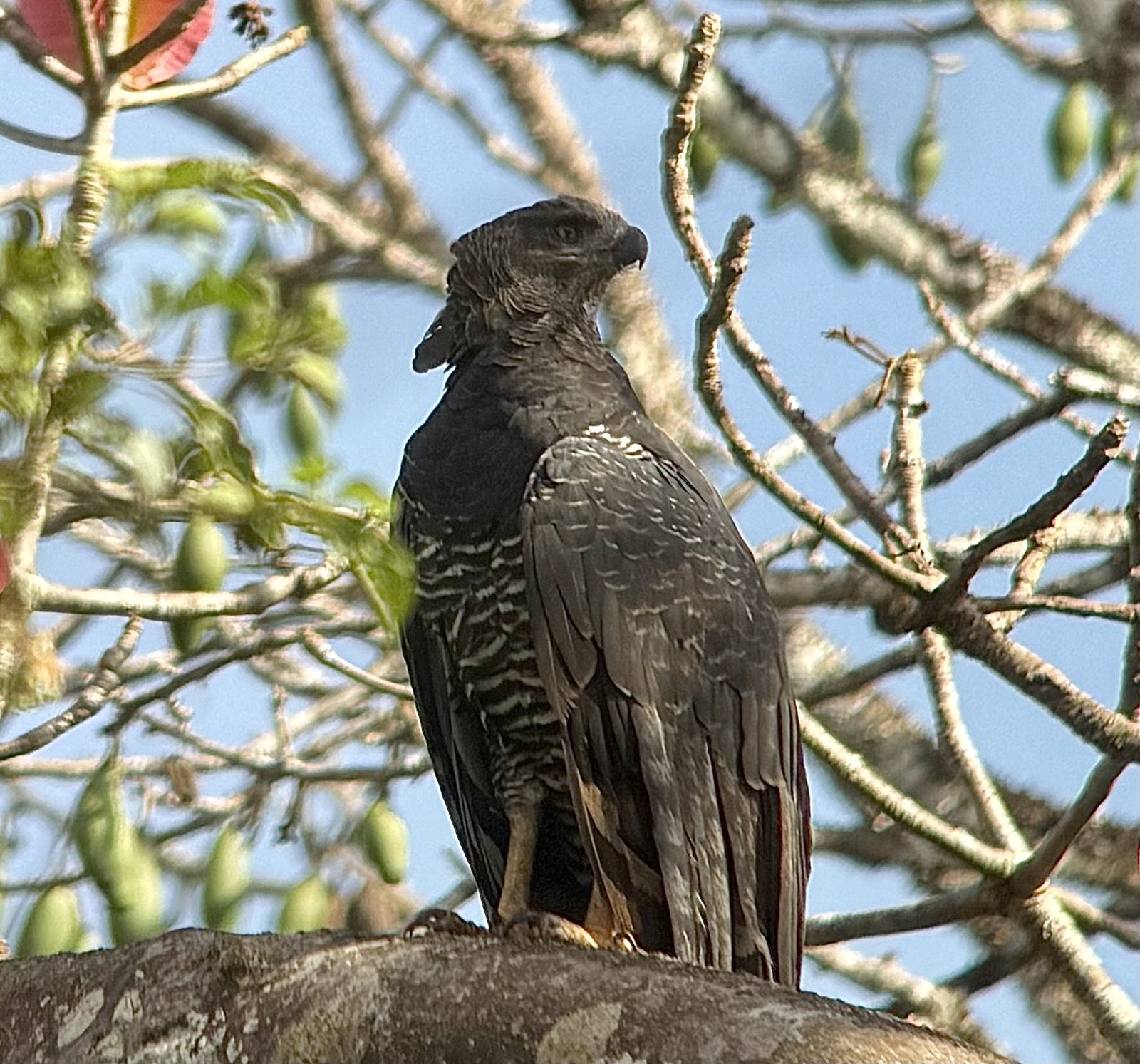
The Crested Eagle is a large, slender forest eagle of lowland rainforest that resembles a smaller Harpy Eagle. It is much rarer than its large relative and little studied. It hunts smaller mammals, birds and reptiles in and below the canopy.
Voice
A high, drawn-out whistle, often in two parts, wheeee-wheeoo; softer calls around the nest.
Recording: Fabrice Schmitt — CC BY-NC-SA 4.0 · xeno-canto
Identification
79–89 cm, with fairly short, broad wings and a long tail. The pale morph has a pale grey head and breast with a single pointed, dark crest, a white or finely rufous-barred belly, blackish back and wings, and a blackish tail with grey bands. The rarer dark morph is dark grey with a black-and-white barred belly. The legs are yellow and much thinner than in Harpy Eagle. Juveniles have a white head and underparts, pale grey upperparts and a barred tail.
Confusion species
Harpy Eagle Harpia harpyja is larger and heavier, with a split crest, a black breast band and very thick legs. Juvenile Ornate Hawk-Eagles Spizaetus ornatus are smaller, with legs feathered to the toes and barred flanks. Black-and-white Hawk-Eagle Spizaetus melanoleucus is smaller, with a white head, a short crest, black lores and an orange cere. Black Hawk-Eagle Spizaetus tyrannus resembles the dark morph, but is blacker, with a streaked head and feathered legs.
Habitat
Tall humid lowland rainforest, especially terra firme, also várzea and gallery forest, mostly below 600 m, locally up to about 1200 m in the foothills. It hunts from a perch in the canopy, taking mammals such as opossums, kinkajous and small monkeys, birds, and snakes and lizards. The nest is a large stick nest high in an emergent tree; a single egg is laid.
Where the bird is most at home, classified by the vegetation units of the Andes and the west coast.


Range and movements
In Colombia in Amazonia, locally in the Pacific lowlands and in the north. In Ecuador in the eastern lowlands, very rare in the west. In Peru in Amazonia. In Bolivia in the northern and eastern lowlands. Rare everywhere. Outside the guide area from Guatemala to north-eastern Argentina.
- Resident
- dark = core range, pale = thinly spread
How and when to look
Watch from Amazonian canopy towers in the late morning, when it sometimes circles briefly above the canopy; known nests offer the best chance.
Conservation status
Near Threatened. The species lives at low densities, needs large forest tracts and is declining through deforestation; hunting also plays a role locally.
Scientific name
Morphnus guianensis | (Daudin, 1800)
Daudin described the species in 1800 as Falco guianensis; because it was later moved to another genus, the author and year stand in brackets. The genus Morphnus was introduced in 1816 by Dumont. The genus name comes from Greek morphnos, 'dusky', the name of a dark eagle in Homer. The species name refers to the Guianas, not necessarily the type locality. The specimen the first description was based on came from Cayenne, French Guiana.