All species › Birds of prey › Kites, Old World vultures, eagles and hawks › Grey-bellied Hawk
Grey-bellied Hawk | Accipiter poliogaster
Zuid-Amerikaanse havik | Azor ventrigrís | Tauató-pintado
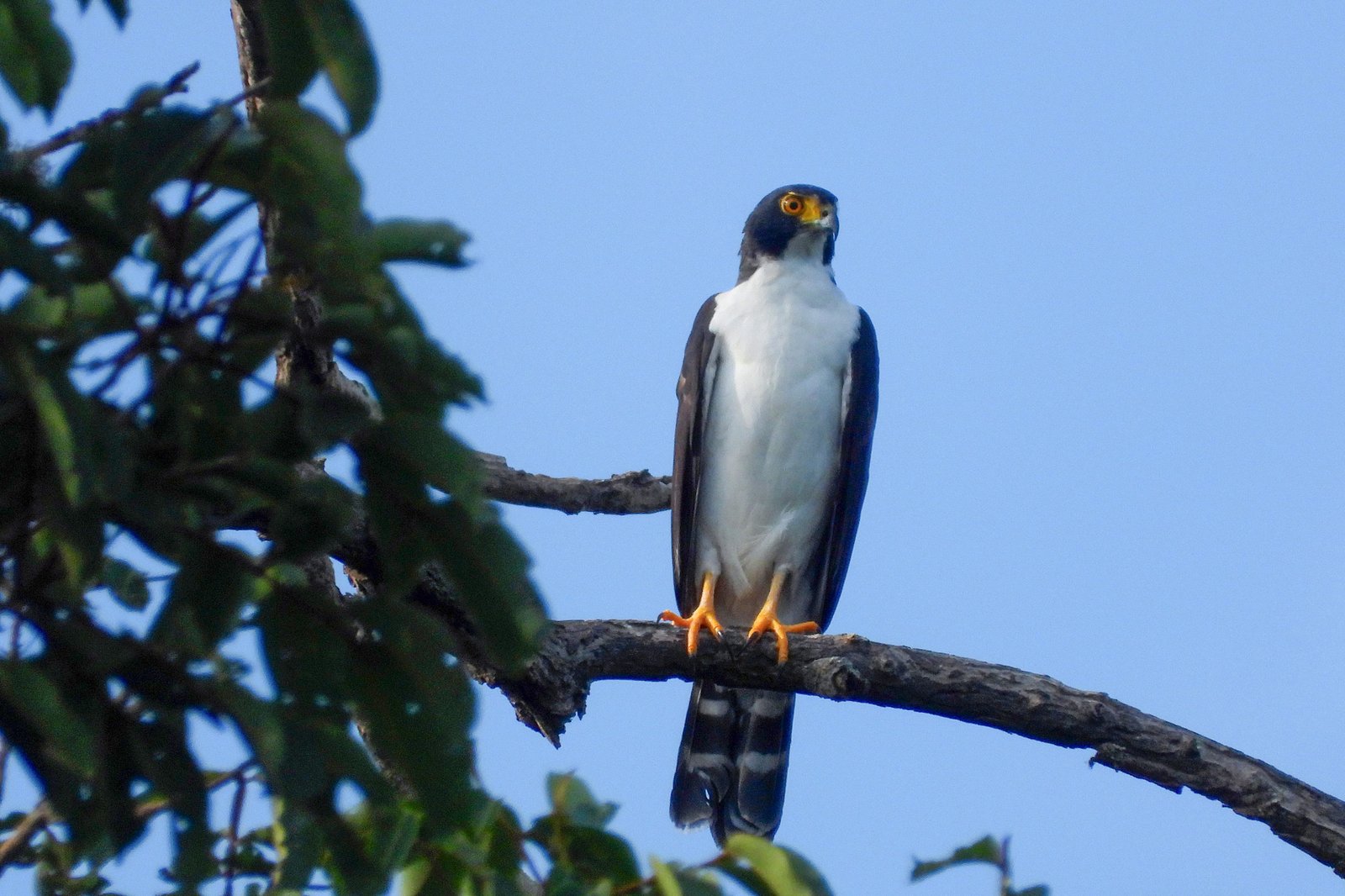
The Grey-bellied Hawk is a large, rare hawk of lowland rainforest that is seldom seen and poorly known. Its juvenile plumage closely resembles the adult plumage of Ornate Hawk-Eagle. There are indications that birds from the south move to Amazonia outside the breeding season.
Voice
Poorly known and seldom heard; gives series of short, cackling notes, like other large Accipiter hawks.
Recording: Willian Menq — CC BY-NC-SA 4.0 · xeno-canto
Identification
38–51 cm; the female is clearly larger than the male. Adults are dark slate grey above, with an almost black head, and white to pale grey below, sometimes with fine grey barring. The tail is dark with three narrow grey bands. The cere and legs are yellow. Juveniles have a black crown, rufous sides to the head and neck, a black malar stripe, a white throat, white underparts barred black and a brownish-black back.
Confusion species
Bicolored Hawk Astur bicolor is smaller, with rufous thighs and a less contrasting black head. Collared Forest Falcon Micrastur semitorquatus has a long, graduated tail with narrow white bands, a pale collar and a dark crescent behind the cheek. Adult Ornate Hawk-Eagle Spizaetus ornatus closely resembles juveniles, but is larger, has a crest and legs feathered to the toes.
Habitat
Tall humid lowland rainforest, also várzea and forest edge along rivers, mostly below 500 m, locally higher in the foothills. It hunts unobtrusively in the canopy and mid-storey, probably mainly on birds. Breeding has not been described in the guide area; known nests are from the south of the range.
Where the bird is most at home, classified by the vegetation units of the Andes and the west coast.


Range and movements
In Amazonian Colombia, Ecuador, Peru and Bolivia known from scattered records; rare and irregular everywhere. Outside the guide area from Venezuela and the Guianas to south-eastern Brazil, Paraguay and north-eastern Argentina, where the species breeds.
- Summer visitor (c. Apr–Sep)
- Winter visitor (c. Oct–Mar)
- Passage (Mar–Apr, Oct–Nov)
- dark = core range, pale = thinly spread
How and when to look
There is no reliable site; at canopy towers and along rivers in Amazonia watch for a large hawk with dark grey upperparts and contrasting white underparts.
Conservation status
Near Threatened. The species occurs at low densities and depends on forest; deforestation in Amazonia and in the Atlantic Forest is the main threat.
Scientific name
Accipiter poliogaster | (Temminck, 1824)
Temminck described the species in 1824 as Falco poliogaster; because it was later moved to another genus, the author and year stand in brackets. The genus Accipiter was introduced in 1760 by Brisson. The genus name is Latin accipiter, 'hawk', from accipere, 'to grasp'. The species name comes from Greek polios, 'grey', and gastēr, 'belly'. The specimen the first description was based on came from Ipanema, São Paulo, Brazil.