All species › Birds of prey › Kites, Old World vultures, eagles and hawks › Sharp-shinned Hawk
Sharp-shinned Hawk | Accipiter striatus
Amerikaanse sperwer | Gavilán americano | Tauató-miúdo
The Sharp-shinned Hawk is a small, fast hawk that in the Andes lives in montane forest, forest edges and semi-open country with copses. The birds in the guide area belong to the Andean form, sometimes treated as a separate species, Plain-breasted Hawk (Accipiter ventralis), and are highly variable in colour. It hunts small birds with fast attacks from cover.
Voice
A fast, high series, kee-kee-kee-kee or kek-kek-kek, mainly around the nest.
Recording: Pedro Rinaldi — CC BY-NC-SA 4.0 · xeno-canto
Identification
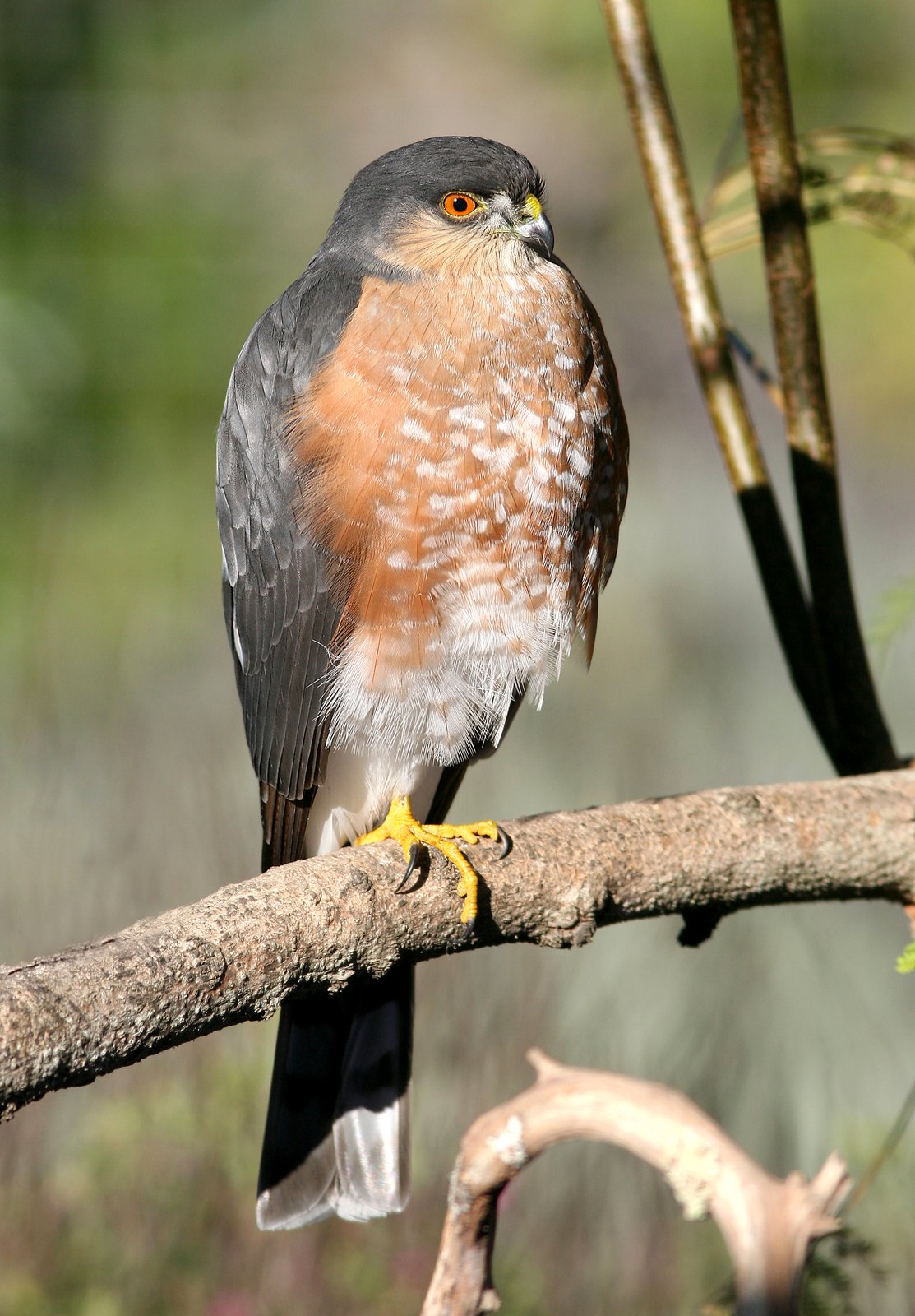
25–33 cm, with short, rounded wings and a long, square-tipped tail; the female is clearly larger than the male. Adults are dark slate grey above. The underparts vary greatly: white with rufous barring, plain rufous on the breast, or almost unmarked pale grey to white; there is also an all-dark morph. The thighs are rufous in all forms. The tail has three or four dark bands. Eye, cere and legs are yellow. Juveniles are brown above and white to cream below with brown streaks or spots.
Confusion species
Bicolored Hawk Astur bicolor is larger, with plain grey underparts, rufous thighs and a rounded tail. Semicollared Hawk Microspizias collaris is smaller and densely barred brown below, with dark cheeks and a pale half-collar. Tiny Hawk Microspizias superciliosus is smaller, finely barred grey below, lacks rufous thighs and lives mainly in the lowlands. Barred Forest Falcon Micrastur ruficollis has bare yellow facial skin, a longer tail with narrow white bands and finely barred grey underparts. Roadside Hawk Rupornis magnirostris is bulkier, with broader wings and a slower flight.
Habitat
Montane forest, cloud forest, forest edges, secondary growth, eucalyptus and pine plantations, coffee plantations and semi-open country with copses, mostly between about 1000 and 3500 m, also in villages with trees. It hunts small birds with fast attacks from cover and low over the vegetation, sometimes large insects and small mammals. The nest is a stick nest in a dense tree crown.
Where the bird is most at home, classified by the vegetation units of the Andes and the west coast.


Range and movements
In Colombia, Ecuador and Peru in the Andes, on both slopes and in the inter-Andean valleys. In Bolivia in the Andes and the Yungas. Absent from the Amazonian lowlands and the Galápagos. Outside the guide area in the Andes of Venezuela; other forms live in North and Central America, the Greater Antilles and from southern Brazil to northern Argentina.
- Resident
- dark = core range, pale = thinly spread
How and when to look
In the Andes watch for a small raptor dashing low along forest edges and over clearings, or circling on thermals in the late morning, with short, rounded wings and a long, narrow tail.
Conservation status
Least Concern. The species tolerates a varied landscape with copses and plantations.
Scientific name
Accipiter striatus | Vieillot, 1808
Vieillot described the species in 1808 and placed it straight away in the genus where it still stands. The genus Accipiter was introduced in 1760 by Brisson. The genus name is Latin accipiter, 'hawk', from accipere, 'to grasp'. The species name is Latin striatus, 'striped'. The specimen the first description was based on came from Santo Domingo (Hispaniola).