All species › Birds of prey › Kites, Old World vultures, eagles and hawks › Bicolored Hawk
Bicolored Hawk | Astur bicolor
Tweekleurige havik | Gavilán bicolor | Gavião-bombachinha-grande
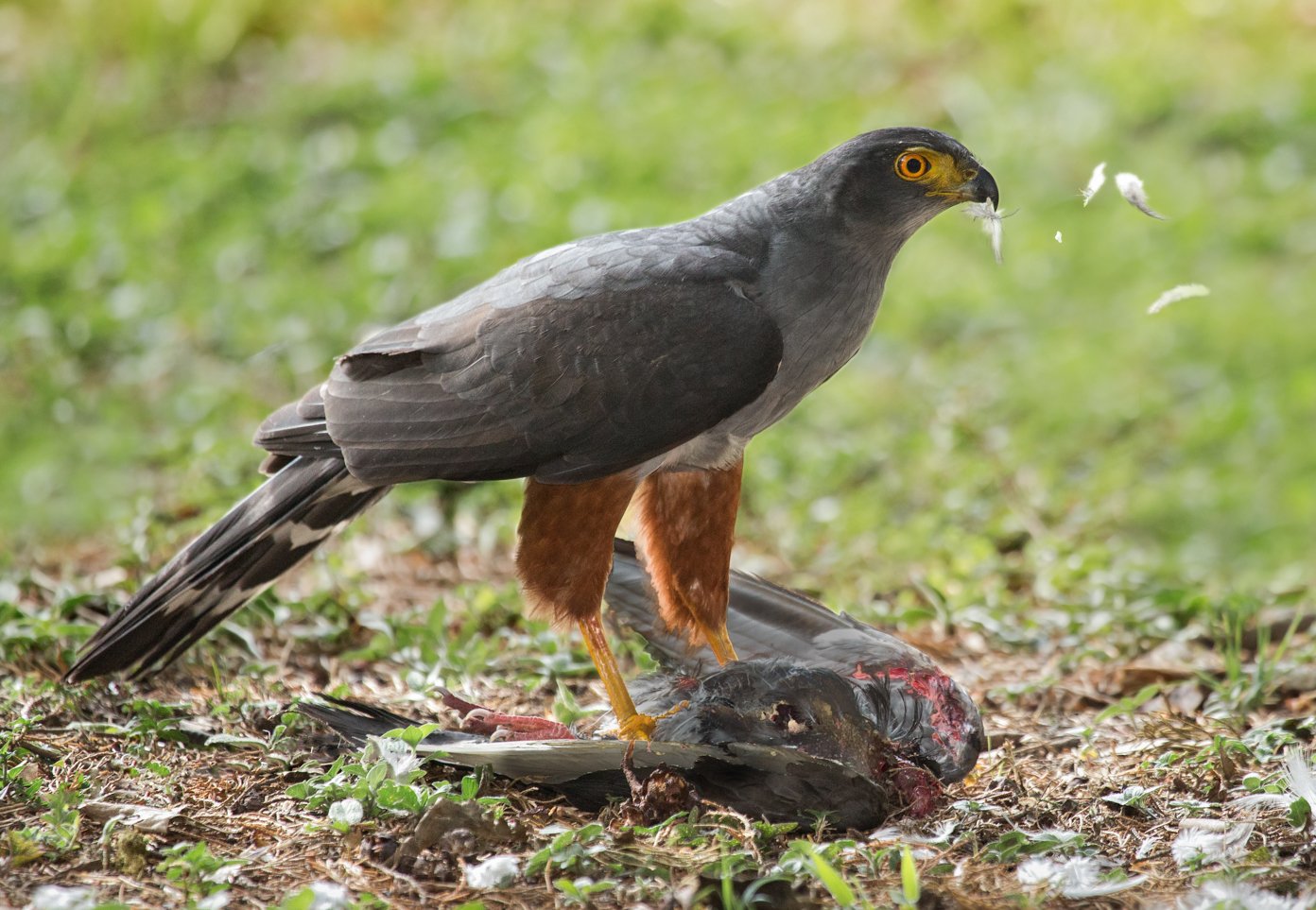
The Bicolored Hawk is a medium-sized forest hawk with dark grey upperparts, plain grey underparts and conspicuous rufous thighs. It lives unobtrusively in the forest mid-storey and is usually noticed only when it flies fast between the trees. It occurs from the lowlands into the lower montane forest.
Voice
A hoarse, repeated kek-kek-kek-kek, mainly around the nest; otherwise seldom heard.
No recording with a suitable Creative Commons licence is available for this species yet.
Identification
33–44 cm, with short, rounded wings and a long, rounded tail; the female is much larger than the male. Adults are dark slate grey above, with a blackish crown, and plain pale grey below, with bright rufous thighs. The tail is blackish with three narrow grey bands and a white tip. Eye orange to yellow, cere and legs yellow. Juveniles are highly variable: brown above, with a pale collar, and white to rufous below, often with dark spots; the thighs are rufous or barred.
Confusion species
Sharp-shinned Hawk Accipiter striatus is smaller, with a square-tipped tail and usually a barred or rufous breast. Grey-bellied Hawk Accipiter poliogaster is larger, with whiter underparts and no rufous thighs. Collared Forest Falcon Micrastur semitorquatus has a pale collar, a dark crescent behind the cheek and a long, graduated tail. Slaty-backed Forest Falcon Micrastur mirandollei is white below, with bare yellow facial skin and no rufous thighs.
Habitat
Humid and semi-humid forest, forest edges, gallery forest, secondary forest and well-wooded farmland, from the lowlands up to about 2500 m. It hunts unobtrusively in the mid-storey and below the canopy, mainly on birds up to the size of doves, sometimes lizards and small mammals. The nest is a stick nest high in a tree.
Where the bird is most at home, classified by the vegetation units of the Andes and the west coast.


Range and movements
In Colombia widespread in the lowlands and on the mountain slopes. In Ecuador in the west and the east. In Peru in Amazonia, along the east slope of the Andes and locally in the north-west. In Bolivia in the lowlands and the Yungas. Scarce everywhere. Outside the guide area from Mexico to northern Argentina.
- Resident
- dark = core range, pale = thinly spread
How and when to look
At forest edges and clearings watch for a hawk dashing low and fast between the trees; on a perched bird the rufous thighs are the best feature.
Conservation status
Not Evaluated in the current circumscription of the species; as a whole widespread, but scarce everywhere and dependent on forest.
Scientific name
Astur bicolor | (Vieillot, 1817)
Vieillot described the species in 1817 as Sparvius bicolor; because it was later moved to another genus, the author and year stand in brackets. The genus Astur was introduced in 1799 by De Lacépède. The genus name comes from Latin astur, 'hawk'. Lacépède erected the genus in 1799. The species name is Latin bicolor, 'two-coloured'. The specimen the first description was based on came from Cayenne, French Guiana.