All species › Birds of prey › Kites, Old World vultures, eagles and hawks › Northern Harrier
Northern Harrier | Circus hudsonius
Amerikaanse blauwe kiekendief | Aguilucho norteamericano | Gavião-do-banhado-norte-americano
The Northern Harrier is the North American counterpart of the Hen Harrier of Europe and Asia. It hunts in a low, tilting glide over open grassland and marsh, with the wings held in a shallow V. In the guide area it is a rare winter visitor, mainly in the north.
Voice
Almost silent in the wintering area; when disturbed sometimes a rapid kek-kek-kek.
Recording: Phoebe Barnes — CC BY-NC-SA 4.0 · xeno-canto
Identification
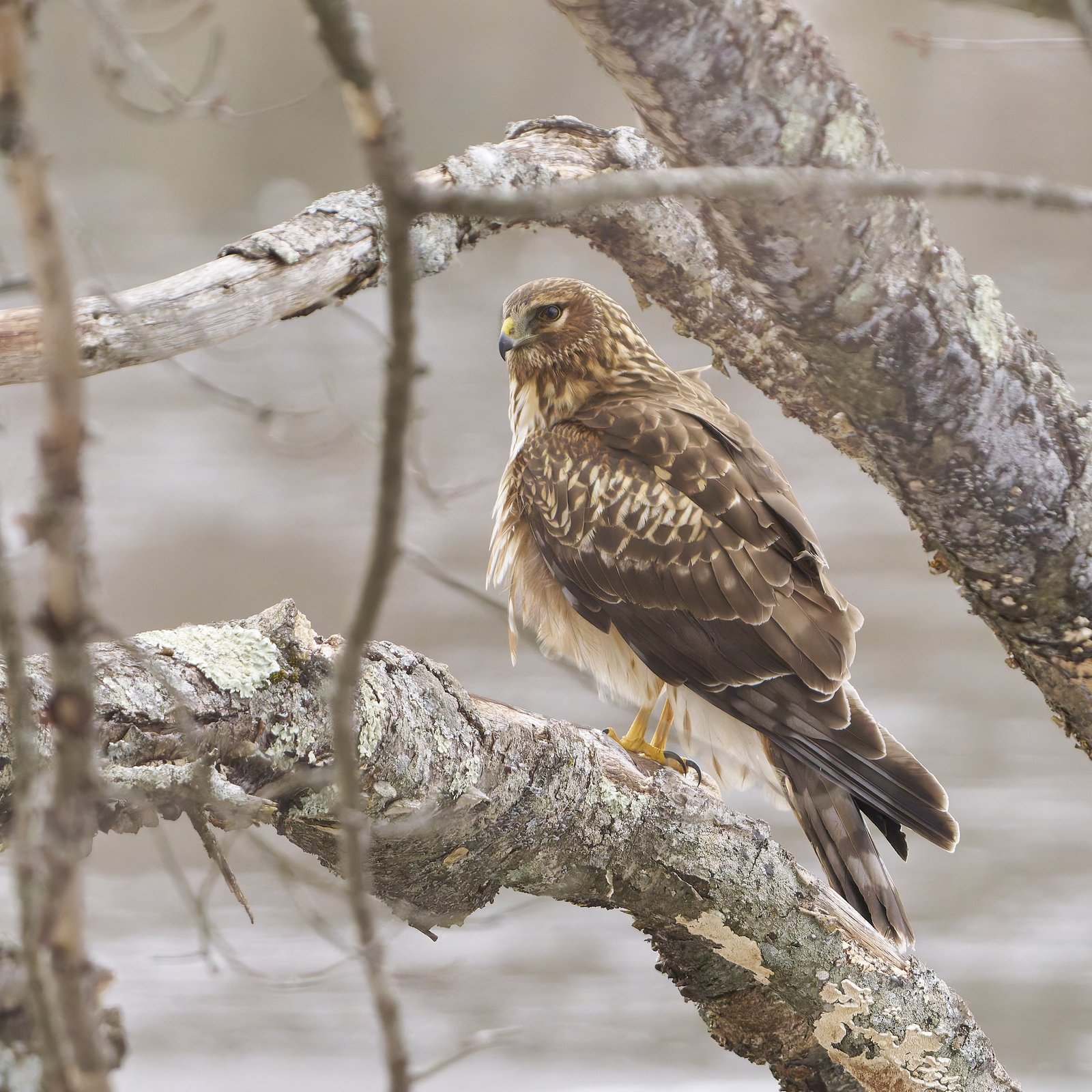
41–50 cm, slender, with long, narrow wings, a long tail and a white rump; an owl-like facial disc helps it hear prey. The male is pale grey above and white with fine rusty spots below, with black wingtips and a dark trailing edge to the wing. The female is larger, brown above and cream with brown streaks below. Juveniles resemble the female, but have almost unstreaked, warm orange-brown underparts.
Confusion species
Cinereous Harrier Circus cinereus is smaller; the male has a rufous-barred belly and the female rufous-barred underparts; it lives mainly in the Andes. Long-winged Harrier Circus buffoni is larger, with longer wings, a smaller white rump and pale and dark morphs; it lives in lowland marshes. Crane Hawk Geranospiza caerulescens is plain slate grey, with long orange legs and a white band across the primaries.
Habitat
Open grassland, marshes, rice fields, wet meadows and salt marshes, mainly in the lowlands, sometimes on the Andean high plateaus. It hunts low over the vegetation for rodents and small birds and roosts on the ground in tall grass, sometimes with several birds together.
Where the bird is most at home, classified by the vegetation units of the Andes and the west coast.


Range and movements
In Colombia a rare winter visitor, mainly in the north and on the Andean high plateaus. In Ecuador and Peru only a few records; not or scarcely recorded in Bolivia and the Galápagos. It breeds in Canada and the United States and winters south to Central America and northern South America.
- Winter visitor (c. Oct–Mar)
- dark = core range, pale = thinly spread
How and when to look
Search between October and March over extensive wet grasslands and rice fields in northern Colombia; on every harrier check the white rump and the pattern of the underparts.
Conservation status
Least Concern. In parts of North America the population is declining through loss of grassland and marshes.
Scientific name
Circus hudsonius | (Linnaeus, 1766) (GBIF: Circus cyaneus)
Linnaeus described the species in 1766 as Falco hudsonius; because it was later moved to another genus, the author and year stand in brackets. The genus Circus was introduced in 1799 by De Lacépède. The genus name comes from Greek kirkos, a bird of prey named for its circling flight. The species name refers to Hudson Bay in Canada, not necessarily the type locality. The specimen the first description was based on came from Hudson Bay, Canada.