All species › Birds of prey › Kites, Old World vultures, eagles and hawks › Cinereous Harrier
Cinereous Harrier | Circus cinereus
Grijze kiekendief | Gavilán ceniciento | Gavião-cinza
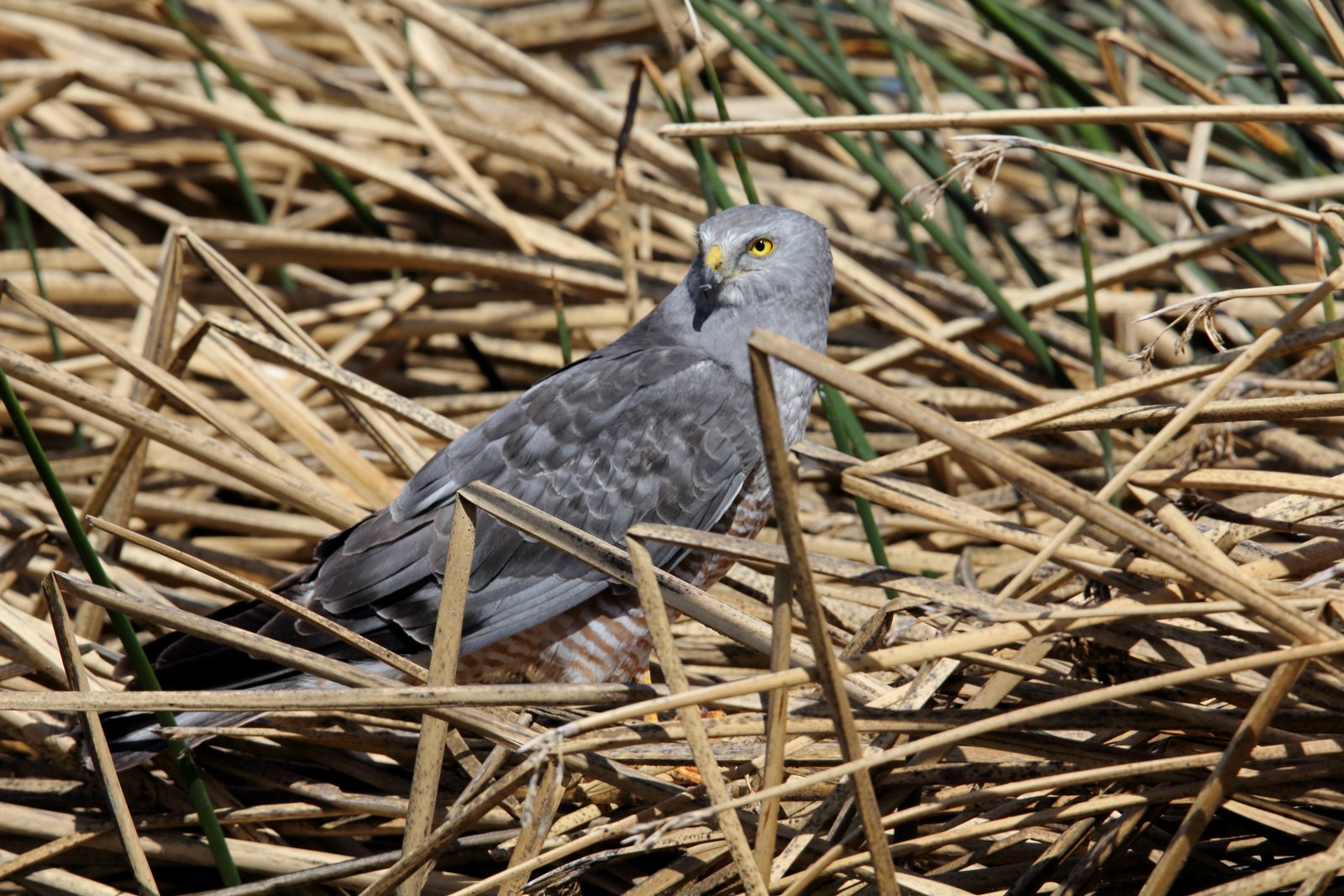
The Cinereous Harrier is the harrier of the high Andes. It flies low and tilting over páramo, puna and marshes, with its wings held in a shallow V, scanning the ground for prey. The male is mostly grey, the female brown; both have a white rump.
Voice
Usually silent. At the nest a rapid, shrill kek-kek-kek and high, squeaky whistles.
Recording: Bernabe Lopez-Lanus — CC BY-NC-SA 3.0 · xeno-canto
Identification
40–50 cm; the female is larger than the male. Slender, with long, narrow wings, a long tail and an owl-like facial disc. The male is dark bluish grey on the head, breast and upperparts, with a white rump; the belly is white with fine rufous barring. In flight the wingtips are black and the grey tail has dark bands. The female is dark brown above, with a white rump, a strongly banded tail and creamy underparts with streaks on the breast and rufous barring on the belly. Juveniles resemble the female but are buff below with coarse dark streaks instead of barring.
Confusion species
Long-winged Harrier Circus buffoni is larger, with longer wings, and lives mainly in the lowlands; the male has a blackish head and breast or is entirely dark, and lacks the rufous barring on the belly. In Northern Harrier Circus hudsonius, a rare winter visitor from North America, the male is much whiter below and juveniles are plain rusty below. Aplomado Falcon Falco femoralis hunts in the same open country but has pointed wings, a dark moustache and no white rump.
Habitat
Open, wet grassland in the high mountains: páramo, wet puna, bofedales, reedbeds and shores of Andean lakes, and fields and pastures in between; mainly between about 2500 and 4500 m. In Peru also in coastal marshes and reedbeds. It hunts in a low quartering flight for small mammals, birds, lizards and frogs. The nest is on the ground, hidden in tall grass or reeds.
Where the bird is most at home, classified by the vegetation units of the Andes and the west coast.


Range and movements
In Colombia rare and local in the Andes. In Ecuador in páramo and marshes along the Andes. In Peru widespread in the high Andes and locally on the coast. In Bolivia on the altiplano and in the high Andes; in the austral winter also in the eastern lowlands. Outside the guide area in Chile and Argentina to Tierra del Fuego and on the Falkland Islands, and in the austral winter north to Paraguay, Uruguay and southern Brazil.
- Resident
- dark = core range, pale = thinly spread
How and when to look
Search over wet puna and along the shores of Andean lakes such as Lake Titicaca and Lake Junín, and over páramo in Ecuador. Birds fly low and slowly over the grass, constantly tilting; the white rump is visible even at a distance.
Conservation status
Least Concern. Widespread, although habitat is lost locally through drainage and overgrazing of highland marshes.
Scientific name
Circus cinereus | Vieillot, 1816
Vieillot described the species in 1816 and placed it straight away in the genus where it still stands. The genus Circus was introduced in 1799 by De Lacépède. The genus name comes from Greek kirkos, a bird of prey named for its circling flight. The species name comes from Latin cinereus, 'ash-grey'. The specimen the first description was based on came from Paraguay.