All species › Birds of prey › Kites, Old World vultures, eagles and hawks › Long-winged Harrier
Long-winged Harrier | Circus buffoni
Buffons kiekendief | Gavilán planeador | Gavião-do-banhado
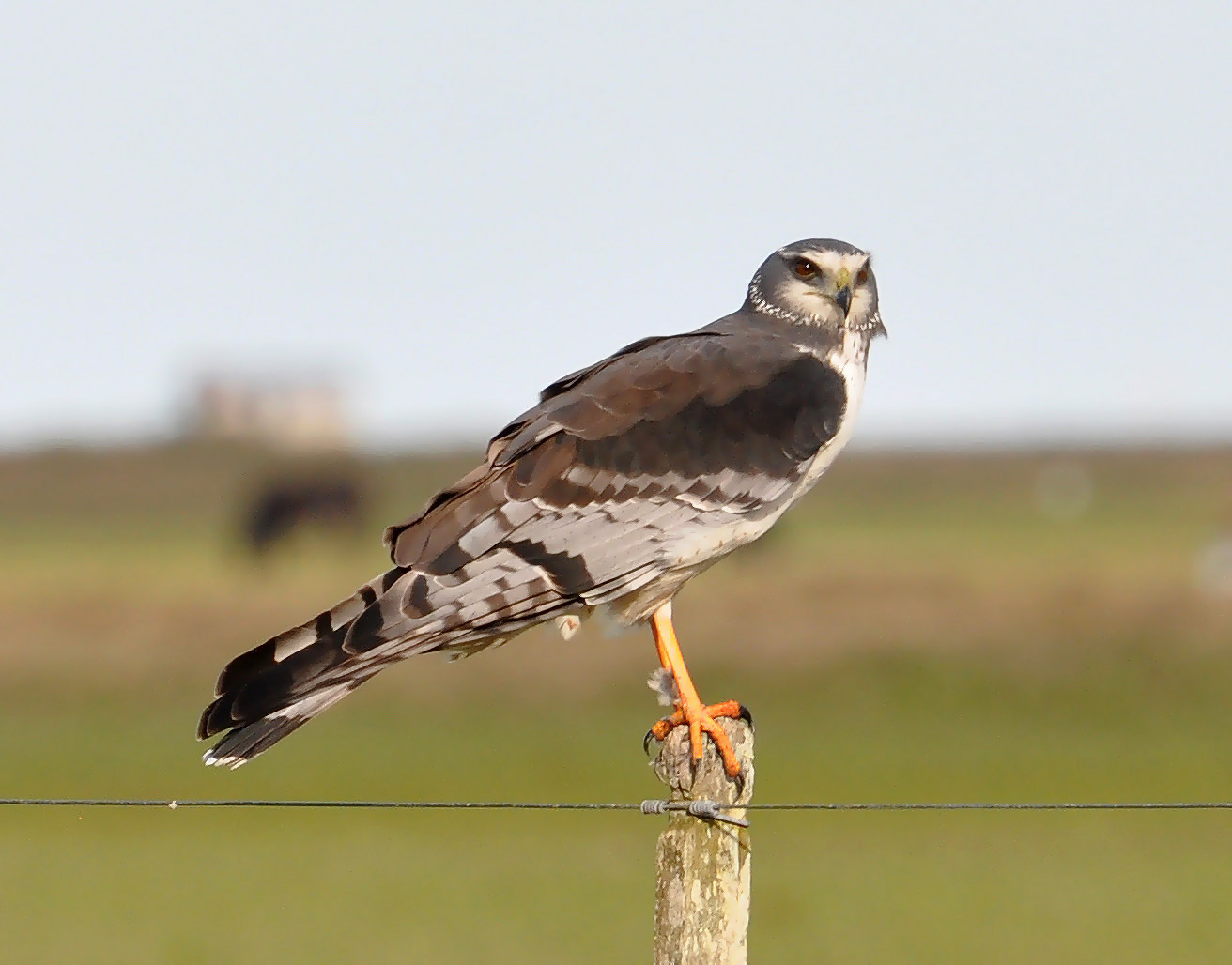
The Long-winged Harrier is the largest harrier in South America, with very long wings. It flies low over savannas, marshes and rice fields in the lowlands. There are a pale and a dark morph. In the guide area it is mainly a bird of the llanos and northern Colombia.
Voice
Usually silent. At the nest high whistles and a cackling kek-kek-kek.
Recording: Bernabe Lopez-Lanus — CC BY-NC-SA 3.0 · xeno-canto
Identification
46–58 cm; the female is larger than the male. Very long, narrow wings and a long tail. The pale-morph male has a blackish head, breast and upperparts, a white rim around the facial disc, a white belly and a white rump; from below the flight feathers are pale grey with dark bands and black tips, and the grey tail has dark bands. The female is browner above and has buff to white underparts with streaks on the breast. The dark morph is mostly blackish brown, with a white rump and pale, banded flight feathers. Juveniles are brown above and buff below with dark streaks.
Confusion species
Cinereous Harrier Circus cinereus is smaller, with shorter wings; the male is grey with a rufous-barred belly, and the species lives mainly high in the Andes. Northern Harrier Circus hudsonius is smaller, and the male is pale grey. Snail Kite Rostrhamus sociabilis also hunts over marshes and has a white tail base, but has broader wings, a thin, strongly hooked bill and a black terminal tail band.
Habitat
Open lowlands with water: wet savannas, marshes, reedbeds, floodplains, rice fields and other wet farmland; nearly always below about 500 m. It flies low over grass and reeds and takes small birds, rodents, frogs and reptiles. The nest is on the ground in dense marsh vegetation.
Where the bird is most at home, classified by the vegetation units of the Andes and the west coast.


Range and movements
In Colombia mainly in the llanos and the Caribbean lowlands, also in the Magdalena valley. In Ecuador rare and local, with records from marshes in the western lowlands. In Peru a rare visitor to the lowlands. In Bolivia locally in the savannas of the Beni and the east. Outside the guide area in Venezuela, the Guianas, Trinidad, eastern Brazil, Paraguay, Uruguay and northern Argentina.
- Resident
- dark = core range, pale = thinly spread
How and when to look
Search in the Colombian llanos over wet savannas and rice fields, especially in the wet season. Look for a large, slender raptor flying low and tilting over the reeds, with very long wings held in a shallow V.
Conservation status
Least Concern. Widespread, but sensitive to the drainage of marshes.
Scientific name
Circus buffoni | (Gmelin, 1788)
Gmelin described the species in 1788 as Falco Buffoni; because it was later moved to another genus, the author and year stand in brackets. The genus Circus was introduced in 1799 by De Lacépède. The genus name comes from Greek kirkos, a bird of prey named for its circling flight. The species name honours Georges-Louis Leclerc, comte de Buffon (1707–1788), French naturalist and author of the Histoire naturelle. The specimen the first description was based on came from northeastern Brazil.