All species › Birds of prey › Kites, Old World vultures, eagles and hawks › Double-toothed Kite
Double-toothed Kite | Harpagus bidentatus
Tandwouw | Gavilán bidentado | Gavião-ripina
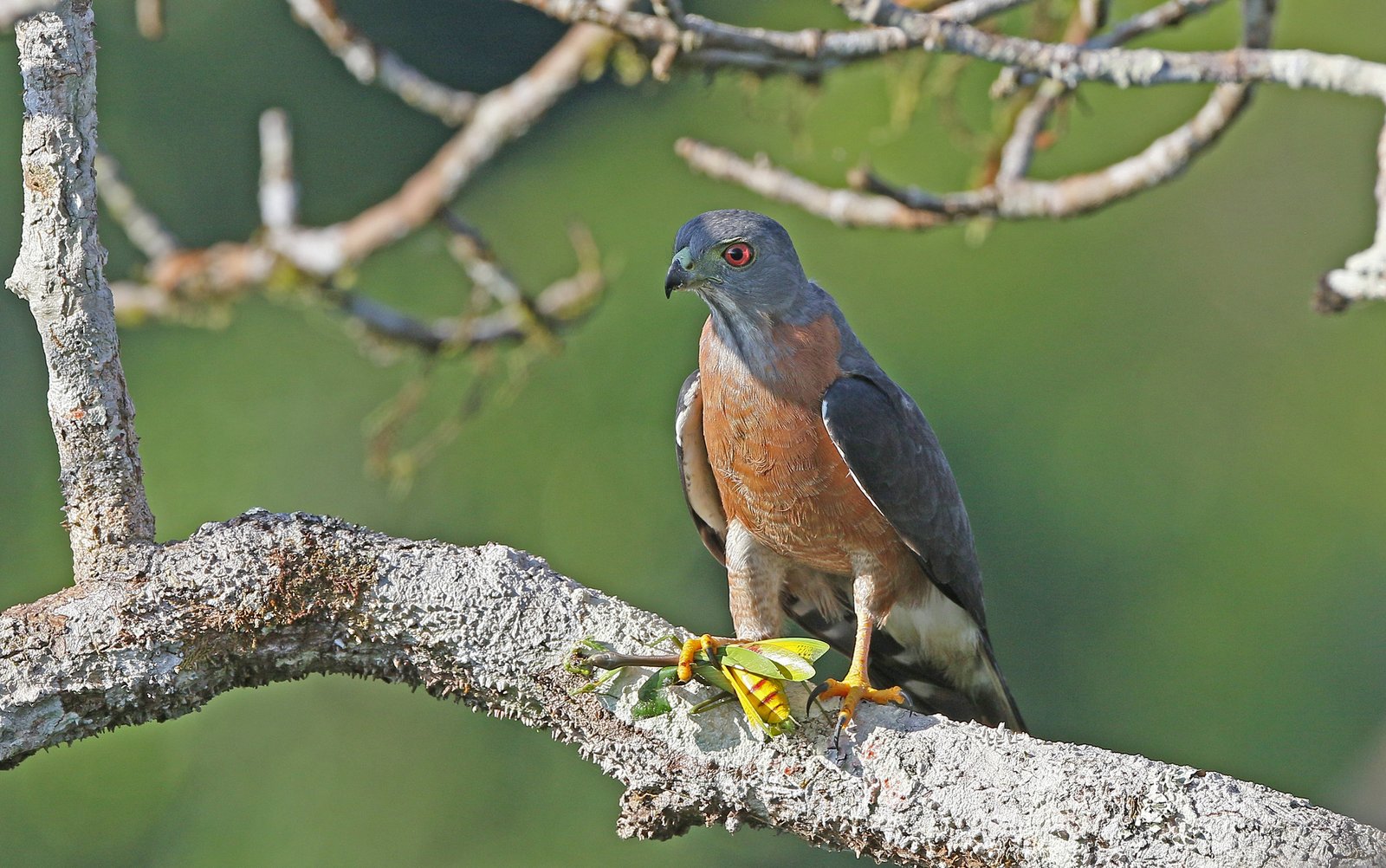
The Double-toothed Kite is a small forest raptor that resembles an accipiter with its striped throat and rufous breast. The name refers to the two notches on the edge of the upper mandible. It often follows troops of monkeys through the canopy and catches the insects and lizards they flush.
Voice
Usually silent. High, thin whistles, such as a repeated tsip-tsip followed by a drawn-out wheeeeoo.
Recording: Fernando Igor de Godoy — CC BY-NC-SA 4.0 · xeno-canto
Identification
30–35 cm; the female is slightly larger. Compact, with a short, hooked bill, red to orange eyes and a white throat with a black central stripe. The male has a slate-grey head and upperparts, a rufous breast and a belly barred rufous and grey; the female is more rufous below. The tail is dark with three narrow pale bands. In flight the fluffy white undertail coverts often show on either side of the tail, and the wings are rounded, with pale, banded flight feathers. Juveniles are brown above and white to buff below with dark streaks, but also have the throat stripe.
Confusion species
Bicolored Hawk Astur bicolor is larger, with grey underparts and rufous thighs, and lacks the black throat stripe. Tiny Hawk Microspizias superciliosus is smaller, finely barred below and has no throat stripe. Barred Forest Falcon Micrastur ruficollis has a longer tail, bare yellow skin around the eye and likewise no throat stripe. Semicollared Hawk Microspizias collaris has a pale collar and a dark cheek.
Habitat
Humid lowland and foothill forest, especially the canopy and forest edges, also tall secondary forest; up to about 1500 m, locally higher. It perches motionless for long periods on a branch in the canopy. It feeds mainly on large insects and lizards, often caught in the company of monkey troops; it occasionally takes small birds and bats. The nest is a shallow stick cup high in a tree.
Where the bird is most at home, classified by the vegetation units of the Andes and the west coast.


Range and movements
In Colombia in the humid lowlands west and east of the Andes, also in the Magdalena valley. In Ecuador in the western and eastern lowlands and in the Andean foothills. In Peru in the Amazonian lowlands and on the lower east slope of the Andes. In Bolivia in the northern and eastern lowlands up to the base of the Andes. Outside the guide area from southern Mexico to Venezuela, the Guianas and Amazonian Brazil, and in the Atlantic Forest of eastern Brazil.
- Resident
- dark = core range, pale = thinly spread
How and when to look
With monkey troops, especially squirrel monkeys and capuchins, watch for a small raptor quietly following through the canopy. In late morning it sometimes soars briefly over the forest, with the white undertail coverts showing on either side of the tail.
Conservation status
Least Concern. Widespread, but dependent on forest and therefore locally declining through deforestation.
Scientific name
Harpagus bidentatus | (Latham, 1790)
Latham described the species in 1790 as Falco bidentatus; because it was later moved to another genus, the author and year stand in brackets. The genus Harpagus was introduced in 1824 by Vigors. The genus name comes from Latin harpago, 'rapacious person, harpy', from Greek harpazō, 'to seize or carry off by violence'. Harpagus is also the name of a Persian general of the 6th century BC. The species name comes from Latin bi-, 'two', and dentatus, 'toothed', for the two teeth on the upper mandible. The specimen the first description was based on came from Cayenne, French Guiana.