All species › Passerines › Antbirds › Black Antshrike
Black Antshrike | Thamnophilus nigriceps
Zwarte mierklauwier | Batará negro | Choca-negra
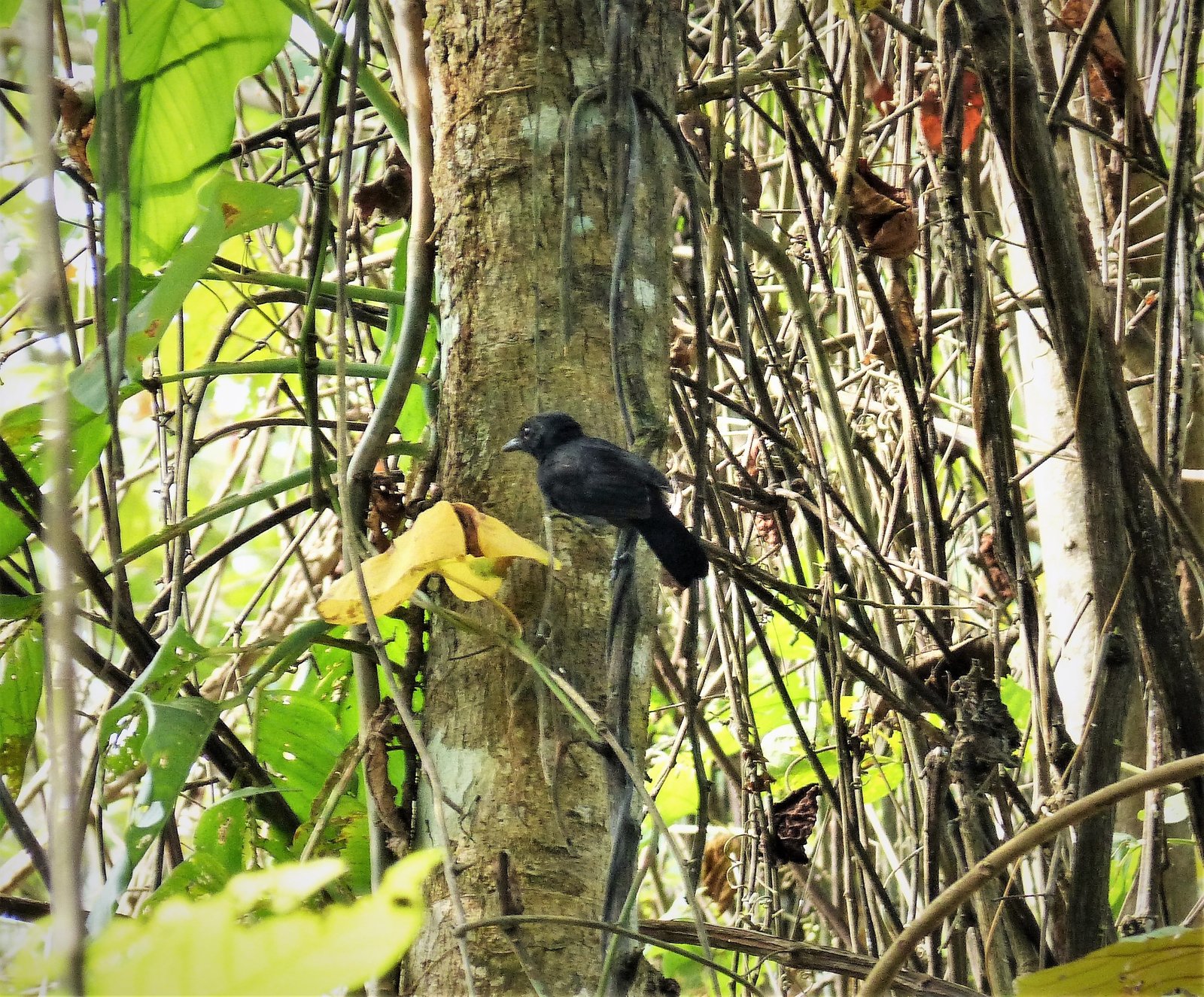
The Black Antshrike is an antshrike of the lowlands of northern Colombia and eastern Panama. The male is almost entirely black; the female has a black-and-white streaked head and breast and a rufous back. It keeps hidden in dense tangles of vines and scrub along forest edges.
Voice
A fairly long, slightly accelerating series of musical yet emphatic notes on an even pitch. Also a hollow, nasal call that is sometimes repeated, and a nasal growl.
Recording: Ross Gallardy — CC BY-NC-SA 4.0 · xeno-canto
Identification
15–16 cm, with a heavy, hooked bill. The male is almost entirely black, with dark grey flanks; the underwing coverts and the inner edges of the flight feathers are white, seen mainly in flight. The female has a blackish-grey head and upper breast with buffy-white streaks, rufous-brown upperparts, wings and tail, a grey lower breast and belly streaked buffy white, and plain buff undertail coverts.
Confusion species
Black-crowned Antshrike Thamnophilus atrinucha has a slate-grey male with white wing spots and a brown, unstreaked female. Barred Antshrike Thamnophilus doliatus has a black-and-white barred male and a cinnamon female. Black-crested Antshrike Sakesphorus canadensis has a crest and a white or grey belly. Jet Antbird Cercomacra nigricans is slimmer, with white wing spots and a white tail tip.
Habitat
Edges and overgrown clearings of evergreen forest, secondary forest and semi-open woodland, favouring dense tangles of vines, thorny shrubs and Heliconia, from sea level to about 600 m. It forages alone or in pairs, rarely with mixed flocks, mostly within 2 m of the ground, gleaning insects from leaves and twigs. Nothing is known about the nest.
Where the bird is most at home, classified by the vegetation units of the Andes and the west coast.


Range and movements
Colombia: in the north, from northern Chocó east through the Caribbean lowlands to western La Guajira (not in the Sierra Nevada de Santa Marta), and south through the Magdalena valley to Tolima. Absent from Ecuador, Peru, Bolivia and the Galápagos. Outside the guide area only in eastern Panama.
- Resident
- dark = core range, pale = thinly spread
How and when to look
Search dense, vine-covered thickets along forest edges in the middle Magdalena valley and the Caribbean lowlands. The bird mostly stays low in cover and gives itself away by its song.
Conservation status
Least Concern. Much of the range has been deforested, but the species lives precisely in secondary growth and forest edges.
Scientific name
Thamnophilus nigriceps | Sclater, 1869
Sclater described the species in 1869 and placed it straight away in the genus where it still stands. The genus Thamnophilus was introduced in 1816 by Vieillot. The genus name comes from Greek thamnos, 'bush', and philos, 'loving': bush-lover. The species name comes from Latin niger, 'black', and -ceps, 'headed'. The specimen the first description was based on came from Barranquilla, Colombia.