All species › Passerines › Antbirds › Cocha Antshrike
Cocha Antshrike | Thamnophilus praecox
Cochamierklauwier | Batará de Cocha | Choca-de-cocha
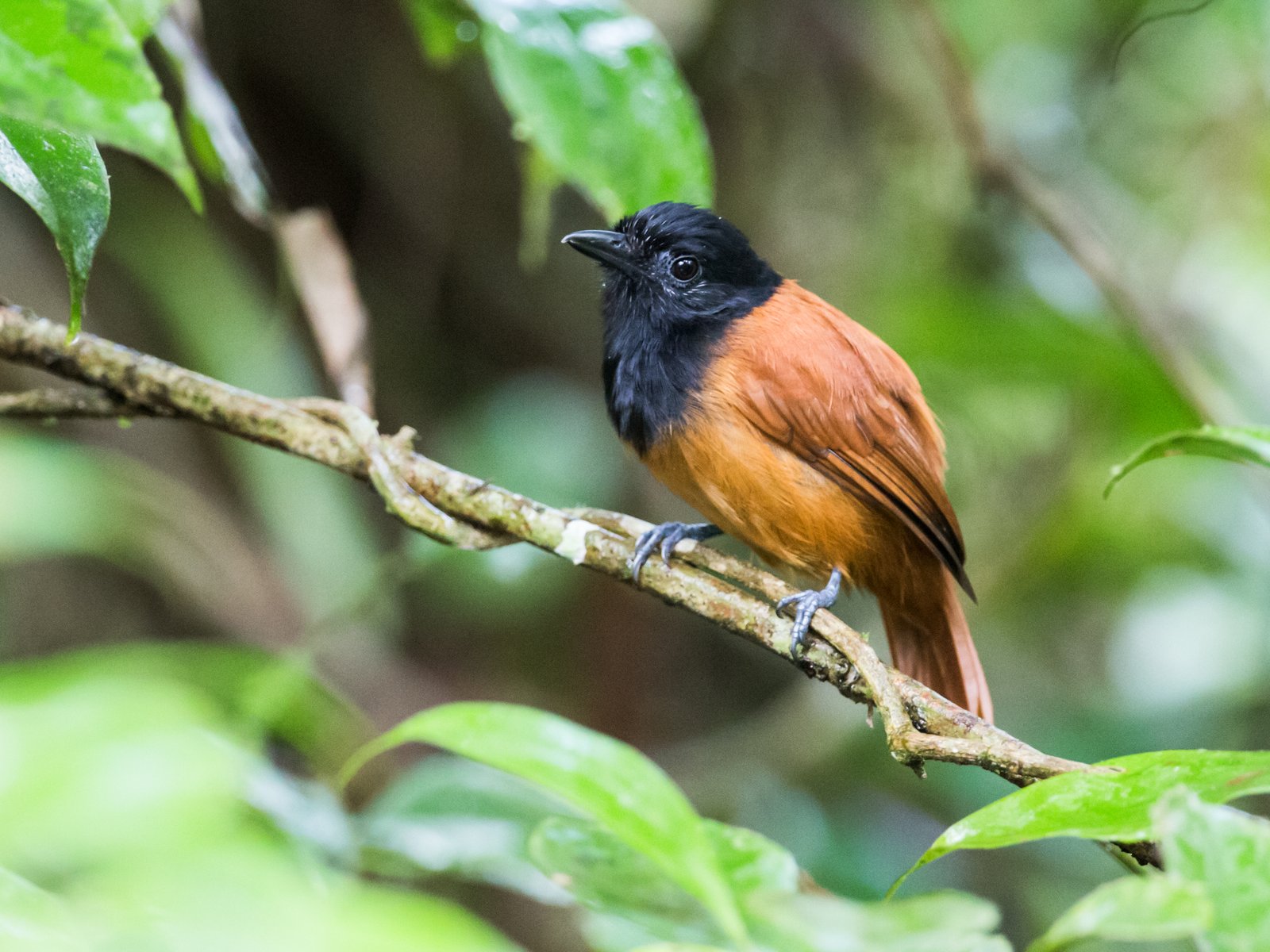
The Cocha Antshrike is an antshrike of flooded blackwater forest in north-western Amazonia. The species was described in 1937 from a single specimen and was found again only in 1990, close to where that specimen had been collected. With her black head and cinnamon-rufous body, the female differs from all her relatives.
Voice
A hollow, evenly paced series of ko notes, sometimes followed by a shorter, higher version. Also a mellow pwow-pwow and a rolling trill.
Recording: Iván Lau — CC BY-NC-SA 4.0 · xeno-canto
Identification
16 cm, with a heavy, hooked bill. The male is entirely black apart from the white underwing coverts, which usually remain hidden. The female has a black head, throat and upper breast, sometimes with faint white streaks on the throat; the rest of the body, the wings and the tail are cinnamon-rufous, the underparts slightly paler than the back.
Confusion species
Castelnau's Antshrike Thamnophilus cryptoleucus is larger; the male has white shoulders and white edges to the wing coverts, and the species lives on river islands of large whitewater rivers. White-shouldered Antshrike Thamnophilus aethiops has small white dots on the wing coverts and lives in terra firme forest. Black Bushbird Neoctantes niger has a shorter tail and an upturned lower mandible; the female is black with a chestnut breast.
Habitat
Dense thickets and tangles in seasonally flooded forest (várzea and igapó) along small blackwater rivers and around lakes (cochas), roughly between 160 and 300 m. It forages in pairs low in dense growth, feeding on insects and other arthropods. Little is known about the nest.
Where the bird is most at home, classified by the vegetation units of the Andes and the west coast.


Range and movements
Ecuador: in the north-east, locally along the Río Napo and its tributaries. Colombia: in the far south (Putumayo and south-western Caquetá). Peru: a separate population in south-central Loreto, along the Canal de Puinahua. Absent from Bolivia and the Galápagos. Does not occur outside the guide area.
- Resident
- dark = core range, pale = thinly spread
How and when to look
Search by canoe in blackwater areas of north-eastern Ecuador, such as Cuyabeno and the tributaries of the Napo, along banks with dense undergrowth. The bird stays low and hidden; the hollow song is the best clue.
Conservation status
Near Threatened. The range is small, and the population, estimated at about 8000 mature individuals, is probably declining. Deforestation linked to oil development is the main threat in the west of the range; farther east large areas of habitat remain intact.
Scientific name
Thamnophilus praecox | Zimmer, 1937
Zimmer described the species in 1937 and placed it straight away in the genus where it still stands. The genus Thamnophilus was introduced in 1816 by Vieillot. The genus name comes from Greek thamnos, 'bush', and philos, 'loving': bush-lover. The species name comes from Latin praecox, 'premature, precocious'; why Zimmer chose this name is not known. The specimen the first description was based on came from Mouth of Lagarto Cocha, Ecuador.