All species › Passerines › Antbirds › Castelnau's Antshrike
Castelnau's Antshrike | Thamnophilus cryptoleucus
Castelnaus mierklauwier | Batará de Castelnau | Choca-de-castelnau
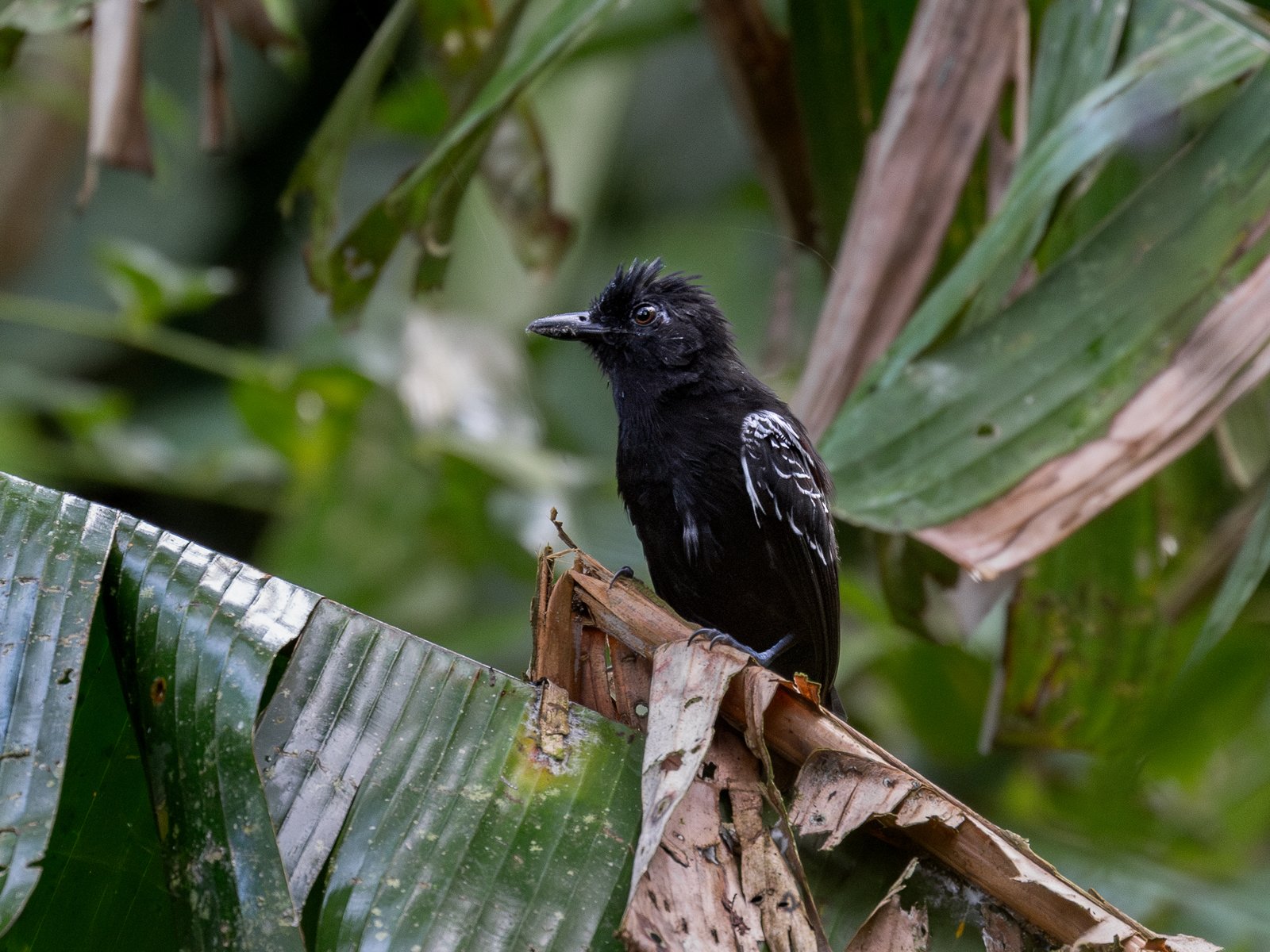
Castelnau's Antshrike is a large, almost entirely black antshrike of the river islands of the western Amazon and its tributaries. It is named after the French naturalist Castelnau; the scientific name cryptoleucus means 'hidden white' and refers to the white underwing coverts and the concealed white back patch. In the guide area it lives along the large rivers of Peru, Ecuador and the extreme south of Colombia.
Voice
The song is a short, fast, accelerating series of nasal notes with a bouncing quality. Calls are a drawn-out single or double kawh and a rasping kowah followed by a rolling r-sound.
Recording: Urias Edgardo Gonzalez Carreño — CC BY-NC-SA 4.0 · xeno-canto
Identification
17 cm (16–18 cm), with a heavy, hook-tipped bill and a fairly long tail. The male is black, with white tips to the scapulars and wing coverts, white underwing coverts, a concealed white patch between the shoulders and a dark grey belly. The female is also black but lacks the white on the scapulars and wing coverts. Immatures resemble the female but are browner. The eye is brown.
Confusion species
White-shouldered Antshrike Thamnophilus aethiops is smaller and lives in the understorey of terra firme forest, not on river islands; the male has only a few white dots on the wing and the female is entirely rufous-brown. Blackish-grey Antshrike Thamnophilus nigrocinereus leads a similar life along rivers, but the male is grey with a black crown and the female has rufous underparts; that species lives farther north and east. The female Cocha Antshrike Thamnophilus praecox has a black head and a rufous body.
Habitat
Dense understorey and mid-storey of scrub and young forest on river islands, less often in riverside forest on the mainland along large rivers, up to about 300 m. It lives in pairs and searches dense foliage for insects and other arthropods. Little is known about the nest.
Where the bird is most at home, classified by the vegetation units of the Andes and the west coast.


Range and movements
Peru: along the Amazon, the Napo, the Marañón and the Ucayali, probably also the lower Pastaza. Ecuador: along the Napo and the Pastaza in the east. Colombia: only in the extreme south, along the Amazon. Absent from Bolivia and the Galápagos. Outside the guide area in Brazil along the Amazon (Solimões) almost to the Rio Negro.
- Resident
- dark = core range, pale = thinly spread
How and when to look
Visit the river islands in the Amazon near Iquitos or in the lower Napo by boat. Listen in the early morning for the bouncing song from the dense scrub of younger island vegetation.
Conservation status
Least Concern; assessed as Near Threatened until 2023. The range is large, but numbers are thought to be declining because river islands and riverside forest, which lie within reach of settlements, are being cleared for agriculture.
Scientific name
Thamnophilus cryptoleucus | (Ménégaux & Hellmayr, 1906)
Ménégaux & Hellmayr described the species in 1906 as Myrmelastes cryptoleucus; because it was later moved to another genus, the author and year stand in brackets. The genus Thamnophilus was introduced in 1816 by Vieillot. The genus name comes from Greek thamnos, 'bush', and philos, 'loving': bush-lover. The species name comes from Greek kruptos, 'hidden', and leukos, 'white', for a concealed white patch in the plumage. The specimen the first description was based on came from Pebas, Peru.