All species › Cranes, rails and allies › Rails, gallinules and coots › Black-banded Crake
Black-banded Crake | Rufirallus fasciatus
Zwartbandral | Polluela negrifajeada | Sanã-zebrada
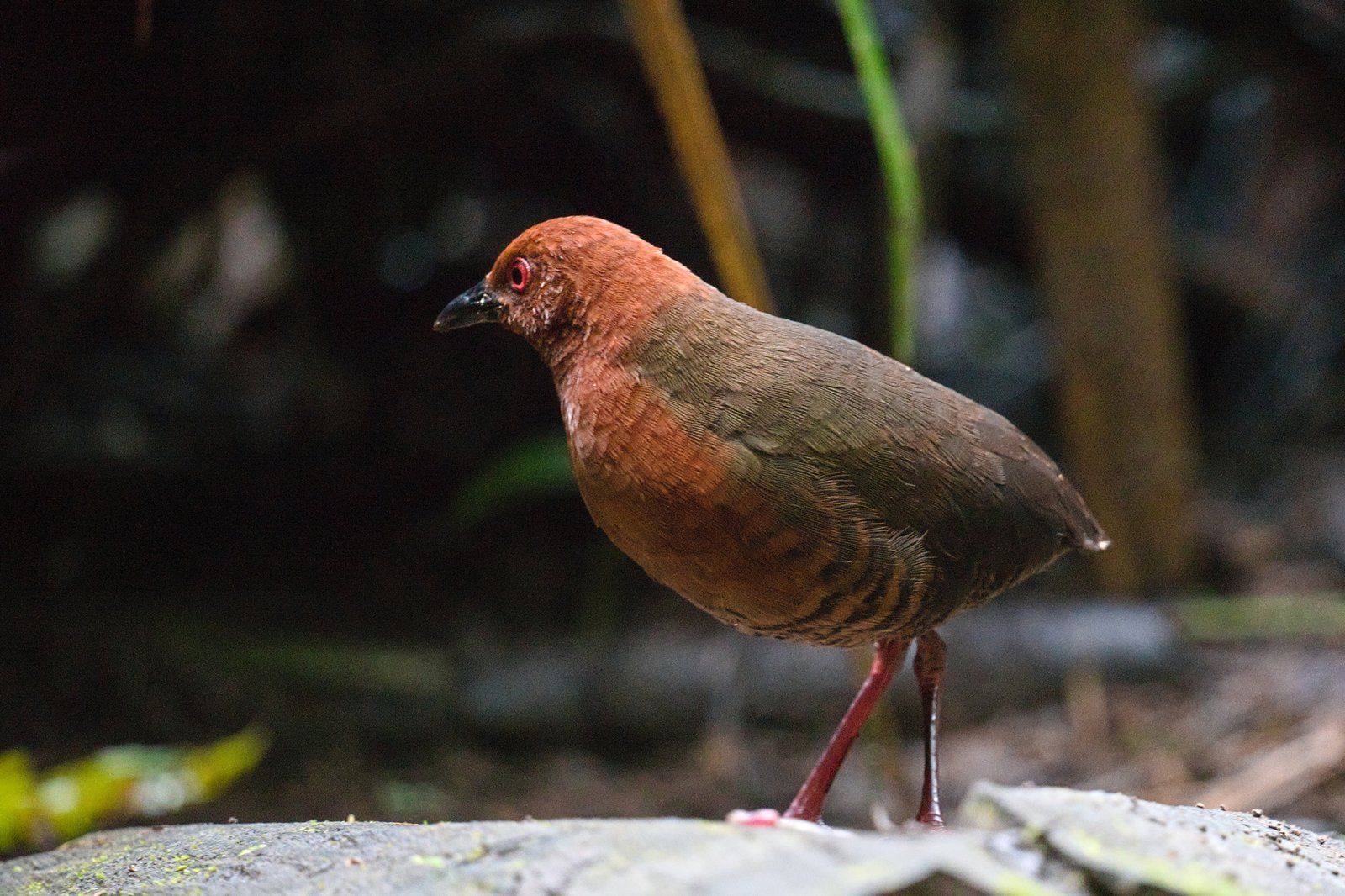
The Black-banded Crake is a small, rufous rail of thickets and tall grass along rivers and forest edges in western Amazonia. It lives hidden in dense vegetation and is noticed mainly by its rattling call. The black barring on the flanks and belly separates it from the related Russet-crowned Crake.
Voice
A loud, rattling trill, often in duet, that slowly fades; also short, harsh chek calls.
No recording with a suitable Creative Commons licence is available for this species yet.
Identification
17–19 cm, with a short tail. Head, neck and breast are warm rufous to cinnamon. The upperparts are dark olive-brown. Flanks, belly and undertail are boldly barred black and cinnamon-brown. The bill is dark, the iris red and the legs red. The sexes are alike. Juveniles are duller and browner, with less crisp barring.
Confusion species
Russet-crowned Crake Rufirallus viridis has a grey face and unbarred rufous underparts and lives in drier, open grasslands. Chestnut-headed Crake Anurolimnas castaneiceps is larger, with a dark, unbarred body and a greenish-yellow bill. Grey-breasted Crake Laterallus exilis has a grey head and breast, a rufous nape and black-and-white barred flanks.
Habitat
Dense tall grass, Heliconia thickets, scrub and young vegetation along riverbanks, on river islands, at the edges of marshes and in damp forest edges, in the lowlands up to about 1000 m. It searches the ground for insects and other invertebrates. Little is known about the nest.
Where the bird is most at home, classified by the vegetation units of the Andes and the west coast.


Range and movements
In Colombia in the south-east, in Amazonia. In Ecuador in the Amazonian lowlands. In Peru in the north and centre of the Amazonian lowlands. Occurrence in Bolivia uncertain; absent from the Galápagos. Outside the guide area in western Brazilian Amazonia.
How and when to look
Listen in the early morning along overgrown riverbanks and on young river islands in the Amazonian lowlands of Ecuador and Peru; birds usually stay in cover, but sometimes cross an open strip.
Conservation status
Least Concern. The riverside habitat is extensive and the species tolerates secondary vegetation.
Scientific name
Rufirallus fasciatus | (Sclater & Salvin, 1868)
Sclater & Salvin described the species in 1868 as Porzana fasciata; because it was later moved to another genus, the author and year stand in brackets. The genus Rufirallus was introduced in 1856 by Bonaparte. The genus name combines Latin rufus, 'rufous', with the genus Rallus. The species name is Late Latin fasciatus, 'banded'. The specimen the first description was based on came from Pebas, Loreto, Peru.