All species › Cranes, rails and allies › Rails, gallinules and coots › Yellow-breasted Crake
Yellow-breasted Crake | Laterallus flaviventer
Geelbuikporseleinhoen | Polluela pecho amarillo | Sanã-amarela
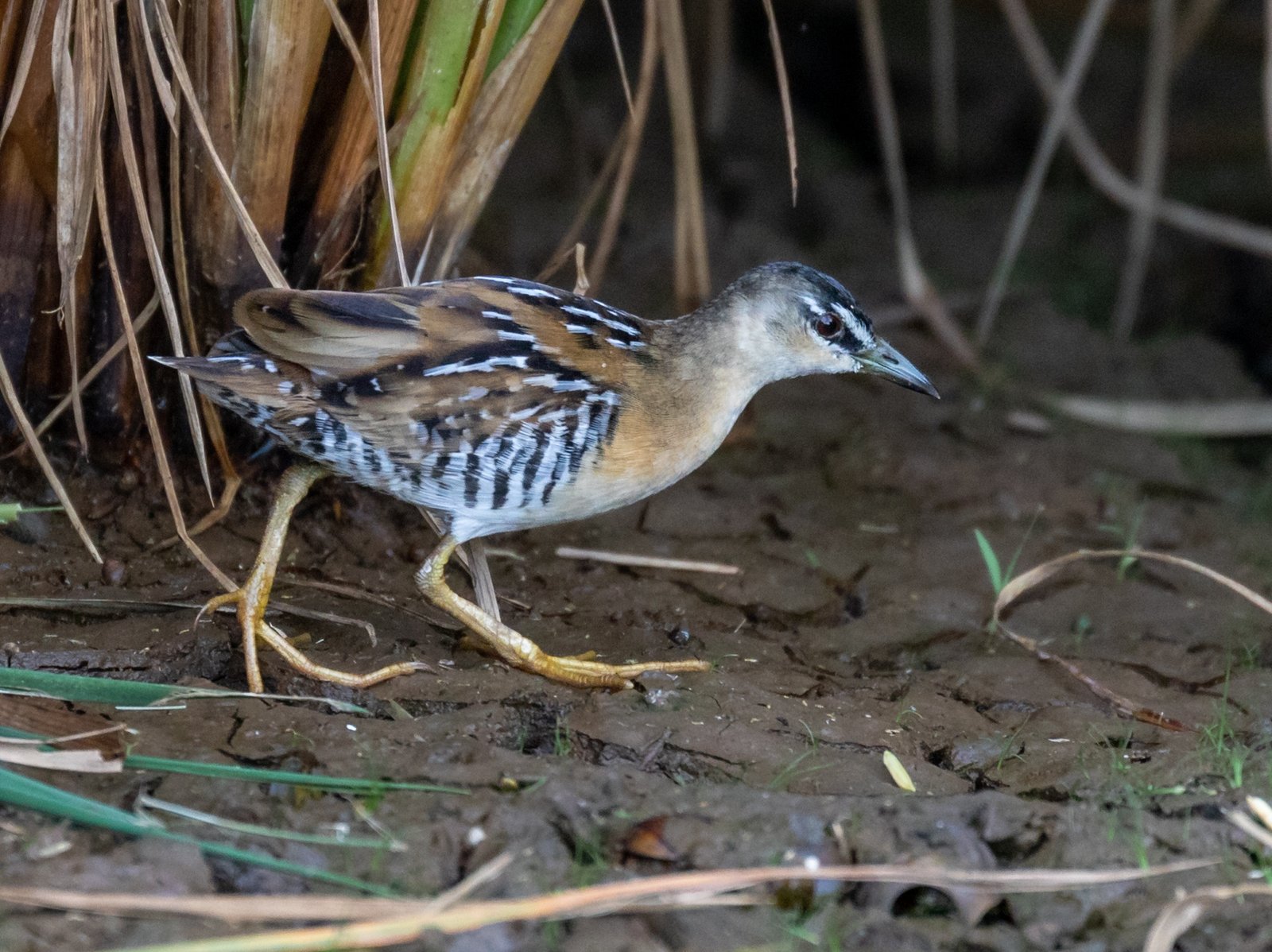
The Yellow-breasted Crake is one of the smallest rails in the guide area, with a buff breast, a white supercilium and black-and-white barred flanks. It lives in lowland marshes with floating plants and often walks over the leaves of water hyacinth and water lilies. Unlike most small crakes it flushes fairly readily, with fluttering wingbeats and dangling legs.
Voice
A hoarse, descending squeal and a short series of harsh notes, as well as a soft, ticking tuk; mainly at dusk.
Recording: Juan Freile — CC BY-NC-SA 4.0 · xeno-canto
Identification
13–14 cm. Crown and eyestripe dark brown, with a clear white supercilium. Throat white, neck and breast buff to ochre. The upperparts are brown with black streaks and fine white bars. Flanks and undertail coverts are barred black and white. The bill is short and dark, and the legs are yellowish. The sexes are alike; juveniles are duller.
Confusion species
Grey-breasted Crake Laterallus exilis has a grey head and breast and a rufous nape, without a supercilium. Rufous-sided Crake Laterallus melanophaius is larger, with rufous sides to the neck and a white throat and centre of the breast. Sora Porzana carolina is much larger, with a yellow bill and a black face. Paint-billed Crake Mustelirallus erythrops is larger, with plain brown upperparts and a red base to the bill.
Habitat
Freshwater marshes and the shores of lakes and lagoons with floating vegetation such as water hyacinth and water lilies, also wet grassland and rice fields in the lowlands, mostly below 500 m. It walks over floating plants, picking insects and other small invertebrates from the leaves. The nest is a cup of grass and leaves above the water in dense vegetation.
Where the bird is most at home, classified by the vegetation units of the Andes and the west coast.


Range and movements
In Colombia locally in the northern lowlands, the Magdalena Valley and the llanos. In Ecuador rare and local in the western lowlands and the Amazonian lowlands. In Peru locally in the Amazonian lowlands. In Bolivia in the savannas and marshes of the north and east. Absent from the Galápagos. Outside the guide area in Central America, the Greater Antilles, Venezuela, the Guianas, Brazil, Paraguay and northern Argentina.
- Resident
- dark = core range, pale = thinly spread
How and when to look
Search in the early morning and late afternoon along the edges of lagoons with water hyacinth and water lilies; the bird sometimes walks briefly in the open over floating leaves or flies low over the water to the next reed fringe.
Conservation status
Least Concern. The species depends on marshes with floating vegetation, which are shrinking locally through drainage and pollution.
Scientific name
Laterallus flaviventer | (Boddaert, 1783) (GBIF: Porzana flaviventer)
Boddaert described the species in 1783 as Rallus flaviventer; because it was later moved to another genus, the author and year stand in brackets. The genus Laterallus was introduced in 1855 by Gray. The genus name is a portmanteau of Rallus lateralis, an old name of the Rufous-sided Crake (Latin lateralis, 'of the side'). The species name comes from Latin flavus, 'yellow', and venter, 'belly'. The specimen the first description was based on came from Cayenne, French Guiana.