All species › Cuckoos › Cuckoos › Black-billed Cuckoo
Black-billed Cuckoo | Coccyzus erythropthalmus
Zwartsnavelkoekoek | Cuclillo piquinegro | Papa-lagarta-de-bico-preto
The Black-billed Cuckoo is a North American breeding bird that winters in northwestern South America. Unlike the Yellow-billed Cuckoo it winters mainly in Andean montane and foothill forest. It lives hidden in foliage and is infrequently recorded in the guide area.
Voice
Usually silent in the guide area. The call is a fast, rhythmic series of hollow notes in groups of three or four, coo-coo-coo, coo-coo-coo.
Recording: Jeff Stewart — CC BY-NC-SA 4.0 · xeno-canto
Identification
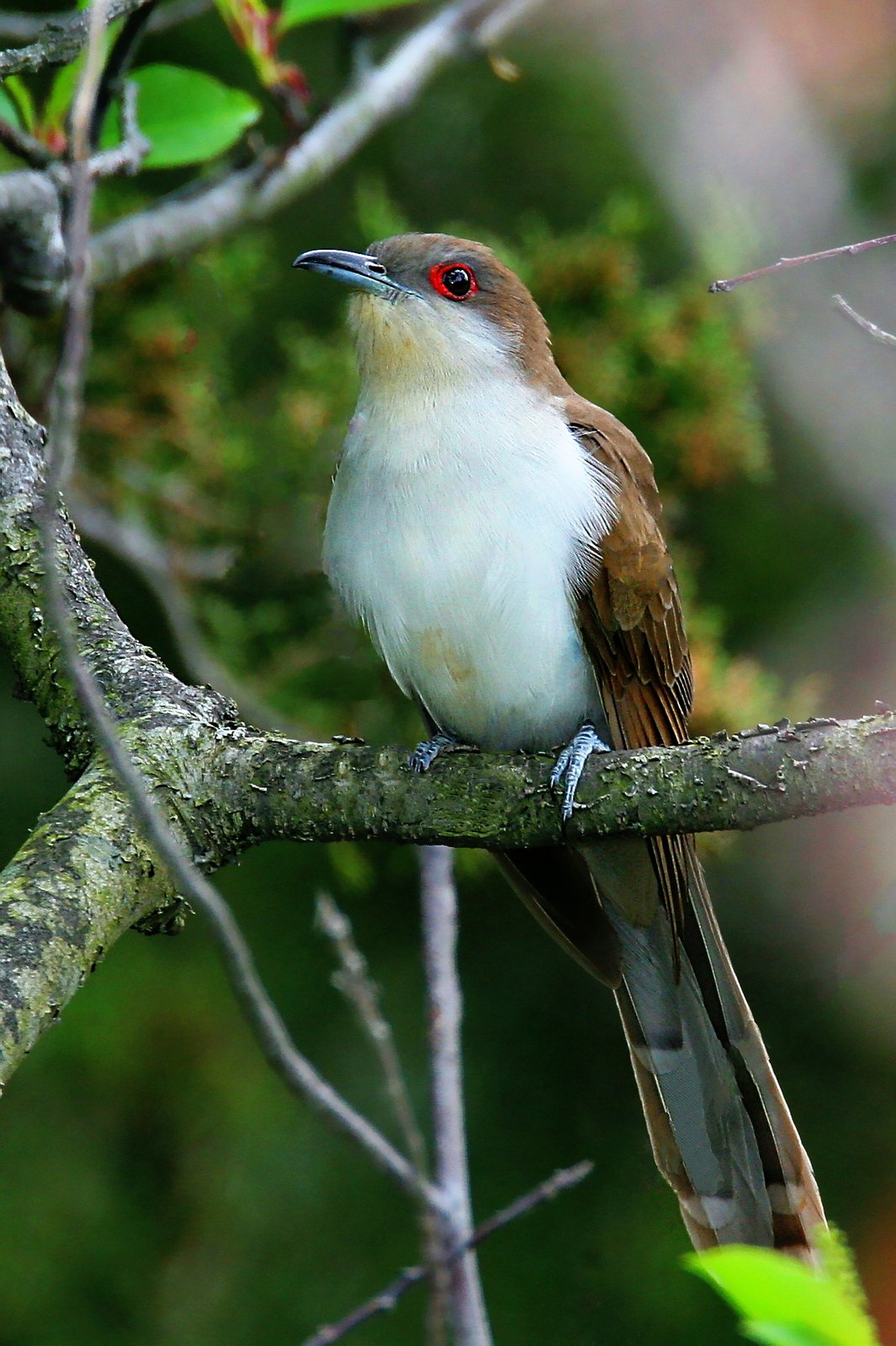
28–30 cm, slender with a long, graduated tail. The upperparts are plain grey-brown, the underparts white to off-white, sometimes with a faint ochre wash on the throat. The wings show at most a hint of rufous. The underside of the tail is grey with small, narrow white tips and a dark band in front of them. The bill is entirely black. Adults have a red eye-ring, juveniles a pale to yellow eye-ring and a browner tail. The sexes are alike.
Confusion species
Yellow-billed Cuckoo Coccyzus americanus has a yellow lower mandible, rufous primaries and large, sharply defined white tail tips on a black background. Pearly-breasted Cuckoo Coccyzus euleri likewise has a yellow lower mandible and large white tail tips. Dark-billed Cuckoo Coccyzus melacoryphus also has a black bill but is ochre below, with a dark mask and large white tail tips.
Habitat
Edges of montane and foothill forest, secondary forest, riparian woodland and scrub, in winter mainly between about 500 and 2500 m; on passage also in the lowlands. It searches slowly and unseen in the foliage for caterpillars, including hairy ones, and other large insects. It does not breed in the guide area.
Where the bird is most at home, classified by the vegetation units of the Andes and the west coast.


Range and movements
In Colombia a passage migrant and winter visitor, mainly in the Andes. In Ecuador and Peru a scarce winter visitor on the eastern slope of the Andes and in Andean valleys, locally also on the western slope. In Bolivia scarce and rare, mainly on the eastern slope of the Andes. It breeds in southern Canada and the eastern and central United States and winters mainly in northwestern South America.
- Passage (Mar–Apr, Oct–Nov)
- dark = core range, pale = thinly spread
How and when to look
From October to April in forest edges and secondary forest on the eastern slope of the Andes in Ecuador and Peru, where it usually sits silent and hidden in the foliage.
Conservation status
Least Concern. In North America its numbers have declined in recent decades.
Scientific name
Coccyzus erythropthalmus | (Wilson, 1811)
Wilson described the species in 1811 as Cuculus erythropthalma; because it was later moved to another genus, the author and year stand in brackets. The genus Coccyzus was introduced in 1816 by Vieillot. The genus name comes from Greek kokkuzō, 'to cry cuckoo'. The species name erythropthalmus comes from Greek eruthros, 'red', and ophthalmos, 'eye', after the red eye-ring. The specimen the first description was based on came from Near Philadelphia, Pennsylvania, United States.