All species › Cuckoos › Cuckoos › Mangrove Cuckoo
Mangrove Cuckoo | Coccyzus minor
Mangrovekoekoek | Cuclillo de manglar | Papa-lagarta-do-mangue
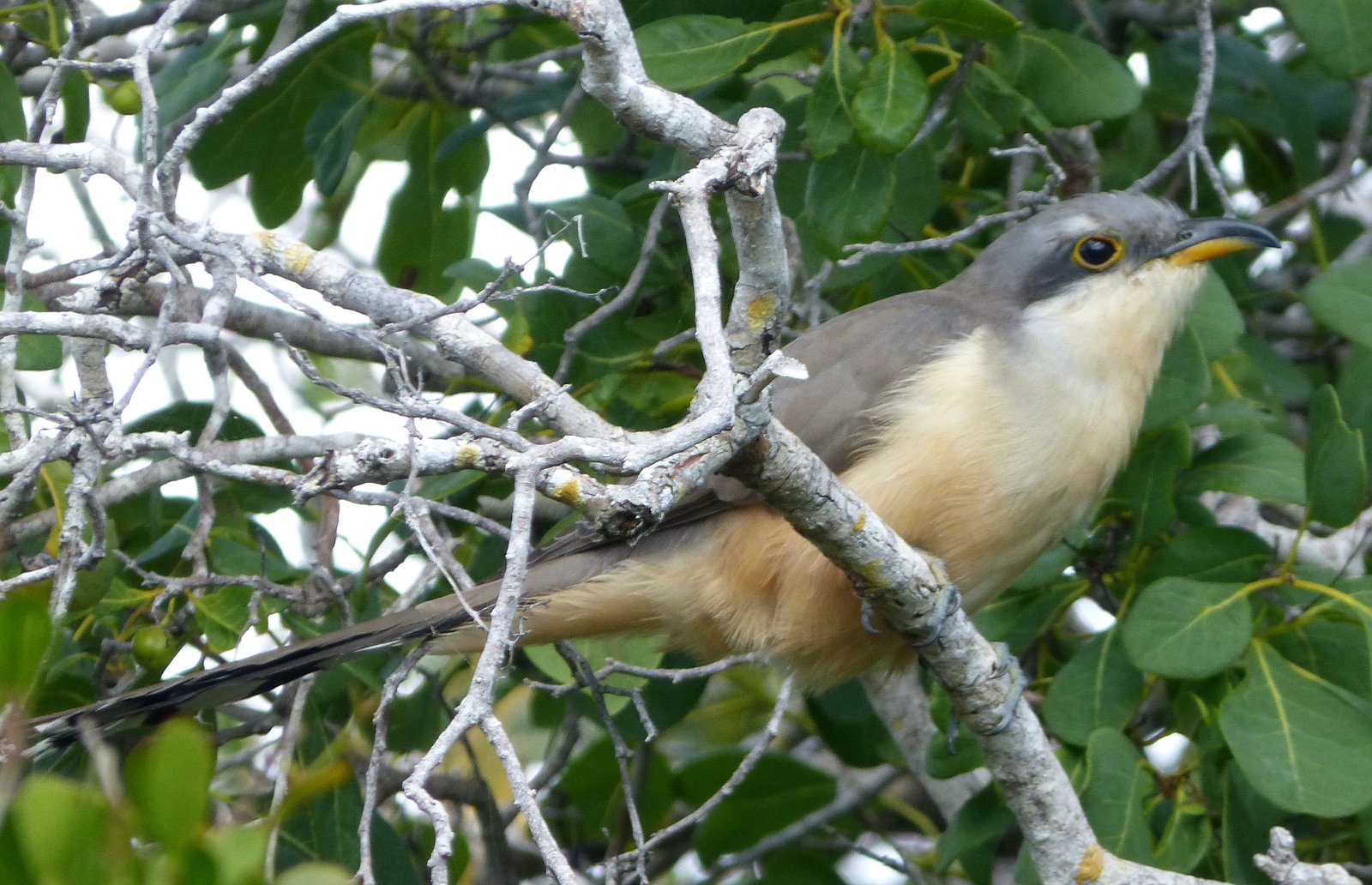
The Mangrove Cuckoo is a cuckoo of Caribbean coasts that in the guide area occurs only on the Caribbean coast of Colombia. It lives hidden in mangroves and dense coastal vegetation and moves slowly through the foliage. Its black mask and ochre belly are characteristic.
Voice
A series of low, guttural notes, gaw-gaw-gaw-gauw-gauw, slowing towards the end. Calls mainly in the breeding season and is otherwise usually silent.
Recording: GABRIEL LEITE — CC BY-NC-SA 4.0 · xeno-canto
Identification
28–31 cm, with a long, graduated tail. The upperparts are grey-brown, the crown greyer. A black mask runs from the lores through the eye over the ear coverts. The throat is whitish, the breast and belly warm ochre to cinnamon. The underside of the tail is black with large white tips. The upper mandible is black, the lower mandible mostly yellow; the eye-ring is yellow. The sexes are alike; juveniles have a fainter mask and tail pattern.
Confusion species
Dark-billed Cuckoo Coccyzus melacoryphus is smaller, with an all-black bill, a less contrasting mask with a grey band along the side of the neck and an ochre rather than white throat. Yellow-billed Cuckoo Coccyzus americanus also has a yellow lower mandible but is white below, without a mask, and has rufous primaries. Grey-capped Cuckoo Coccyzus lansbergi has a dark grey cap, a black bill and rufous-brown upperparts.
Habitat
Mangroves, dry coastal forest, scrub and shoreline vegetation, locally also further inland in dry forest, almost only at low elevations. It searches slowly in the foliage for caterpillars, grasshoppers, spiders and other large invertebrates, sometimes also lizards. It builds its own loose nest of twigs in a shrub or tree, often in mangroves.
Where the bird is most at home, classified by the vegetation units of the Andes and the west coast.


Range and movements
In Colombia on the Caribbean coast, among others around Santa Marta and on the Guajira Peninsula, and on the islands of San Andrés and Providencia. Not known from Ecuador, Peru or Bolivia. Outside the guide area in southern Florida, the Caribbean, along the coasts of Mexico and Central America, and in northern Venezuela, the Guianas and the north coast of Brazil.
- Resident
- dark = core range, pale = thinly spread
How and when to look
In mangroves and dry coastal forest around Santa Marta and in La Guajira, especially in the morning when birds call; it often sits motionless in the foliage for long periods.
Conservation status
Least Concern. Locally sensitive to the loss of mangroves through coastal development.
Scientific name
Coccyzus minor | (Gmelin, 1788)
Gmelin described the species in 1788 as Cuculus minor; because it was later moved to another genus, the author and year stand in brackets. The genus Coccyzus was introduced in 1816 by Vieillot. The genus name comes from Greek kokkuzō, 'to cry cuckoo'. The species name minor is Latin for 'smaller'. The specimen the first description was based on came from Cayenne, French Guiana.