All species › Cuckoos › Cuckoos › Pearly-breasted Cuckoo
Pearly-breasted Cuckoo | Coccyzus euleri
Witbuikkoekoek | Cuclillo ventriblanco | Papa-lagarta-de-euler
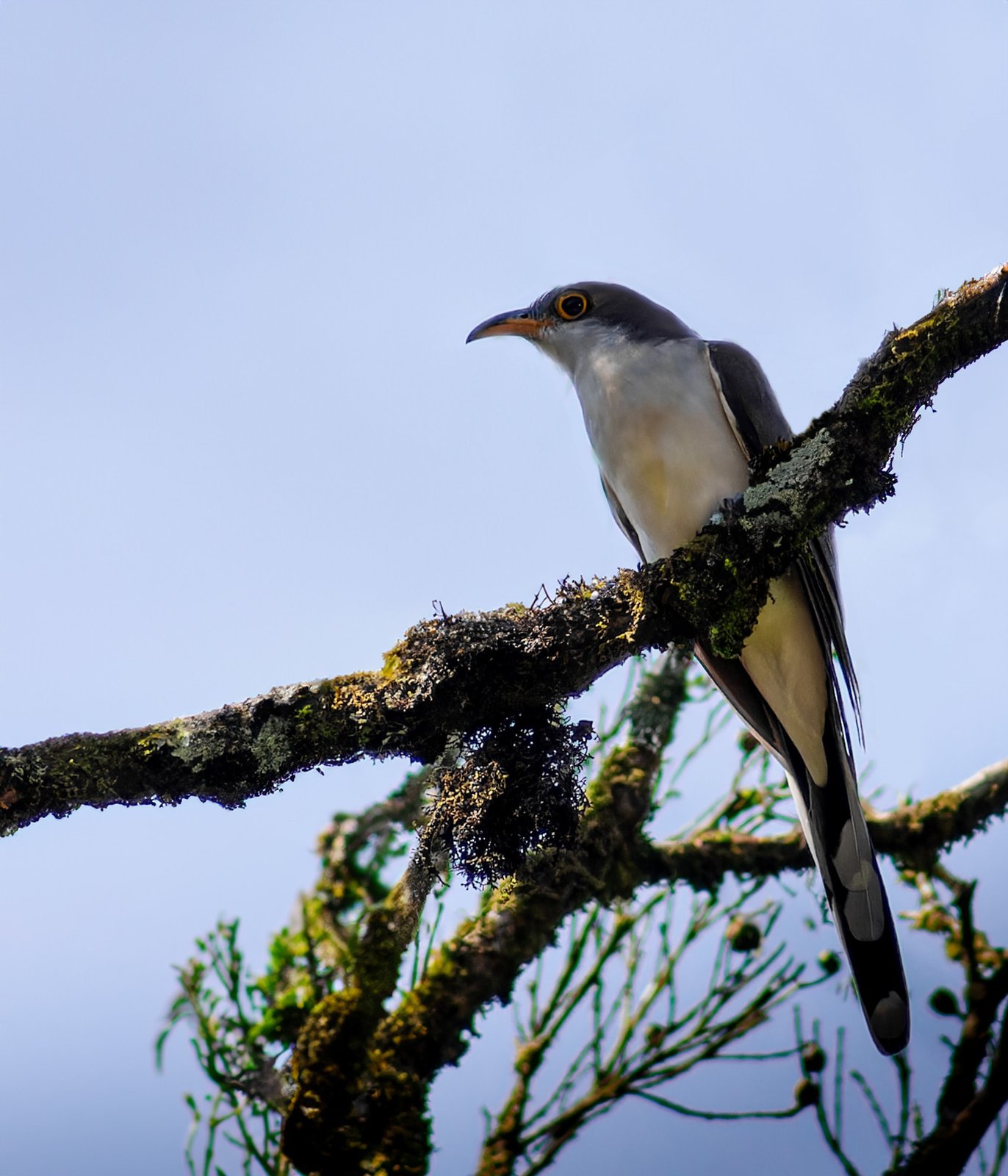
The Pearly-breasted Cuckoo is a small, unobtrusive cuckoo that closely resembles the Yellow-billed Cuckoo but has no rufous in the wings. It breeds mainly in eastern and southern Brazil and adjacent countries and moves north in the southern winter. In the guide area it is scarce, and its distribution and movements are still incompletely known.
Voice
Usually silent in the guide area. The call is a series of hollow notes, kwup-kwup-kwup, similar to the call of the Yellow-billed Cuckoo but without the fast knocking introduction.
Recording: Miguel Angelo Biz — CC BY-NC-SA 4.0 · xeno-canto
Identification
25–27 cm, slender with a long, graduated tail. The upperparts are plain grey-brown, the underparts white with a greyish wash on the breast. The wings are grey-brown without rufous in the primaries. The underside of the tail is black with large white tips. The upper mandible is black, the lower mandible yellow with a dark tip. The sexes are alike; juveniles have a fainter tail pattern.
Confusion species
Yellow-billed Cuckoo Coccyzus americanus is slightly larger and has rufous primaries, visible mainly in flight; it occurs in the guide area in the northern winter and on passage. Black-billed Cuckoo Coccyzus erythropthalmus has an all-black bill and small tail tips. Dark-billed Cuckoo Coccyzus melacoryphus is ochre below, with a black bill and a dark mask.
Habitat
Forest edges, secondary forest, flooded forest, the upper levels of humid lowland forest and trees in savannas and open country, mainly in the lowlands. It searches quietly in the foliage for caterpillars and other large insects. Breeding in the guide area has not been confirmed.
Where the bird is most at home, classified by the vegetation units of the Andes and the west coast.


Range and movements
In Colombia scarce and local in the lowlands east of the Andes. In Ecuador and Peru only a few records in the eastern lowlands. In Bolivia scarce in the north and east, mainly in the southern winter. Outside the guide area it breeds in eastern and southern Brazil, Paraguay and northeastern Argentina, and locally in Venezuela and the Guianas; in the southern winter it occurs in Amazonia.
- Summer visitor (c. Apr–Sep)
- Winter visitor (c. Oct–Mar)
- Passage (Mar–Apr, Oct–Nov)
- dark = core range, pale = thinly spread
How and when to look
Between April and October in forest edges and flooded forest in the lowlands of Bolivia and southeastern Peru; check every white-bellied cuckoo for the absence of rufous in the wing.
Conservation status
Least Concern. Widespread but scarce in large parts of its range.
Scientific name
Coccyzus euleri | Cabanis, 1873
Cabanis described the species in 1873 and placed it straight away in the genus where it still stands. The genus Coccyzus was introduced in 1816 by Vieillot. The genus name comes from Greek kokkuzō, 'to cry cuckoo'. The species name euleri honours Carl Hieronymus Euler (1834–1901), Swiss amateur ornithologist who settled in Brazil in 1853 and was vice-consul in Rio de Janeiro from 1867 to 1901. The specimen the first description was based on came from Cantagalo, Rio de Janeiro, Brazil.