All species › Woodpeckers and allies › Toucans › Black-billed Mountain Toucan
Black-billed Mountain Toucan | Andigena nigrirostris
Witwangbergtoekan | Tucán andino piquinegro | Tucano-andino-de-bico-preto
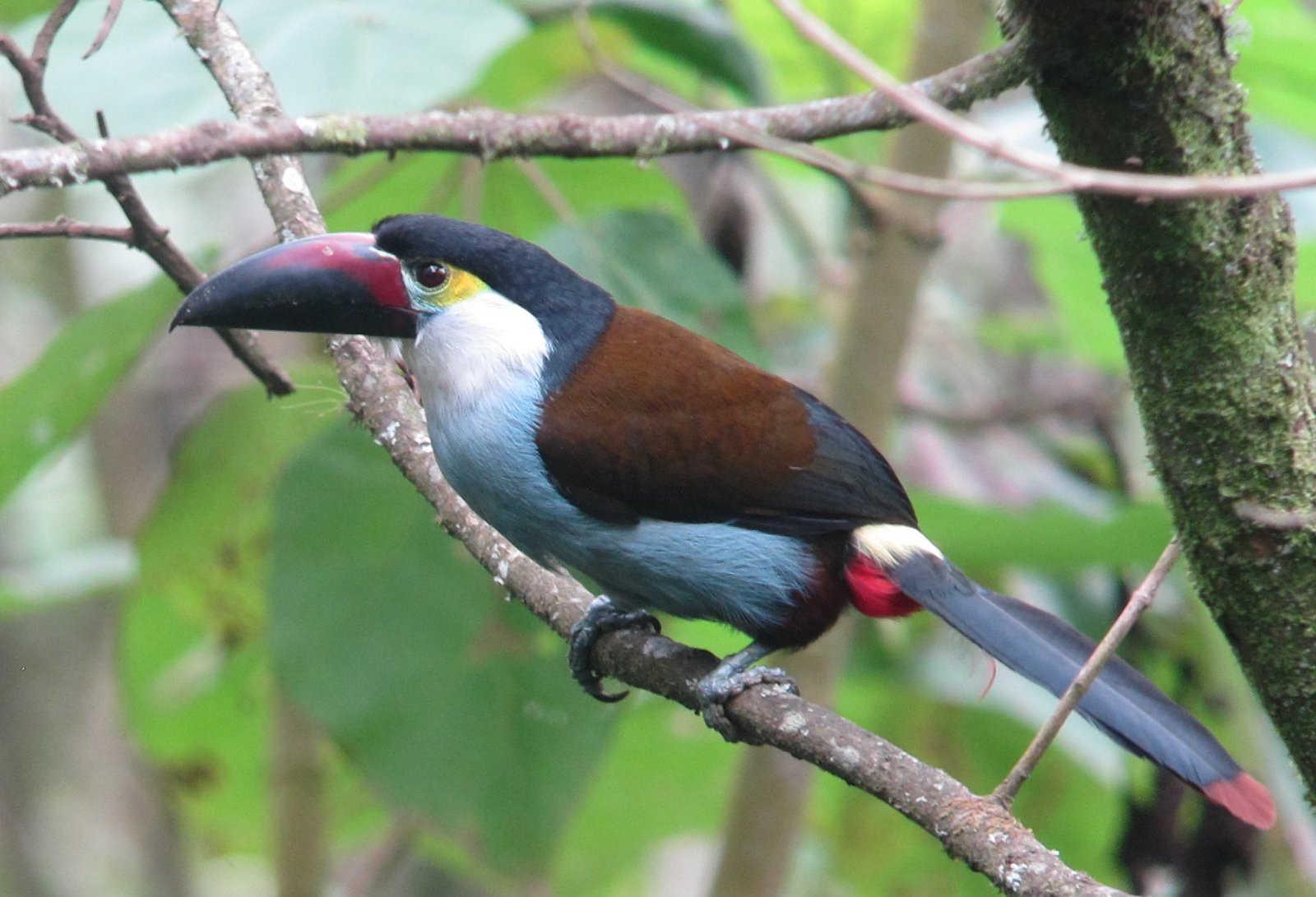
The Black-billed Mountain Toucan is a mountain toucan of the cloud forest of the northern Andes, with white cheeks and throat and a mainly black bill. It lives in pairs or small family groups in the canopy. Of the mountain toucans in the guide area it is the only one with a white throat.
Voice
Nasal, croaking gwaaak calls of varying form, sometimes drawn out or yelping, often accompanied by rattling bill-clatter.
Recording: A Edwar H Guarín — CC BY-NC-SA 4.0 · xeno-canto
Identification
46–51 cm. The crown and nape are black, the cheeks and throat white, shading to pale blue on the breast and belly. The upperparts are bronzy olive-brown and the rump is pale yellow. The tail is dark slate with chestnut tips to the central feathers. The thighs are chestnut and the undertail coverts red. The bare skin around the eye is pale blue in front of the eye and yellow or orange behind it. The bill is black; in Ecuador and the Central Andes of Colombia with some dark red at the base, in the Western Andes of Colombia with more red along the upper mandible. The sexes are alike, but the female has a shorter bill.
Confusion species
Grey-breasted Mountain Toucan Andigena hypoglauca has a blue-grey throat and a bill with red, black and yellowish green; the two occur together on the eastern slope in Ecuador and in Colombia. Plate-billed Mountain Toucan Andigena laminirostris of the western slope in south-western Colombia and Ecuador has a yellow flank patch, no white throat and an ivory plate on the upper mandible. Southern Emerald Toucanet Aulacorhynchus albivitta is much smaller and mainly green.
Habitat
Cloud forest and humid montane forest, also forest edges, semi-open country with scattered trees and fields near forest, mostly between 1700 and 2700 m, sometimes from 1200 m and up to above 3200 m. It forages in the canopy, in pairs or small family groups. It eats mainly fruit, also insects. It nests in a tree cavity.
Where the bird is most at home, classified by the vegetation units of the Andes and the west coast.


Range and movements
In Colombia in all three Andean ranges. In Ecuador on the eastern slope of the Andes. In Peru only in the far north-west (Piura). Absent from Bolivia and the Galápagos. Outside the guide area in the Andes of western Venezuela.
- Resident
- dark = core range, pale = thinly spread
How and when to look
At fruiting trees and along forest edges in the cloud forest of the Colombian Andes and on the eastern slope in Ecuador. In the morning pairs give themselves away by their nasal calls and bill-clatter from the canopy.
Conservation status
Least Concern, but the population is probably declining because cloud forest is fragmented over much of the range.
Scientific name
Andigena nigrirostris | (Waterhouse, 1839)
Waterhouse described the species in 1839 as Pteroglossus nigrirostris; because it was later moved to another genus, the author and year stand in brackets. The genus Andigena was introduced in 1851 by Gould. The genus name comes from the Andes and Latin -gena, 'born in', thus 'Andes-born'. The species name comes from Latin niger, 'black', and rostrum, 'bill', for the black bill. The specimen the first description was based on came from Subia, near La Mesa, Cundinamarca, Colombia.