All species › Woodpeckers and allies › Toucans › Yellow-eared Toucanet
Yellow-eared Toucanet | Selenidera spectabilis
Geeloorpepervreter | Tucancillo orejiamarillo | Saripoca-de-orelha-amarela
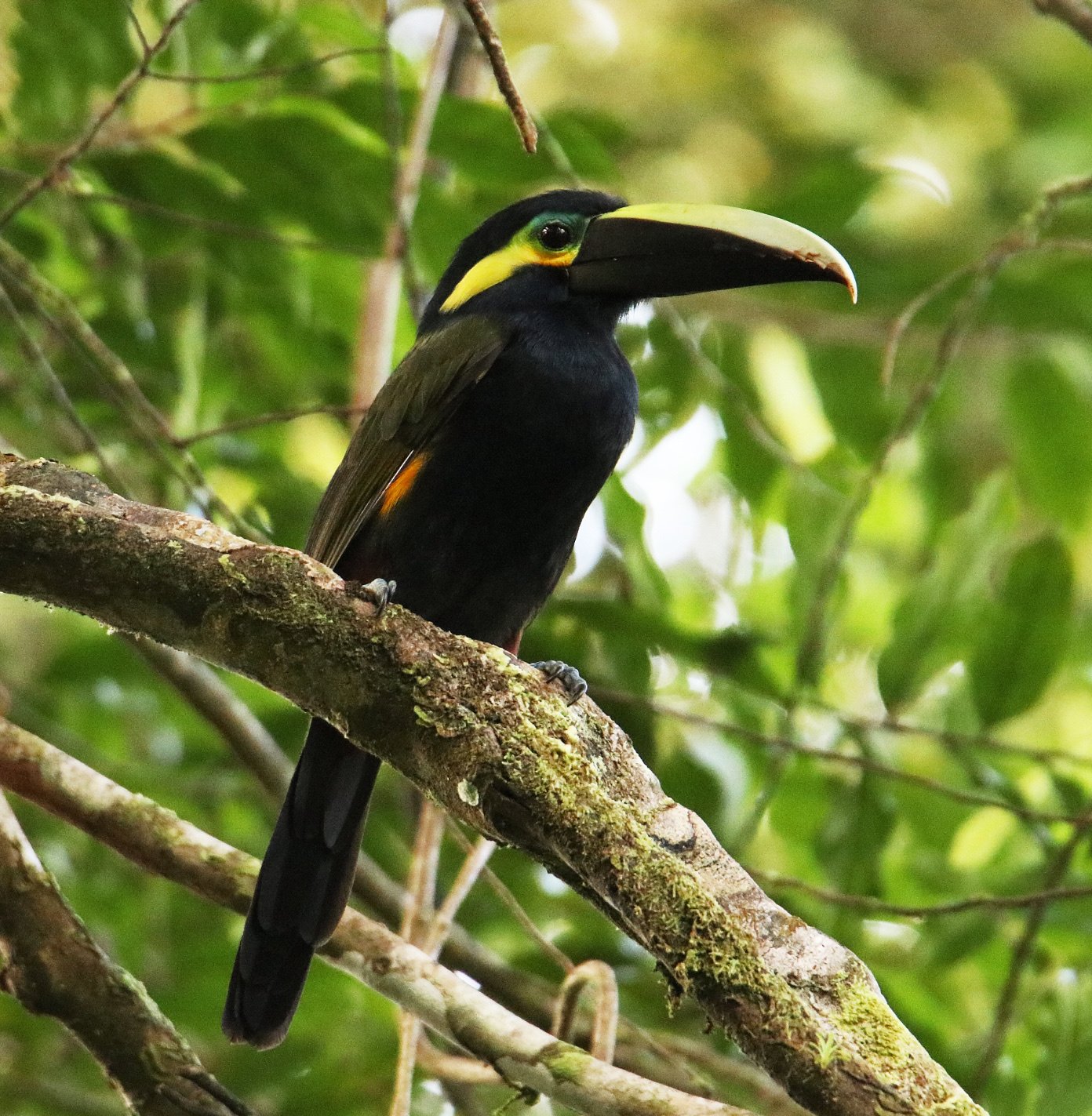
The Yellow-eared Toucanet is a small toucan of the humid forest on the Pacific side of Colombia and in the far north-west of Ecuador, where it reaches the southern limit of its range. The male has a large yellow tuft behind the eye, which the female lacks. It lives in pairs or small groups in the mid-storey and canopy.
Voice
A series of double, grating notes, roughly tik-ett, often with bill-snapping; pairs sometimes sing together. Also short and long rattles.
Recording: Andrew Spencer — CC BY-NC-SA 3.0 · xeno-canto
Identification
36–38 cm. The male has a black crown and hindneck, a large yellow tuft behind the eye and bare blue to green skin around the eye. The back is green and the tail blackish. The throat, breast and belly are black, with a yellow flank patch, chestnut thighs and red undertail coverts. The female has a chestnut crown and hindneck and no yellow tuft. The upper mandible is yellowish with an olive-brown triangle near the base, the lower mandible dark olive to brownish black; the female has a shorter bill. Juveniles are duller.
Confusion species
Collared Aracari Pteroglossus torquatus is slimmer and longer-tailed, with yellow underparts with a dark breast spot and band and a red rump. Choco Toucan Ramphastos brevis is much larger, with a yellow throat and breast. Southern Emerald Toucanet Aulacorhynchus albivitta lives higher in the Andes and is mainly green.
Habitat
Humid forest on slopes and ridges in the lowlands and foothills, also adjacent secondary forest and fruit trees along forest edges, mostly between 300 and 1100 m, sometimes at sea level and up to about 1500 m. It forages from the mid-storey to the canopy. It eats mainly fruit, also insects. It nests in a tree cavity.
Where the bird is most at home, classified by the vegetation units of the Andes and the west coast.


Range and movements
In Colombia in the humid forest of the Pacific side and the north-west, local and uncommon. In Ecuador only in the far north-west (Esmeraldas), very rare. Absent from Peru, Bolivia and the Galápagos. Outside the guide area from Honduras through Nicaragua and Costa Rica to Panama.
- Resident
- dark = core range, pale = thinly spread
How and when to look
In the foothill forest on the Pacific side of Colombia, especially at fruiting trees along forest edges. Listen for the double, grating calls and bill-snapping from the mid-storey.
Conservation status
Least Concern. The population is probably declining through deforestation; in Colombia and Ecuador the species is local and rare.
Scientific name
Selenidera spectabilis | Cassin, 1858
Cassin described the species in 1858 and placed it straight away in the genus where it still stands. The genus Selenidera was introduced in 1837 by Gould. The genus name comes from Greek selēnē, 'moon', and deirē, 'neck', after the yellow crescent on the male's nape. The species name spectabilis is Latin for 'notable, remarkable'. The specimen the first description was based on came from Cucuyos de Veragua, Panama.