All species › Woodpeckers and allies › Toucans › Golden-collared Toucanet
Golden-collared Toucanet | Selenidera reinwardtii
Reinwardts pepervreter | Tucanete de Reinwardt | Saripoca-de-coleira
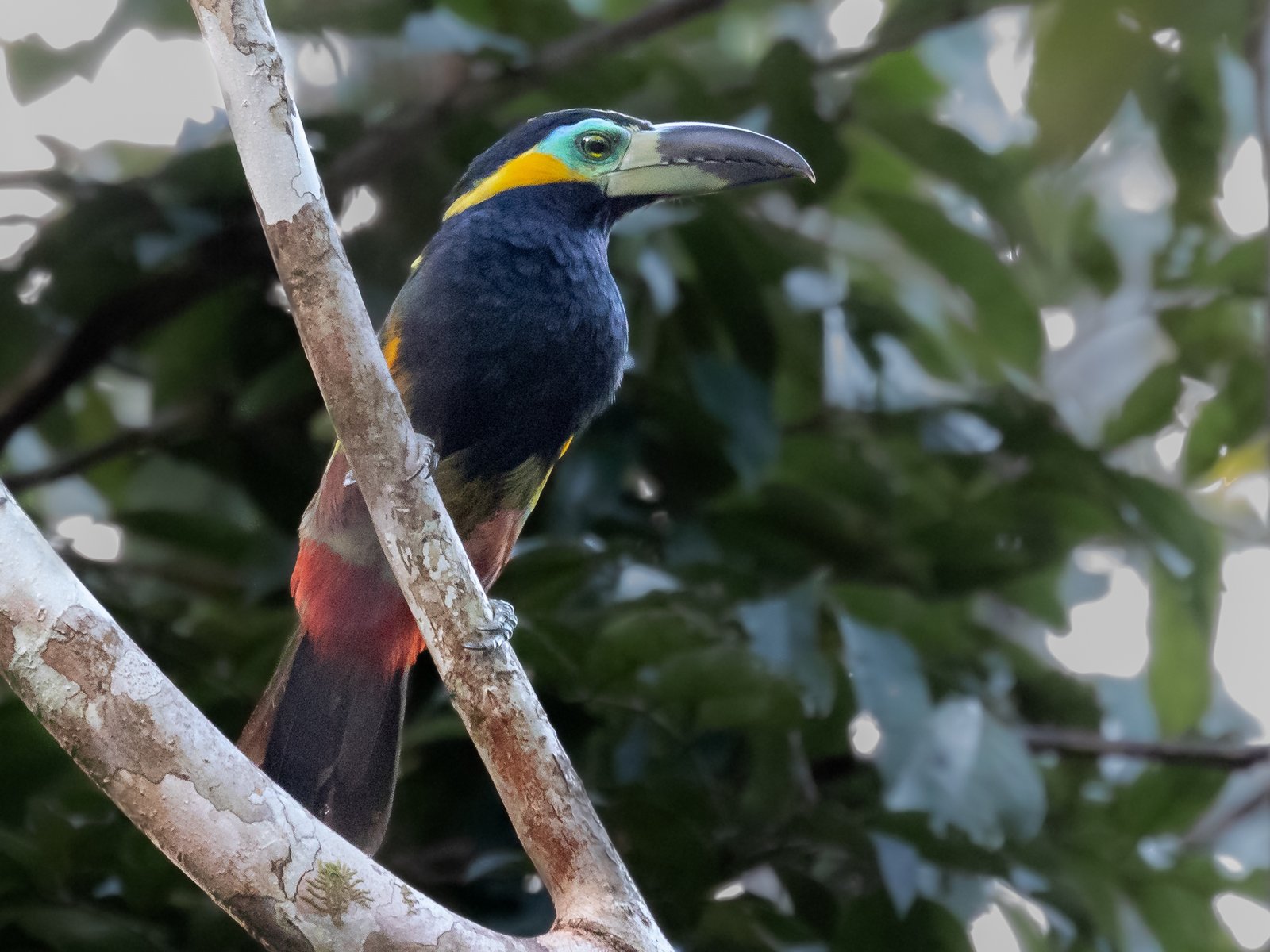
The Golden-collared Toucanet is a small toucan of the Amazonian forest at the foot of the Andes. It lives in the mid-storey of tall forest and gives itself away mainly by its croaking song. Two forms occur in the guide area: a red-billed form in the north and a form with a black and green bill in the south, which is sometimes treated as a separate species.
Voice
A series of about 4 to 14 deep, croaking grraawk notes, usually sung by a single bird. Also softer eh, uh and kik calls.
Recording: JAYRSON ARAUJO DE OLIVEIRA — CC BY-NC-SA 4.0 · xeno-canto
Identification
33–35 cm. The male has a black head, nape and underparts, a golden-yellow tuft behind the eye, bare blue skin around the eye and a narrow yellow band between the black nape and the green back. The flanks are golden yellow, the undertail coverts red and the green tail has chestnut tips. In the female the black parts are chestnut and the tuft and flanks are duller. In the northern form reinwardtii the bill is mostly red with a black outer third; in the southern form langsdorffii the upper mandible is mostly black with a green base and the lower mandible half green, half black. The female has a shorter bill; juveniles are duller.
Confusion species
Tawny-tufted Toucanet Selenidera nattereri in the far east of Colombia has a reddish brown bill with blue at the base and white stripes on the lower mandible, and a tawny tuft behind the eye. Gould's Toucanet Selenidera gouldii in eastern Bolivia has a black and ivory bill with an orange-yellow tip. Aracaris such as Lettered Aracari Pteroglossus inscriptus are slimmer and longer-tailed, with yellow underparts and a red rump.
Habitat
The interior and edges of humid lowland and foothill forest, mainly on higher terra firme, sometimes in várzea; it avoids secondary forest. Mostly below 1000 m, locally up to 1200–1500 m. It lives in pairs or small groups in the mid-storey. It eats mainly fruit, also insects. It nests in a tree cavity.
Where the bird is most at home, classified by the vegetation units of the Andes and the west coast.


Range and movements
In Colombia in the south-eastern lowlands. In Ecuador in the eastern lowlands and foothills. In Peru in the Amazonian lowlands: the form reinwardtii in the north, langsdorffii further south; where they meet, hybrids occur. In Bolivia (langsdorffii) in the north-western lowlands. Absent west of the Andes and from the Galápagos. Outside the guide area in western Brazil.
- Resident
- dark = core range, pale = thinly spread
How and when to look
In tall terra firme forest in the eastern lowlands of Ecuador and Peru, away from rivers. Listen for the series of croaking notes and then search the foliage below the canopy.
Conservation status
Not Evaluated in this species limit; as two separate species both forms are assessed as Least Concern. Deforestation in Amazonia may reduce numbers locally.
Scientific name
Selenidera reinwardtii | (Wagler, 1827)
Wagler described the species in 1827 as Pteroglossus Reinwardtii; because it was later moved to another genus, the author and year stand in brackets. The genus Selenidera was introduced in 1837 by Gould. The genus name comes from Greek selēnē, 'moon', and deirē, 'neck', after the yellow crescent on the male's nape. The species name reinwardtii honours Caspar Georg Carl Reinwardt (1773–1854), German-Dutch naturalist and botanist, founder of the botanic garden at Buitenzorg (Bogor). The specimen the first description was based on came from Brazil.