All species › Woodpeckers and allies › Toucans › Tawny-tufted Toucanet
Tawny-tufted Toucanet | Selenidera nattereri
Natterers pepervreter | Tucanete de Natterer | Saripoca-de-bico-castanho
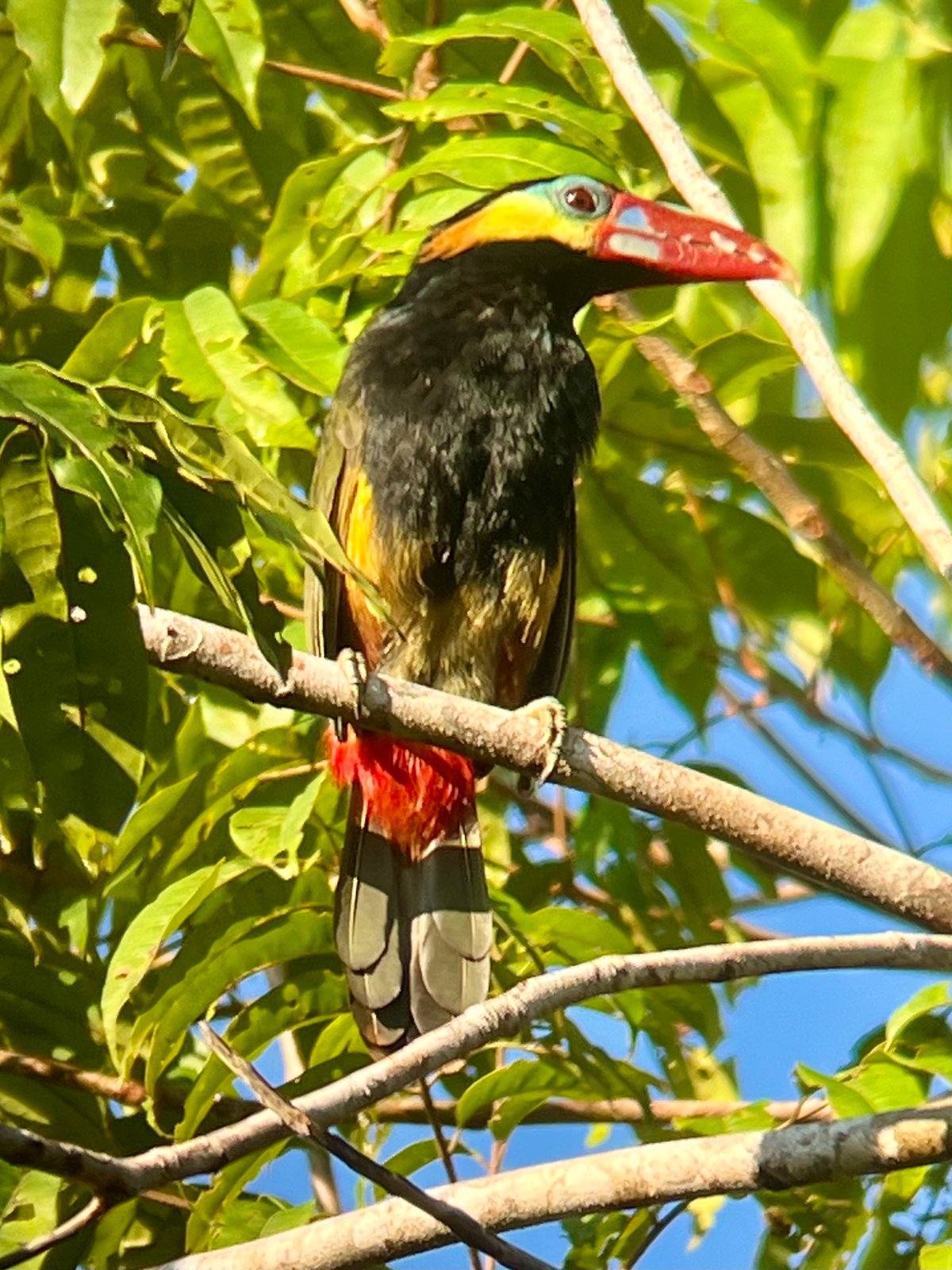
The Tawny-tufted Toucanet is a small toucan of north-western Amazonia, which in the guide area occurs only in the far east of Colombia. It is identified by its multicoloured, reddish brown bill and the tawny tuft behind the eye. The species is named after the Austrian collector Johann Natterer.
Voice
Grating, croaking grruuuk notes that may continue for 10 to 15 seconds, and a rattling ddrik.
Recording: GABRIEL LEITE — CC BY-NC-SA 4.0 · xeno-canto
Identification
32–33 cm. The male has a black head, nape, throat and belly, bare pale blue skin around the eye and a yellow to tawny tuft behind it. The upperparts are green, with a yellow band on the lower hindneck; the flanks are yellow to rusty and the undertail coverts red. The green tail has chestnut tips. The female has a chestnut crown and a rusty throat and belly. The bill is mostly red to reddish brown, with a green culmen, blue at the base and white vertical stripes on the lower mandible; the female has a shorter bill.
Confusion species
Golden-collared Toucanet Selenidera reinwardtii in south-eastern Colombia has a golden-yellow tuft behind the eye and a red bill with a black tip, without blue and white. Aracaris such as Many-banded Aracari Pteroglossus pluricinctus are larger and longer-tailed, with yellow underparts crossed by black bands.
Habitat
Humid lowland forest, often on sandy soil and near rivers and streams, also lower forest on white sand. It lives in pairs or small groups in the mid-storey and canopy. It eats mainly fruit, also insects. It nests in a tree cavity.
Where the bird is most at home, classified by the vegetation units of the Andes and the west coast.


Range and movements
In Colombia only in the far east, for example around Mitú in Vaupés. Absent from Ecuador, Peru, Bolivia and the Galápagos. Outside the guide area in southern Venezuela and in north-western Brazil north of the Solimões, east to the upper Rio Negro.
- Resident
- dark = core range, pale = thinly spread
How and when to look
Around Mitú in Vaupés, in forest on sandy soil along streams. In the morning listen for the long, sustained croaking calls from the mid-storey.
Conservation status
Least Concern. Most of the range is still forested.
Scientific name
Selenidera nattereri | (Gould, 1835)
Gould described the species in 1835 as Pteroglossus Nattereri; because it was later moved to another genus, the author and year stand in brackets. The genus Selenidera was introduced in 1837 by Gould. The genus name comes from Greek selēnē, 'moon', and deirē, 'neck', after the yellow crescent on the male's nape. The species name nattereri honours Johann Natterer (1787–1843), Austrian naturalist who collected in Brazil from 1817 to 1835. The specimen the first description was based on came from Brazil.