All species › Passerines › Tyrant flycatchers and allies › Black-billed Shrike-Tyrant
Black-billed Shrike-Tyrant | Agriornis montanus
Zwartbekklauwiertiran | Gaucho serrano | Gaúcho-de-bico-preto
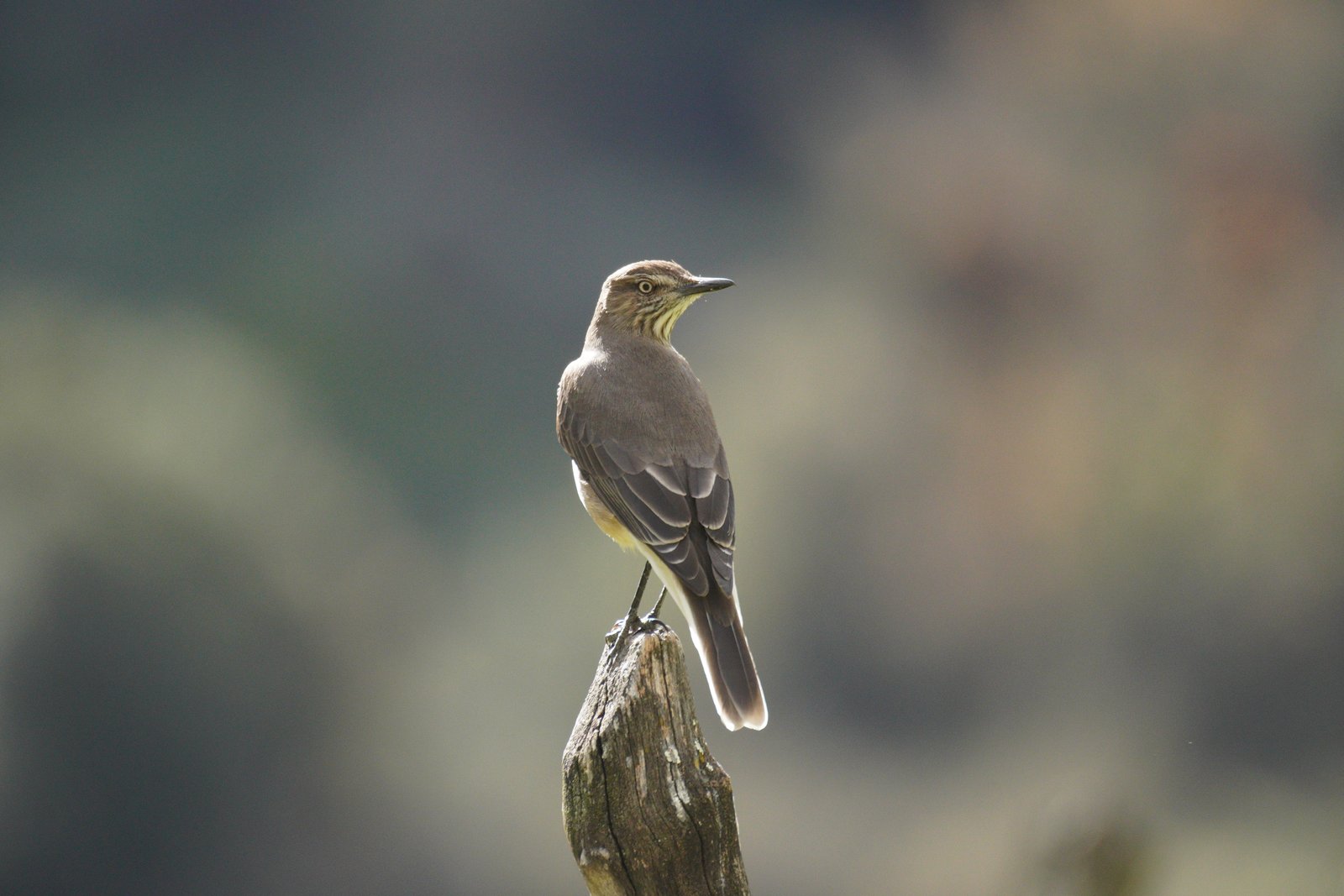
The Black-billed Shrike-Tyrant is a large, grey-brown flycatcher of open high mountains, with a heavy, hooked bill reminiscent of a shrike. It perches upright on rocks, walls, posts and roofs, hunting large insects and small vertebrates from there. Of the shrike-tyrants of the Andes it is the most widespread and most often seen.
Voice
A loud, clear whistle, often a repeated tee-ooo or wheet-wheet, mainly in the twilight before sunrise.
Recording: Niels Krabbe — CC BY-NC-SA 4.0 · xeno-canto
Identification
23–24 cm, with a heavy, hooked, entirely black bill. The upperparts are plain greyish brown, the underparts paler greyish brown, becoming whitish on the belly. The throat is white with black streaks. The wings are dark brown with pale edges. The tail is dark with much white in the outer feathers, well visible in flight. The sexes are alike.
Confusion species
White-tailed Shrike-Tyrant Agriornis albicauda is larger, with a heavier bill with a pale base to the lower mandible, a more heavily streaked throat and an almost entirely white tail. Grey-bellied Shrike-Tyrant Agriornis micropterus has a pale lower mandible and only a narrow whitish outer edge to the tail. Brown-backed Mockingbird Mimus dorsalis has a thinner bill, a white supercilium and a rufous back. Red-rumped Bush Tyrant Cnemarchus erythropygius has a small bill and a rufous rump.
Habitat
Open puna, páramo and high scrub with rocks, gorges and scattered shrubs, and also fields, stone walls, villages and farmyards, mostly between 2500 and 4500 m. From a lookout it searches the ground for large insects, lizards and sometimes small rodents. The nest is in a cavity in a rock face, stone wall or building.
Where the bird is most at home, classified by the vegetation units of the Andes and the west coast.


Range and movements
Colombia: very locally in the far south (Nariño). Ecuador: locally in the higher Andes. Peru: widespread in the Andes from north to south. Bolivia: in the Andes and on the altiplano. Absent from the Galápagos. Outside the guide area in Chile and Argentina.
- Resident
- dark = core range, pale = thinly spread
How and when to look
In high villages and along stone walls and rocks on the puna, look for a large grey-brown flycatcher perched upright on a lookout; in flight it shows the white outer tail feathers.
Conservation status
Least Concern. The species is widespread and tolerates small-scale farmland well.
Scientific name
Agriornis montanus | (d'Orbigny, ACVMD & de Lafresnaye, 1837)
D'Orbigny, ACVMD & de Lafresnaye described the species in 1837 as P[epoaza] Montana; because it was later moved to another genus, the author and year stand in brackets. The genus Agriornis was introduced in 1839 by Gould. The genus name comes from Greek agrios, 'wild, fierce', and ornis, 'bird'. The species name comes from Latin montanus, 'of the mountains'. The specimen the first description was based on came from Sucre, Chuquisaca, Bolivia.