All species › Passerines › Tyrant flycatchers and allies › Rufous Casiornis
Rufous Casiornis | Casiornis rufus
Rosse casiornis | Burlisto castaño | Maria-ferrugem
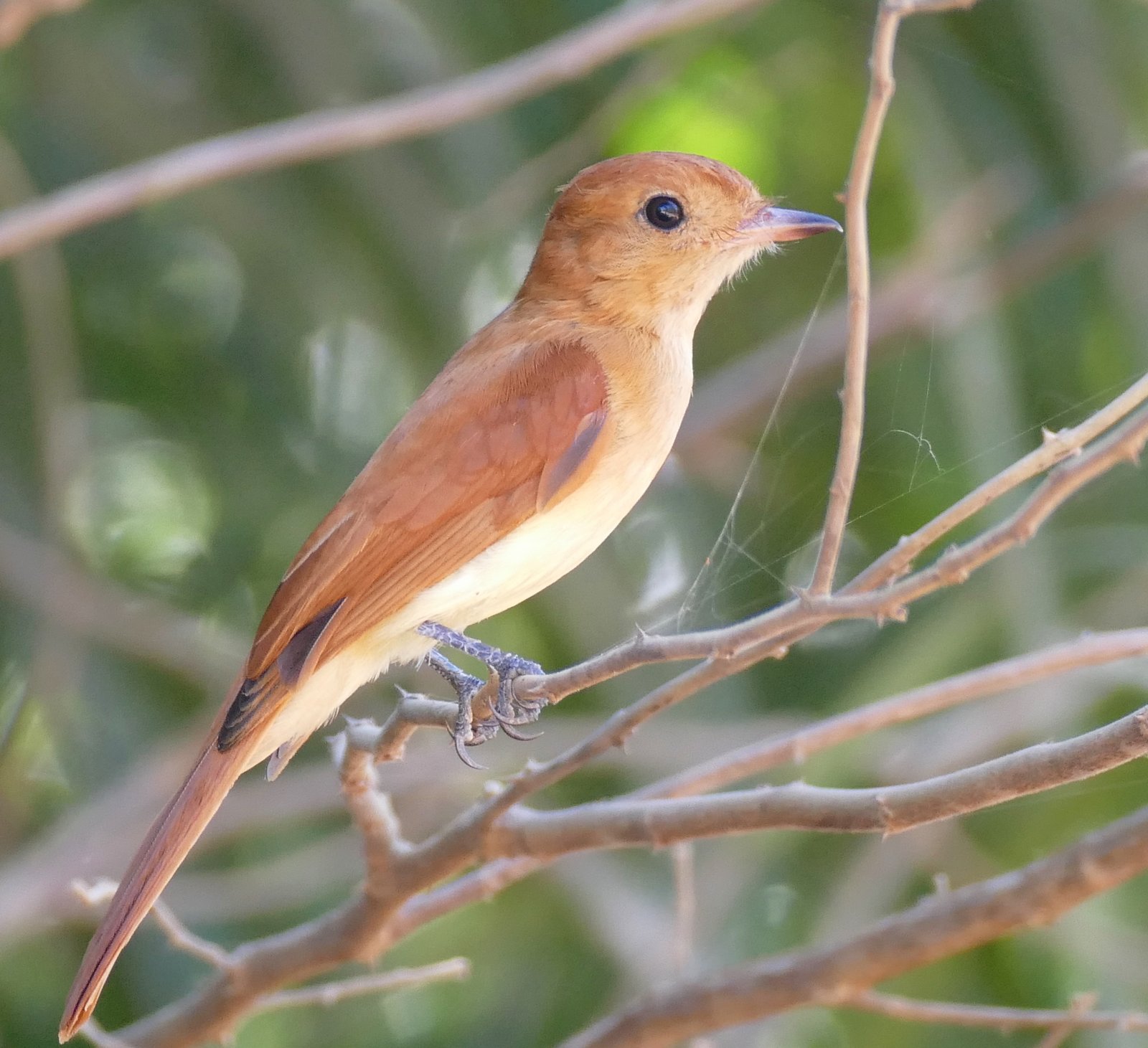
The Rufous Casiornis is a slender, almost entirely rufous flycatcher of dry woodland and wooded savanna in interior South America. It is rather quiet and usually sits in the middle storey, where its colour and posture recall a becard or a small attila. Some birds move north in the austral winter.
Voice
Rather quiet. Calls include a very high, falling feeeeh and a brief, weak psee note.
Recording: JAYRSON ARAUJO DE OLIVEIRA — CC BY-NC-SA 4.0 · xeno-canto
Identification
17–18 cm, with a fairly long tail and a dark bill with a pink base. The head, upperparts, wings and tail are rufous, the crown slightly warmer in tone. The throat and breast are cinnamon, the belly pale yellow to pale buff. The eye is dark brown. The sexes are alike.
Confusion species
Chestnut-crowned Becard Pachyramphus castaneus has a grey band behind the crown, a shorter tail and a thicker bill. White-eyed Attila Attila bolivianus is larger, with a white eye and a heavy, hooked bill. The rufous mourners of the genus Rhytipterna live in humid forest and do not overlap with the casiornis in its range.
Habitat
Deciduous woodland, gallery forest, wooded cerrado and scrubby to wooded Chaco; in Peru also dry forest. In Bolivia locally up to 2500 m. It forages in the middle storey for insects, which it takes from the foliage with a short sally; it joins mixed flocks. The two known nests were in tree cavities at 1.2 and 1.5 m.
Where the bird is most at home, classified by the vegetation units of the Andes and the west coast.


Range and movements
Colombia and Ecuador: absent. Peru: a rare, non-breeding austral winter visitor in the southeast (Madre de Dios, Puno). Bolivia: in much of the lowlands and in dry valleys at the foot of the Andes. Absent from the Galápagos. Outside the guide area in interior Brazil, Paraguay and northern Argentina.
- Resident
- dark = core range, pale = thinly spread
How and when to look
Search the middle storey of dry and gallery forest in Santa Cruz and Beni, especially in mixed flocks; look for a quiet, rufous bird with a pale belly.
Conservation status
Least Concern. Widespread in dry woodland; little is known about its movements.
Scientific name
Casiornis rufus | (Vieillot, 1816)
Vieillot described the species in 1816 as Thamnophilus rufus; because it was later moved to another genus, the author and year stand in brackets. The genus Casiornis was introduced in 1856 by Des Murs. The genus name comes from Greek kasia, 'cinnamon tree', and ornis, 'bird', after the cinnamon-coloured plumage. Latin rufus, 'red, rufous', after the rufous colour. The specimen the first description was based on came from Paraguay.