All species › Passerines › Tyrant flycatchers and allies › Scissor-tailed Flycatcher
Scissor-tailed Flycatcher | Tyrannus forficatus
Zwaluwstaartkoningstiran | Tijereta rosada | Tesourinha-rosada
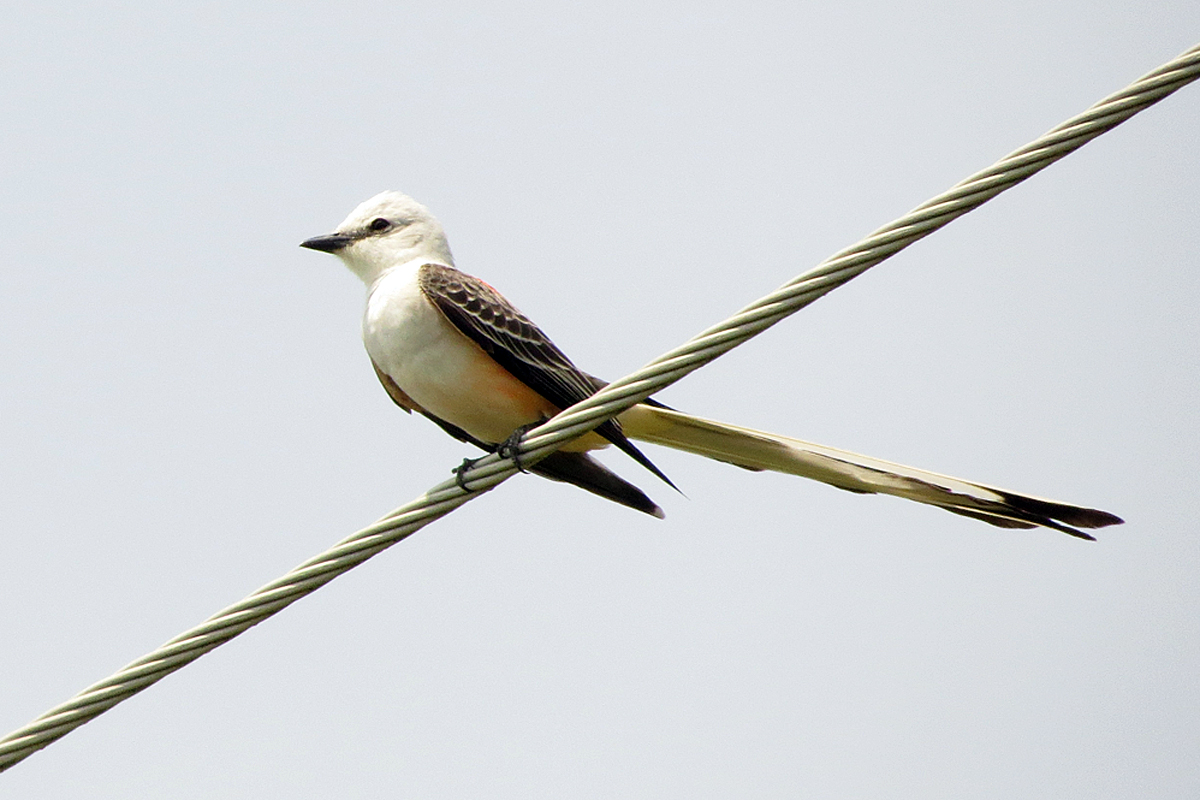
The Scissor-tailed Flycatcher breeds in the southern United States and northern Mexico and winters mainly from southern Mexico to Panama. The guide area lies south of the regular wintering range: here the species is known only from a few records. The very long, deeply forked tail distinguishes it from almost all other tyrants.
Voice
Sharp, short kip or pik calls and a dry twittering; little vocal on the wintering grounds.
Recording: Terry Davis — CC BY-NC-SA 4.0 · xeno-canto
Identification
29–37 cm, of which the tail makes up more than half in the male; females and juveniles have a shorter tail. The head, mantle and breast are pale grey to greyish white, the wings blackish with pale edges. The flanks and undertail coverts are salmon-pink, the axillaries and underwing coverts reddish pink. The tail is black and white. A red crown patch is concealed. Juveniles are paler, with little pink and a shorter tail.
Confusion species
Fork-tailed Flycatcher Tyrannus savana also has a long forked tail, but a black cap, a darker grey mantle, pure white underparts and no pink. Short-tailed juvenile Scissor-tailed Flycatchers can resemble a pale Tropical Kingbird Tyrannus melancholicus, but lack yellow on the belly and show a pink wash on the flanks and undertail.
Habitat
Open country with scattered trees, pastures, forest edges and parks, where it sits on wires, fences and isolated trees and catches insects in flight. On the wintering grounds it roosts communally in trees, often in towns or cities.
Where the bird is most at home, classified by the vegetation units of the Andes and the west coast.


Range and movements
Colombia: a few records, mainly in the north. Peru: a wintering bird on the coast near Lima (Callao). In Ecuador and Bolivia and on the Galápagos no or hardly any records. Outside the guide area the species breeds in the southern United States and north-eastern Mexico and winters from southern Mexico to Panama.
- Winter visitor (c. Oct–Mar)
- dark = core range, pale = thinly spread
How and when to look
In the guide area only a chance find; in the northern winter look for long-tailed tyrants on wires in open country, and check Fork-tailed Flycatchers for a grey head and pink flanks.
Conservation status
Least Concern. On the breeding grounds the population is declining over the long term; in the guide area the species is a rare visitor.
Scientific name
Tyrannus forficatus | (Gmelin, 1789)
Gmelin described the species in 1789 as M[uscicapa] forficata; because it was later moved to another genus, the author and year stand in brackets. The genus Tyrannus was introduced in 1799 by De Lacépède. The genus name is the Latin word tyrannus, 'tyrant'. The specific name is Latin forficatus, 'scissor-shaped' (from forfex, 'scissors'), after the long forked tail. The specimen the first description was based on came from Mexico.