All species › Passerines › Tyrant flycatchers and allies › Eastern Kingbird
Eastern Kingbird | Tyrannus tyrannus
Koningstiran | Pitirre americano | Suiriri-valente
The Eastern Kingbird breeds in North America and winters in the western Amazon basin. In the guide area it passes in flocks through the Andean valleys and lowlands and spends the northern winter in the eastern lowlands. Outside the breeding season it feeds mainly on fruit and lives in flocks, unlike on the breeding grounds.
Voice
Usually silent in the guide area. Sometimes a sharp, buzzy dzee or a short, rasping sputter, mainly in flocks.
Recording: Manuel Grosselet — CC BY-NC-SA 4.0 · xeno-canto
Identification
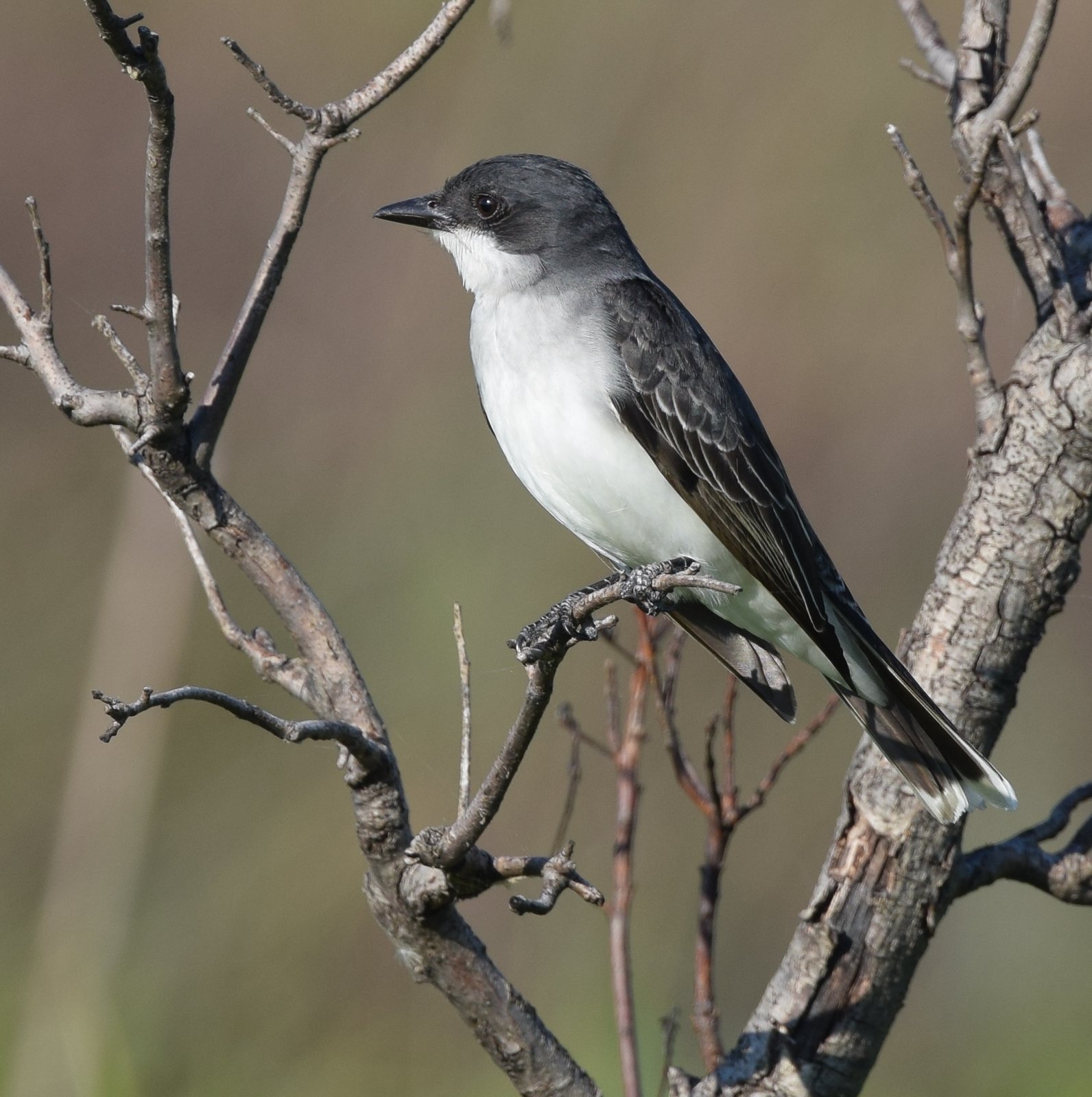
19–21 cm, with a black bill and a square, rounded tail. The head is blackish, the upperparts dark slate-grey and the wings dark with pale edges. The underparts are white, with a grey wash on the breast. The black tail has a distinct white terminal band. An orange-red crown patch is concealed. The sexes are alike; juveniles are browner, with a narrower terminal band.
Confusion species
Grey Kingbird Tyrannus dominicensis is paler grey, with a heavier bill and no white terminal tail band. Fork-tailed Flycatcher Tyrannus savana has a similar black cap and white underparts, but a long, deeply forked tail (sometimes short in moulting birds). Crowned Slaty Flycatcher Empidonomus aurantioatrocristatus is smaller and greyer, with grey underparts and no white terminal tail band.
Habitat
On the wintering grounds the canopy of forest along rivers, forest edges, river islands, várzea and semi-open country with tall trees, mainly in the lowlands below 1000 m. On passage also in Andean valleys, parks and pastures. In winter it eats mainly fruit, and also insects. It gathers at communal roosts, sometimes of hundreds of birds.
Where the bird is most at home, classified by the vegetation units of the Andes and the west coast.


Range and movements
Colombia: passage migrant through almost all the lowlands and the Andean valleys, mainly September–November and March–April. Ecuador: passage migrant, and winter visitor in the eastern lowlands. Peru: winter visitor in the Amazonian lowlands, passage migrant on the eastern slope. Bolivia: winter visitor in the lowlands of the north and east. Outside the guide area the species breeds in North America and also winters in western Brazil and south to northern Argentina.
- Winter visitor (c. Oct–Mar)
- Passage (Mar–Apr, Oct–Nov)
- dark = core range, pale = thinly spread
How and when to look
In October and March–April watch for flocks of dark grey tyrants flying in a straight line high over rivers and forest edges; in the Amazonian lowlands they sit in fruiting trees along rivers in winter.
Conservation status
Least Concern. The breeding population in North America has declined over the long term; on the wintering grounds the species depends on forest with fruiting trees.
Scientific name
Tyrannus tyrannus | (Linnaeus, 1758)
Linnaeus described the species in 1758 as Lanius tyrannus; because it was later moved to another genus, the author and year stand in brackets. The genus Tyrannus was introduced in 1799 by De Lacépède. The genus name is the Latin word tyrannus, 'tyrant'. The specific name repeats the genus name: Latin tyrannus, 'tyrant', after its aggressive behaviour towards larger birds. The specimen the first description was based on came from South Carolina, United States.