All species › Passerines › Tyrant flycatchers and allies › Snowy-throated Kingbird
Snowy-throated Kingbird | Tyrannus niveigularis
Sneeuwkeelkoningstiran | Tirano gorjiníveo | Suiriri-de-garganta-nívea
The Snowy-throated Kingbird is a small kingbird of the dry lowlands along the Pacific coast of Ecuador and north-western Peru. It breeds in the rainy season and afterwards partly moves north. Almost its entire range lies within the guide area.
Voice
Short, dry chip calls and a brief twittering stutter, mainly in the early morning; less full and less drawn out than in Tropical Kingbird.
Recording: Karl S. Berg — CC BY-NC-SA 4.0 · xeno-canto
Identification
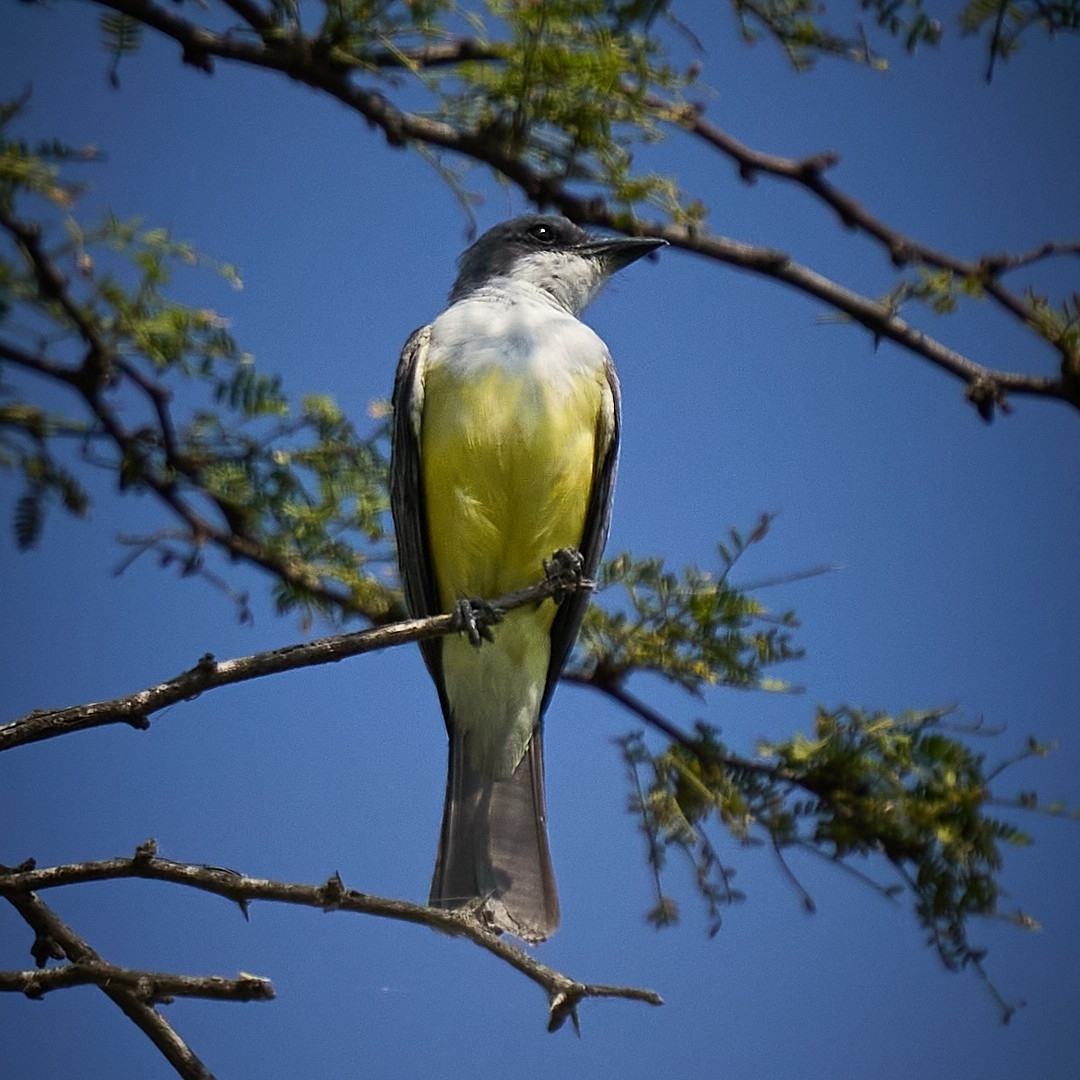
19 cm, with a rather small black bill and a slightly forked tail. The head and mantle are pale grey, with a dark grey to blackish mask through the eye. The throat is pure white and contrasts with the pale grey breast; the belly and undertail coverts are yellow. The wings and tail are greyish brown, the tail without white edges. A yellow crown patch is usually concealed. The sexes are alike; juveniles have pale edges to the wing feathers.
Confusion species
Tropical Kingbird Tyrannus melancholicus is larger, with a heavier bill, a grey rather than white throat and yellow extending onto the breast. White-throated Kingbird Tyrannus albogularis also has a white throat, but an olive-green mantle and a yellow breast, and lives east of the Andes. Eastern Kingbird Tyrannus tyrannus is darker, with white underparts and a white terminal tail band.
Habitat
Dry forest, thorn scrub, open country with scattered trees, riparian woodland and the edges of fields and pastures, from sea level to about 1000 m. It perches high and in the open on branches and wires and catches insects in flight; it also eats berries. The nest is an open cup in a tree or shrub.
Where the bird is most at home, classified by the vegetation units of the Andes and the west coast.


Range and movements
Ecuador: in the western lowlands, from Manabí and Santa Elena to El Oro and Loja. Peru: in the north-west, from Tumbes and Piura south along the coast. Colombia: in the south-west mainly outside the breeding season, in the Pacific lowlands and the valleys of Nariño and Cauca. Absent from Bolivia and the Galápagos. The species does not occur outside the guide area.
- Resident
- dark = core range, pale = thinly spread
How and when to look
Search dry forest and scrub in western Ecuador and north-western Peru in the rainy season (January–May), when the birds sing and breed; they often sit on outer branches or on roadside wires.
Conservation status
Least Concern. The dry forest of the Pacific coast is heavily fragmented, but the species tolerates semi-open farmland.
Scientific name
Tyrannus niveigularis | Sclater, 1860
Sclater described the species in 1860 and placed it straight away in the genus where it still stands. The genus Tyrannus was introduced in 1799 by De Lacépède. The genus name is the Latin word tyrannus, 'tyrant'. The specific name comes from Latin niveus, 'snow-white', and gula, 'throat': 'snowy-throated'. The specimen the first description was based on came from Babahoyo, Los Ríos, Ecuador.