All species › Passerines › Tyrant flycatchers and allies › Grey Kingbird
Grey Kingbird | Tyrannus dominicensis
Grijze koningstiran | Tirano gris | Suiriri-cinza
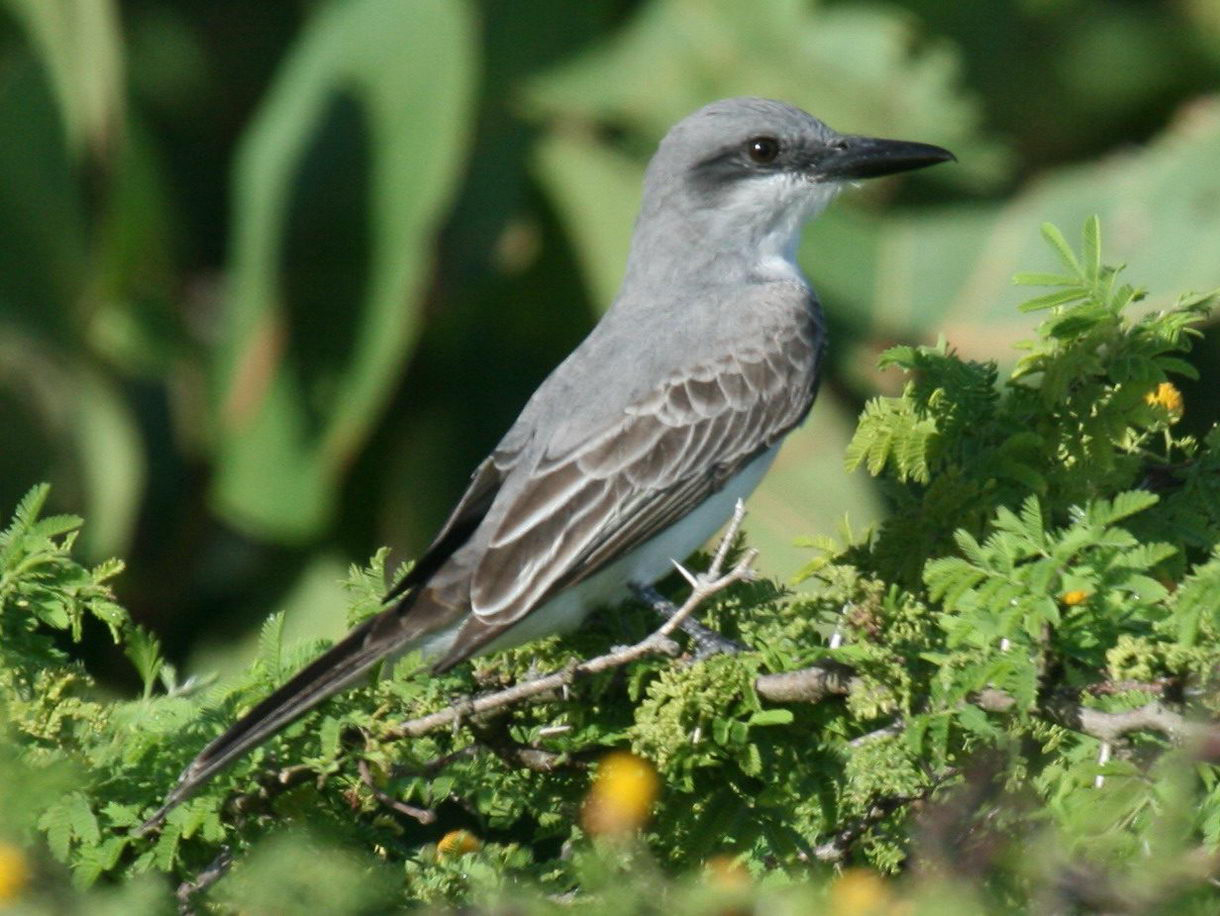
The Grey Kingbird is a large, grey-and-white kingbird of the coasts and islands of the Caribbean. In the guide area it breeds on the Caribbean coast of Colombia; birds from the north also winter in northern and eastern Colombia. Elsewhere in the guide area it hardly occurs.
Voice
A loud, rolling pee-tirr-ree, often repeated, and sharp calls; sings mainly at dawn.
Recording: Rory Nefdt — CC BY-NC-SA 4.0 · xeno-canto
Identification
23 cm. A large kingbird with a heavy, long black bill. The upperparts are grey, with a blackish mask through the eye and a concealed orange crown patch. Wings and tail are dark greyish-brown; the tail is slightly forked. The underparts are white, with a pale grey wash on the breast. Sexes alike.
Confusion species
Eastern Kingbird Tyrannus tyrannus is smaller, with a black head, a dark back and a white terminal band on the tail. Tropical Kingbird Tyrannus melancholicus has a yellow belly. Crowned Slaty Flycatcher Empidonomus aurantioatrocristatus is smaller and darker grey, with a short bill and a black crown with a pale supercilium.
Habitat
Mangroves, coastal scrub, open country with scattered trees, parks and villages near the coast; wintering birds also in savanna, forest edges and pasture inland, mostly below 1000 m. It catches large insects in the air and also eats fruit. It builds a loose cup of twigs in a tree or in mangroves.
Where the bird is most at home, classified by the vegetation units of the Andes and the west coast.


Range and movements
Colombia: breeds along the Caribbean coast and on the Colombian islands in the Caribbean Sea; boreal winter visitors from October to April in the north and east, scarcer farther south. Ecuador: rare winter visitor or vagrant. Peru and Bolivia: not regularly recorded. Absent from the Galápagos. Outside the guide area it breeds in the south-eastern United States, the Caribbean and along the coast of Venezuela; it winters south to Venezuela and the Guianas.
- Resident
- dark = core range, pale = thinly spread
How and when to look
Search along the Caribbean coast of Colombia, for example around Santa Marta and Cartagena, on wires and in mangroves. In the boreal winter also in parks and around farms in the north of the country.
Conservation status
Least Concern. Widespread and common in the Caribbean.
Scientific name
Tyrannus dominicensis | (Gmelin, 1788)
Gmelin described the species in 1788 as [Lanius Tyrannus] dominicensis; because it was later moved to another genus, the author and year stand in brackets. The genus Tyrannus was introduced in 1799 by De Lacépède. The genus name is the Latin word tyrannus, 'tyrant'. The specific name refers to Santo Domingo (Hispaniola), not necessarily the type locality. The specimen the first description was based on came from Santo Domingo, Hispaniola.